



«France, un album de famille»: looking at ourselves to (re)build society?
With France, a family album, Yann Arthus-Bertrand exposes an ordinary, multifaceted France through hundreds of portraits. But what remains of «living together» when social fractures remain off-screen?
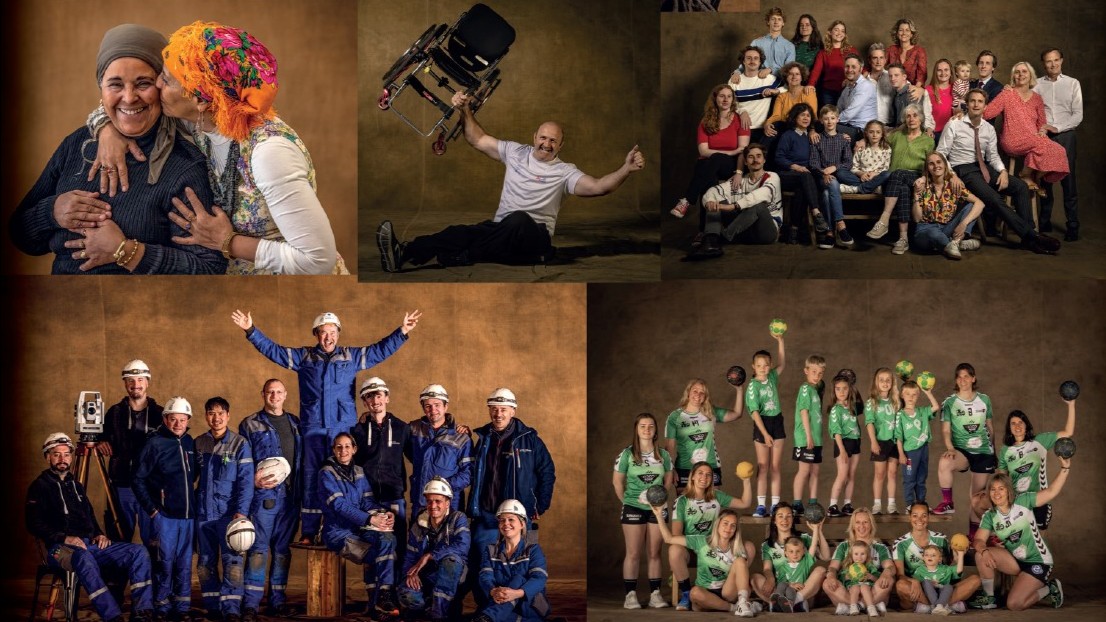
What does a country say through the faces that inhabit it? Can photography concretely question what «living together» still means, and capture a society in portraits, between revelations and shadows? These are just some of the questions that photographer Yann Arthus-Bertrand seeks to answer with France, a family album, a photographic survey conducted with demographer and historian Hervé Le Bras between 2023 and 2026. Fifty studios were set up across the region, where residents posed alone, with their families or colleagues, or with objects that tell us something about their daily lives.
Today, these photographs hang in the Place de la Concorde, providing a glimpse of French society, with its social diversity and everyday realities. The installation immediately captures the attention of passers-by. There's no set direction here. Each person creates his or her own itinerary, focusing on a particular look, profession or posture.
A human map of the territory
What's striking is their presence. Each portrait imposes a pause. It brings seldom-seen faces back into the foreground and makes visible the trajectories, professions and paths they have taken. The device may seem simple, almost obvious. But that's where the project really comes into its own.
But this apparent obviousness raises questions. In trying to embrace all realities, the exhibition runs the risk of smoothing them out. Faces respond to each other, trajectories are juxtaposed, and the whole composes an appeased image of the country.
A picture doesn't tell the whole story
It's not enough to multiply portraits to meet the challenges of «living together». Rather, they are a first step. It's a way of suggesting that, behind functions and categories, there are individuals, with their stories, their contradictions and their differences.
The exhibition sketches out, in fragments, a form of collective capable of holding together despite the gaps. But this reading remains partial: social tensions, territorial fractures and conflicts of representation are barely mentioned. The project invites us not so much to draw conclusions as to question the conditions under which a common image of the country can still be produced.
In a context dominated by digital images, the project opts for the face-to-face approach. And that's what makes it so interesting: its presence in the public space. Set up in the open air, the exhibition remains accessible to a broad public, beyond the usual audience of cultural institutions. Younger visitors, in particular, are welcome to take a stroll through the exhibition.
The social outfield
These images can provoke attention and, sometimes, prolong the gaze. The central challenge is to circulate these faces and what they tell us, to propose a possible image of collective identity, made up of differences, but also of tensions yet to be thought through.
The title of the exhibition, France, a family album, takes on its full meaning. As in any family, bonds are not self-evident. Yet these portraits produce an unexpected closeness. In successive strokes, they sketch out a whole in which each individual fits, without the gaps disappearing.
Free exhibition until May 10 - Place de la Concorde, Paris.
You've just read an unpublished open-access article. Debates, analyses, cultural news: subscribe to support us and access all our content.

You'll also like

 French
  German
  English
Leave a comment