




«Life - Origin unknown»

Cinema Wednesdays - Loris S. Musumeci
«Good evening Moon. Good evening Earth. Good evening Stars.»
Mars Mission, Pilgrim I spacecraft. The crew on board play their last cards to intercept a satellite containing sand from Mars. We've done it! A small step for man and a giant leap for mankind. Glory if the first form of extraterrestrial life is detected in the Martian substance. A being has indeed appeared, in unicellular form. The feat is followed from Times Square. Connecting with the astronauts, the students of a New York class announce on a TV set the name they have chosen for the already endearing little beast: Calvin.
British analyst Hugh (Ariyon Bakare) stimulates the quarantined creature as his colleagues look on in amazement. She tenderly strokes his finger through the plastic glove in the display case. But the caress turns into a violent grip, squeezing ever tighter, with no sign of letting go. The hand is crushed and Calvin escapes from his vivarium. Engineer Rory (Ryan Reynolds) dives into the room, rescues his colleague and locks the glass door from the inside, so as not to endanger the others. Rory will never leave the lab. He is devoured internally by the new enemy that has jumped into his mouth. Weightless drops of blood, arms outstretched like the crucified. Calvin is now a major danger to the ship's scientists. There's no way we're going back to Earth with this thing. He must be eliminated.
Life - Origin unknown won't dull its anguish, right up to the final scene. The filmgoer in search of suspense is well served. However, Espinosa's direction doesn't go beyond a B-movie in its genre. The forthcoming release of the long-awaited new episode of’Alien, the sense of déjà-vu and the emotional flatness of the actors make for a half-failure.
It's only half a failure. In fact, there are some real qualities to be retained and praised. The film's excellent use of off-screen camerawork keeps us on the edge of our seats. Calvin is rarely seen. He is suggested most of the time by his extremely rapid movements. The crew never really knows where the hostile predator is. His existence is a mystery, as is his location on the ship. A skilfully designed work.
But then again, weightlessness couldn't be more realistic. The preparation for this particularity can be explained by the Swedish director's attention to detail. He consulted a number of specialists on life in space. The actors were also filmed in the studio, constantly hanging from cables. As a result, the viewer is left in a daze, no longer feeling the earth's gravity beneath his seat. For once, it's not just abused special effects that are rewarded; cinematic craftsmanship also has its place.
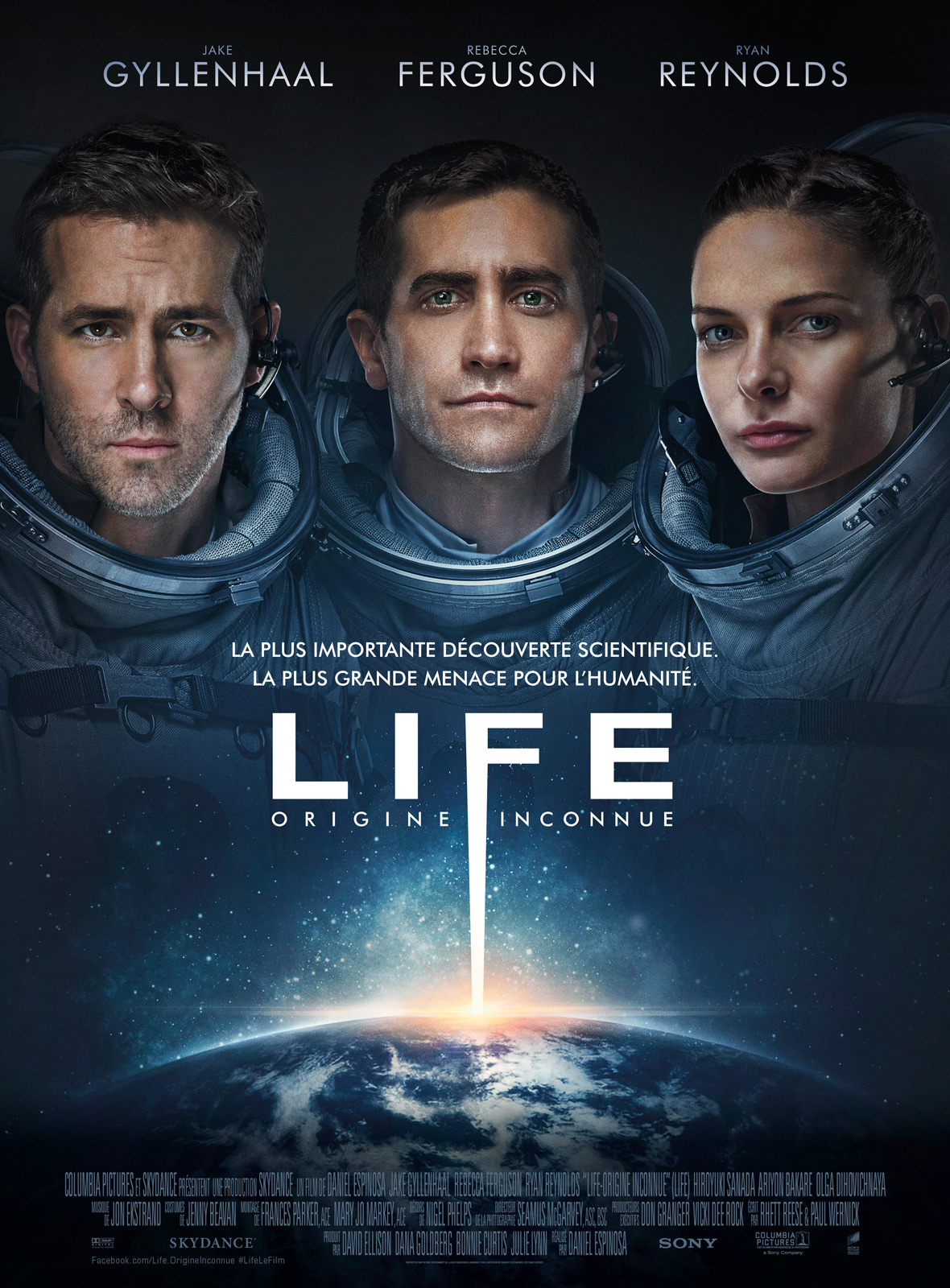
As for the cast, if it doesn't quite manage to touch the heart, it's still top-notch. Rebecca Ferguson, Jake Gyllenhaal and Ryan Reynolds in the lead roles are no beginners. They know how to play great roles. Unfortunately, it's the mediocre script that holds them back. Their lines are too succinct, because they're too many and too well thought-out. The lines are intended to be learned, full of scientific and literary references. Such a practice is dangerous for an action film. Except when there's a perfect mastery of rhythm to match the beautiful text.
This flaw is not without its major advantage, namely its philosophical significance. The film poses a real question: how far can research into extraterrestrial life go? From the small cell to the monster Calvin becomes, there's an absolutely uncontrolled variation. And the possibility of this danger is not light-years away from reality; the reception of samples from the planet Mars is scheduled for 2020. «Science without conscience is but the ruin of the soul». Rabelais warned us, as did Espinosa.
«The very existence of life is correlated with destruction. Calvin doesn't hate us, but he has to kill us to survive.»
Write to the author: [email protected]
Photo credits: © cineseries.fr and acsta.net
You'll also like


 French
  German
  English
Leave a comment