





At Vidy, a new season under the political banner
Le Regard Libre N° 52 - Ivan Garcia
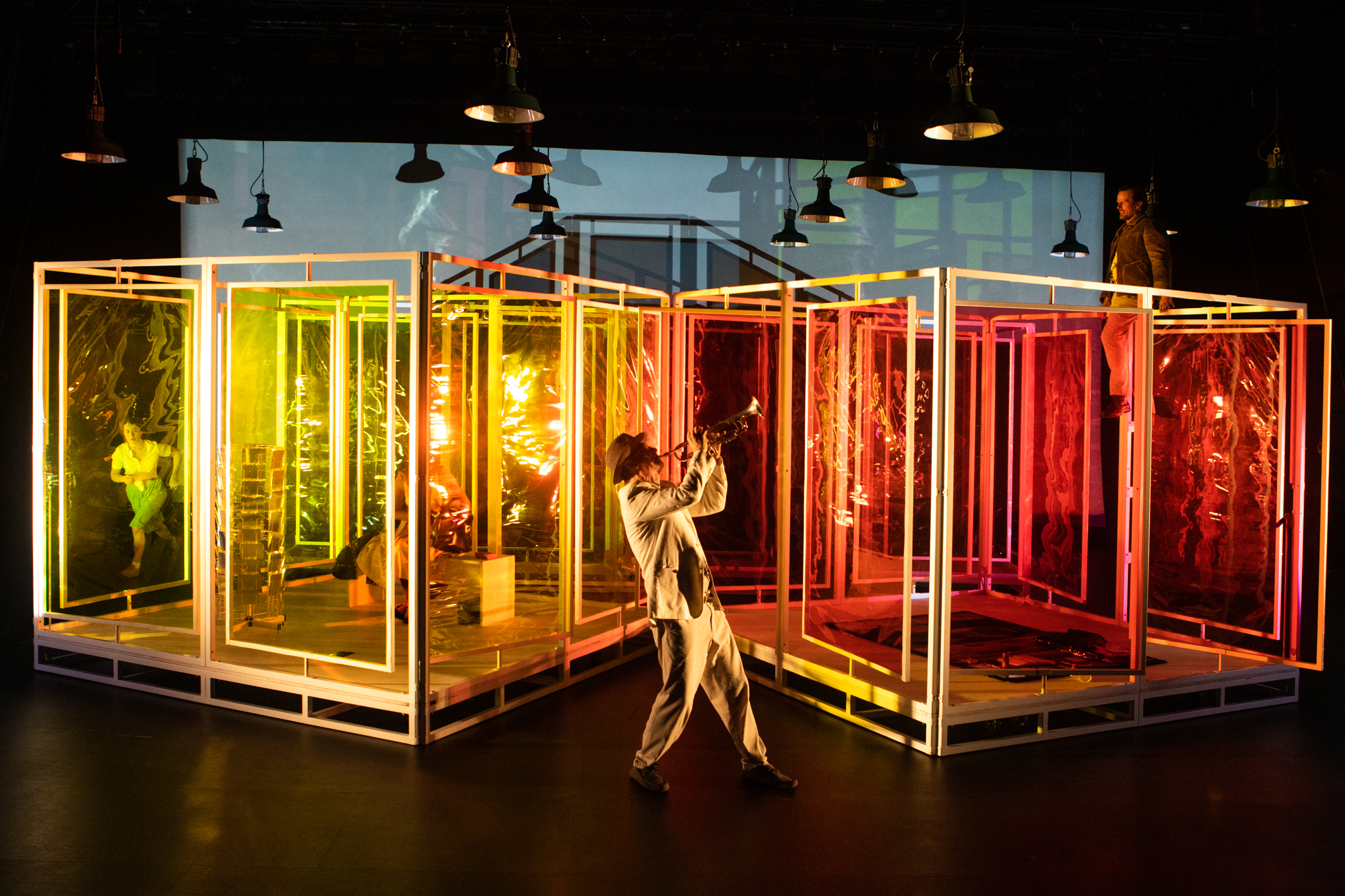
On Monday May 20, the Théâtre de Vidy presented the first part of its new 2019-2020 season. The last season before the theater's renovation, it promises to be rich in quality artists and committed performances.
On May 20, Vincent Baudriller, director of the Vidy Theater, welcomed the crowd that had gathered to attend the presentation of the first part of his institution’s new season. After a few brief words of welcome, the former director of the Avignon Festival kicked off the event by discussing his goal of developing a vibrant theater that engages with the community. The 2019–2020 season marks the maturity of the project the director intends to bring to the stage in Vidy, as well as a clear invitation to political and civic debate on stage—a very powerful and deliberate link between the theatrical genre and its political dimension.
Next year, the venue will celebrate its 55th anniversary. Designed by architect Max Bill for the 1964 National Exhibition, the Vidy-Lausanne Theater will begin renovations in September 2020, which are expected to take about two years. Although part of the theater will remain open, this construction will result in an earlier start to the season with the revival of the show Hate by Laetitia Dosch, which will be performed starting August 29 in the heart of nature in Gimel, as well as a season finale scheduled for around May 2020. These renovations will allow for an expansion of the venue, which will prove to be highly beneficial for both the audience and the performers. Before construction begins, the program will focus on the role of theater in our societies and how we can work together to create a space for culture and reflection for the future.
Order: Le Regard Libre No. 53 (August 2019), featuring our special report on Hate and equestrian theater
Eclectic Creations
One of the highlights of this early part of the season is the productions staged by the Vidy Theater, all of which feature renowned artists. Some of these artists are performing on the Lausanne stage for the first time, while others are regulars there. From September 5 to 15, Massimo Furlan, an artist from Lausanne, will present the first European Philosophical Song Contest in collaboration with Claire de Ribaupierre, playwright and instructor at La Manufacture. The show, based on the model of Eurovision, drew on several disciplines and thinkers. In his brief remarks on the evening of the presentation, Massimo Furlan explained the project’s origins as well as the work that had been done: songs written by contemporary European thinkers from eleven different countries, which will be set to music and then performed before an audience and a jury.
Each theater selected by the authors to participate in this play chose a contemporary philosopher who best represents the intellectual tradition of its country. For Switzerland, the song was composed by Mondher Kilani, an anthropologist and professor emeritus at the University of Lausanne, whose research focuses on critical universalism as well as the concept of cannibalism in our contemporary societies; as for the musical compositions, these were created by students at the HEMU (the Lausanne University of Music) and promise to effectively highlight the texts of the various thinkers. Finally, since this is a competition and the winner will be determined—in part—by the audience’s vote, the outcome may vary with each performance: these evenings promise to be rich in thought and debate for the upcoming season.
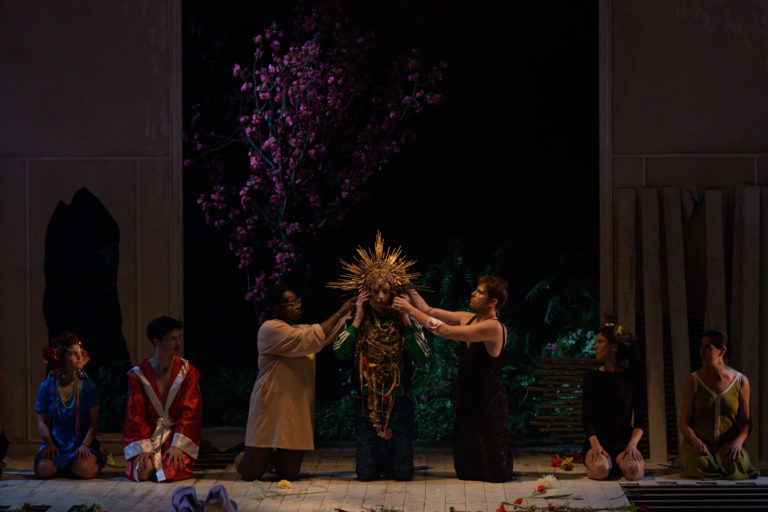
Another production in the field of musical theater, from September 12 to 21, Narcissus and Echo The production by Hungarian musician and director David Marton will give music a prominent role. On the evening of the presentation, the director of the Vidy Theater explained that in Marton’s work, «Music creates the drama». Based on The Metamorphoses From the works of the Latin poet Ovid, Marton chose the myth of Narcissus and Echo to explore on stage—through music—themes related to loneliness and isolation, which, while prominent in this myth, remain as relevant as ever in the age of smartphones.
From October 30 to November 10, the controversial German director Frank Castorf is coming to Vidy with a production of Bajazet, a political tragedy by Racine, reimagined through the lens of the writings of Antonin Artaud, a leading theorist of Western theater. Bajazet, a play little known to the general public, sets the plot within the Ottoman Empire, at the heart of Sultan Amurat’s harem. Amurat, having gone to war, has imprisoned his brother Bajazet and orders Roxane, his favorite—who is secretly in love with Bajazet—to execute him. However, this fails to take into account the ambition of the Grand Vizier, Acomat, whose goal is to have Bajazet rule the empire. The former director of Berlin’s Volksbühne, a devotee of Dostoevsky and reflective political theater, intends to bring the conflict back onto the stage—and into the audience.
For the German director, the theater is a place of conflict where differing opinions clash. As he stated in an interview included in the book The Castorf Republic: «It is utterly detrimental to art to eliminate conflict. One of the achievements of the Greek polis was to accept the fact that people have different opinions and that they argue.» Within this production, we will highlight the prominent role of the set design, created by Aleksandar Denic, a Serbian-born set designer and film production designer, whose initial images reveal an oriental set design blended with more contemporary elements such as the Opel car brand logo and neon lights. Castorf, one of the leading exponents of video’s potential in theater, will likely make masterful use of it, in collaboration with the set designer and Andreas Deinert, the video artist. A spectacular show, not to be missed in Vidy, before it sets off on its European tour.
The key to success
From November 15 to 22, War coins in Switzerland, another Vidy production, will take the stage. A collaboration between Zurich-based director Maya Bösch and Neuchâtel-based playwright Antoinette Rychner, the play explores the meaning of the concept of war for a country like Switzerland. The title, inspired by the English playwright Edward Bond, highlights social issues that are explored in the trilogy comprising War coins in Switzerland. Composed of three acts—the first dealing with an initiative to reinstate the death penalty, the second with the identification of enemies, and the third with reconciliation— tradition, and heritage, Antoinette Rychner’s play—commissioned specifically for the occasion—weaves together a host of absurd situations and characters that serve as mirrors of contemporary Switzerland.
Read also: A luminously macabre dance
In December, Swiss-German director Milo Rau makes his grand return to Lausanne with the show Orestes in Mosul. True to his theatrical style—that of documentary theater—Milo Rau adapts The Oresteia by Aeschylus in the city of Mosul, the former capital of the self-proclaimed caliphate of the Islamic State. Staged with European and Iraqi actors, the production is expected to alternate between personal accounts of life in the midst of the conflict and a staging of Aeschylus’s tragedy, incorporating, among other elements, video. The Oresteia, one of the great dramas of Western culture, recounts the tragedy of the Atreides in the form of a trilogy: Agamemnon, The Choephoroi and The Eumenides. The main protagonist—the one who features in the last two parts—is Orestes, son of Agamemnon, who has returned to the city of Argos to avenge, at the command of the gods, the death of his father, who was murdered by his wife, Clytemnestra.
A story of revenge, but also of the quest for redemption and forgiveness, The Oresteia takes on its full meaning in a context of war such as that of Iraq in recent decades. Milo Rau therefore decided to transpose this ancient fable to ancient Mesopotamia—a civilization that predated Greek civilization—to demonstrate the universality of tragedy, that form of drama linked to fate, which, according to Aristotle in Poetics arouses in us «both fear and pity.».
Vidy and the City
As we mentioned earlier, the upcoming theater season will focus on the connections between politics and the city. With this in mind, philosopher Dominique Bourg, a professor at the University of Lausanne, will lead a series of public events Imaginations of Possible Futures with the aim of exploring alternatives—collectively and collaboratively—to build the world of tomorrow: a sustainable, just, and democratic world. To this end, a series of four sessions has been scheduled, bringing together the philosopher and the theater, with the aim of encouraging participants to actively engage in the creation of new knowledge. This knowledge will culminate in a closing event at the end of the season, titled The Theater of Possible Futures, which will take the form of an exhibition showcasing the research conducted by the group throughout the season; these results may take various forms, ranging from works of art to academic articles to explanatory panels. Bringing together the academic world, the theater, and the community toward a common goal finds its full meaning in this proposal and connects different people and places whose roles will prove vital for the future.
With the resumption of the show Hate From Laetitia Dosch, at the start of the season—this time at Gimel—audiences will witness a performance between an actress and her horse, Corazón, in the heart of nature. The performance will unfold freely, guided by the animal’s own desires. It’s a subtle and gentle way to reestablish a dialogue between humans and nature, as well as to explore our relationship with animals during a bucolic stroll. In October, as part of the Lausanne Méditerrannées festival, this year’s edition will highlight Albania and its culture, which is sure to influence the Lausanne arts scene. For the occasion, several Albanian-speaking troupes have been invited by the theater to introduce the public to the dramatic and artistic traditions of this Balkan region, which was deeply affected by the violent conflict in the former Yugoslavia.
Typically, the Vidy Theater’s programming leans more toward the sacred and ritualistic aspects of the dramatic arts—those that appeal to a sense of communion, emotion, and reverie. Although music and dance have a place in the 2019–2029 season, the season leans very clearly toward the political function of theater by featuring, among other things, thought-provoking plays that elicit critical engagement from the audience.
With the unveiling of this first part of the season, Vincent Baudriller and his team place their theater at the heart of contemporary reflections and issues, emphasizing the need for a dialogue between the world and the audience. This is proof, if any were needed, that one can indeed change the world from the stage—or, at the very least, reinvent it.
Write to the author: [email protected]
Photo credit: © Nurith Wagner
-
 Le Regard Libre - Nº 52CHF10.00
 -
 Le Regard Libre - Nº 53CHF10.00
 -
Standard subscription (Switzerland)CHF100.00 / year
-
Support subscriptionCHF200.00 / year

You'll also like
 French
  German
  English
Leave a comment