



«Au revoir là-haut»
Cinema Wednesdays - Loris S. Musumeci
«It's a long and complicated story.
- We've got plenty of time.»
The faces masked by a dark, thick dust are those of the soldiers in the trenches in 1918. Fatigue, fear and misery fold them into their blue uniforms. A single contrasting look is as self-assured as it is self-satisfied, lifted by the smoke of a cigarette: Lieutenant Pradelle (Laurent Lafitte). His ardor drives him to send men to the slaughter.
Among them is young Edouard (Nahuel Pérez Biscayart), who secretly draws caricatures of his superior, and an older accountant, Albert (Albert Dupontel), who hides his comrade's drawings. In the midst of a German attack, the latter finds himself trapped under the ground, panic-stricken in a bomb blast, with the corpse of a horse. His companion saves him heroically, before being ejected by a bullet. His face is disfigured and bleeding. The shape of his mouth is cruelly obscured by the absence of a jaw. From then on, the two friends are inseparable.
A Simple Story
Au revoir là-haut doesn’t pose any major mysteries. Unlike the opening line, the story is actually quite simple. There’s a war, a cruel lieutenant, a man with a disfigured face who has been declared dead to his family, and two veterans who lack the resources to make ends meet once they return to everyday life. That’s enough to give the plot depth, while still keeping it light and easy to follow.
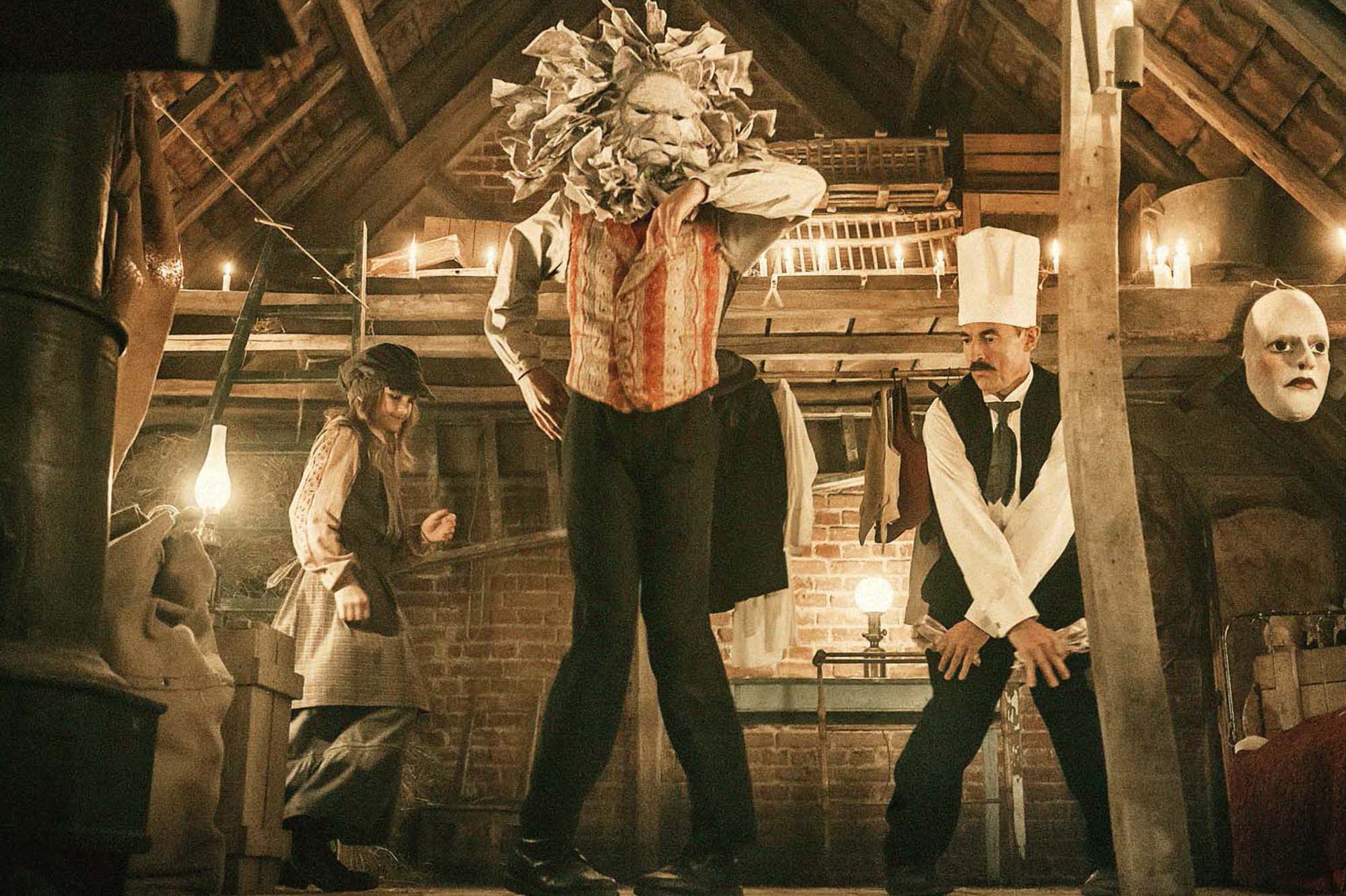
The film is filled with both political and personal dramas, yet it doesn’t lack a touch of the absurd. A variety of masks, the film’s grainy texture, vintage tones, dance steps, and exuberant music bring the macabre postwar setting to life. Certain episodes, narrated simultaneously with the sequence by the narrator, even give the impression of transporting the style of the The Fabulous Life of Amélie Poulain.
De la poésie à l’écran
The adjective fabulous suits both French works equally well. The performance itself creates such an effect. The poetry in the masks’ expressions is guided by theatrical acting, which is, in turn, accompanied by violins during moments of trial or the lively sound of the saxophone during celebrations. The interplay of colors contributes to this fusion of the arts. Notably, the shades of blue—from Edouard’s military uniforms to his light-colored princely robes and fantastical masks—once again lend him a distinctive expression.
The acting, which is flawless in every scene, serves as the foundation for the film’s glowing portrayal. It is only through their restraint and their embodiment of their characters that the feature film avoids falling into the trap of being mere theater on film. Laurent Lafitte succeeds in conveying the sadism of the reckless and opportunistic lieutenant through his smile—at once fickle and indifferent to the suffering of his peers. Nahuel Pérez Biscayart, whose beauty is strongly emphasized despite Edouard’s injury, presents the viewer with a blue bird, graceful in his every movement.
A Precise Work
Albert Dupontel, for his part, successfully juggles his various roles. In addition to directing and co-writing the screenplay with Pierre Lemaitre—author of the novel of the same name, winner of the 2013 Prix Goncourt—he brings his own distinctive touch to the character of Albert Maillard, whom he plays. He is, in fact, the one responsible for narrating the story and adding some humorous commentary. Furthermore, his performance is excellent, as his stuttering, repetitions, and the movements of his lips and eyebrows help bring out his character’s intimate and curious nature.
Goodbye Up There It also has the merit of being precise in the scenes that depict it. One need only think of the eye that opens, desperate beneath a pile of earth, or of the travelling harrowing in the trenches. Moreover, the emotion that permeates the story does not artificially elicit tears. Finally, the humor comes across as genuine. It does not distort reality, but rather poeticizes it. Thus, tragedy and comedy come together perfectly to denounce those who «started the war, enjoyed waging it, and profited from it» and to pay tribute to those who sacrificed their lives in it.
«I wish I could have told him that he was the one who was right to want to be who he was.»
Write to the author : [email protected]
Photo credit: © parismatch.fr
You'll also like


 French
  German
  English
Leave a comment