



«Elementary: lukewarm water under a red light
The Walt Disney Company Switzerland
Pixar continues its industrial-scale production of imaginary worlds with a new concept: a city inhabited by elemental beings. A delightful film, but one that quickly gives way to adult boredom.
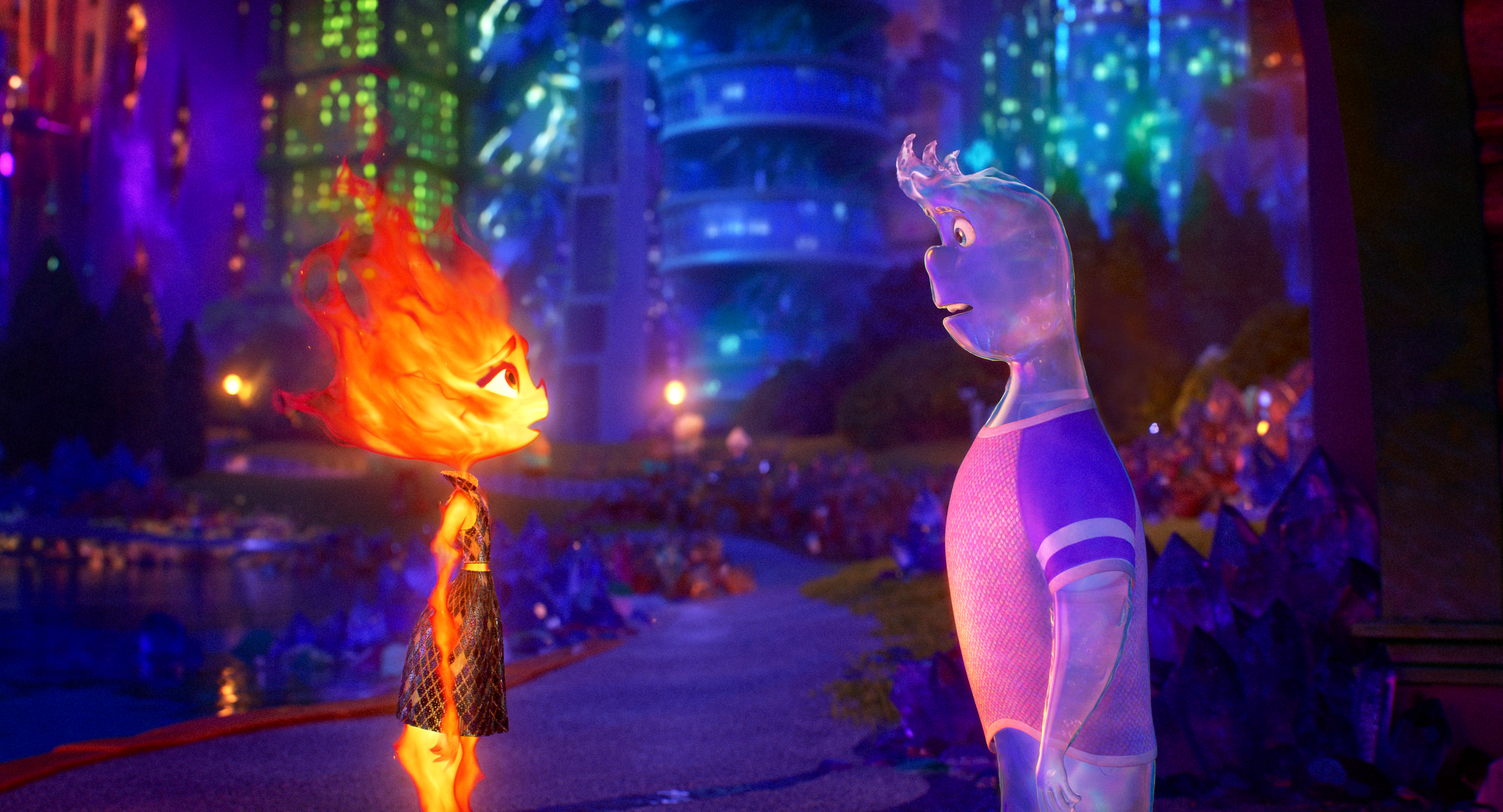
The Lumen family arrives at Element City, a center for all kinds of elements: air, earth, water and fire. They soon realize that they are not welcome. Anything they touch is liable to catch fire instantly. So they settle in a low-lying neighborhood quickly affected by a large influx of other fire elementals. After a few years, the family can finally live in peace, and Bernie, the patriarch, prepares to retire and leave his store to his daughter, Flam. But this doesn't take into account Flam's unusual encounter with Flack, a watery civil servant with whom she begins to form a relationship, at the risk of upsetting all her plans for the future.
Sacrificing originality for education
Does the synopsis sound simple? Desperately so. Like Vice-Versa (2015) or Soul (2020), Elementary is an allegory of modern Western society. This time, the studio has opted for natural elements for its personification, with direction entrusted to Peter Sohn, who made the short film Cloudy periods (2009). At the time, the latter was already featuring clouds, figures taken up here to embody the air elementals. This is not the only borrowing, as the film is also introduced by a short film featuring the famous grandfather and his dog from Up there (2009), very forgettable. It would seem that the studio is struggling to recapture its imagination.
And that's the problem with this Pixar: in trying too hard to educate, it sacrifices its creativity. The universe is often reduced to the Lumen store, and the few excursions, while successful, also make us wish there were more of them. Secondary characters are non-existent. We even go so far as not to include an antagonist. A logical outcome in the studio's line, where «evil» is no longer essential; just a figure to be understood and cared for until it disappears. In short, in this megalopolis full of life but devoid of characters, the only thing that counts is the central couple.
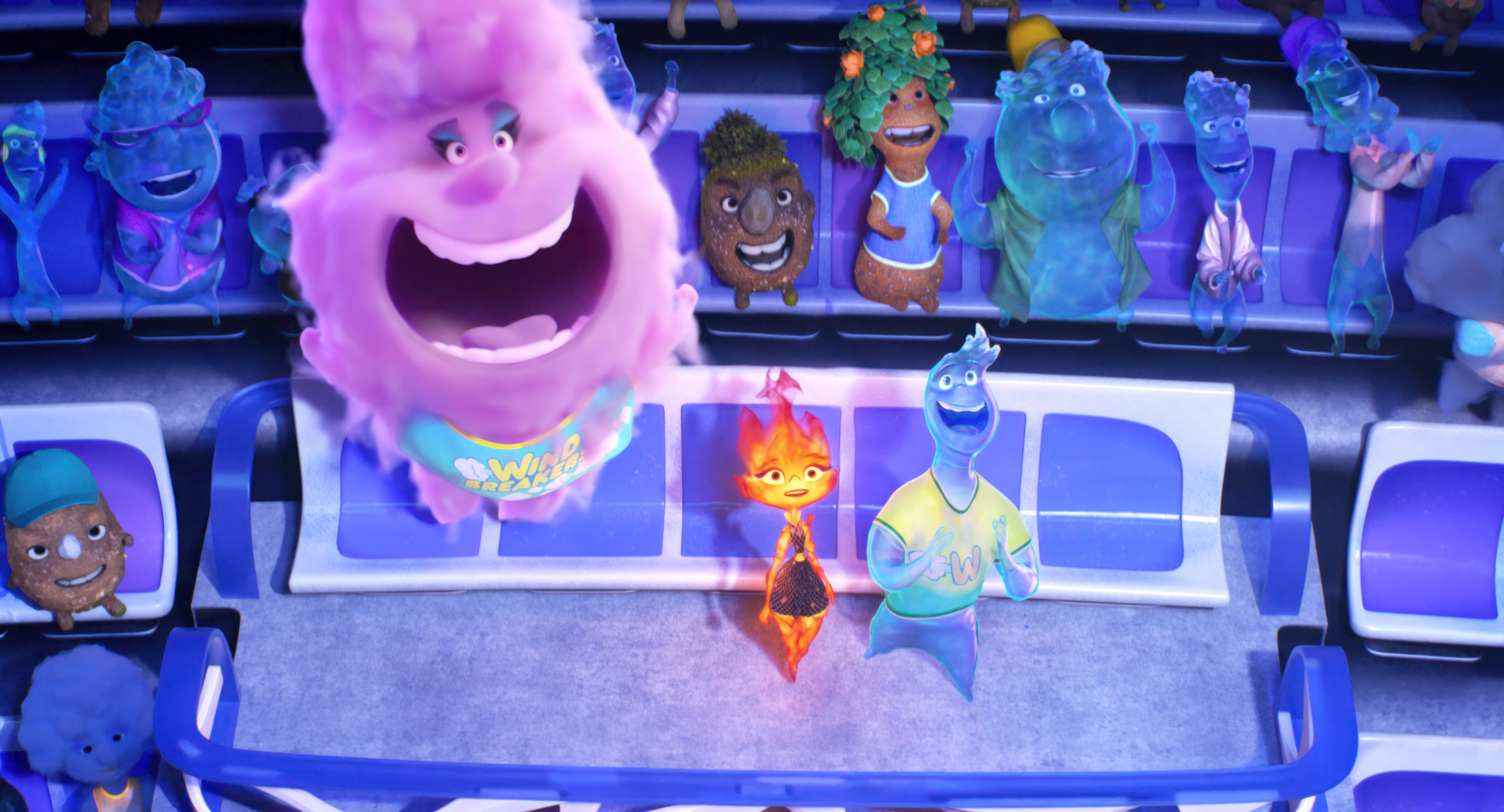
In fact, despite its lack of imagination, the film works very well as an educational tool for younger viewers. The couple, though silly, offer a model of modern, progressive love relationships, as Pixar likes to defend. The woman learns to manage her anger. The man is not ashamed to cry; in fact, it's a recognized quality. The dialogues are also very apt, providing the couple with the repartee they need to deal with all kinds of situations and create a genuine complicity without trying to sugarcoat it at any cost.
Elémentary presents itself as a less ambitious film than the studios are accustomed to, focusing instead on an exemplary pairing in the service of entertaining and educating young audiences. In this respect, the film succeeds. Unfortunately, however, Elémentary is not just a children's film.
Warm water and cold shower
The real problem with’Elementary is that it also carries a discourse aimed at adult audiences. This critical and progressive discourse, aimed essentially at older children, nevertheless leads to some nice ideas. For example, Flam and Flack treat themselves to a photo booth session. As they leave, they are amused to discover that the camera is not designed to capture Flam's natural light source. The result: white, non-contrasting photos. A direct evocation of a technical problem in the world of cinema and photography: cameras are primarily designed to capture the details of white skin. Illuminating darker complexions proves more complicated, and the bodies lack detail, just as the scene illustrates. This phenomenon recurs repeatedly: the society in which fire beings evolve is not designed for them.
Yet the film never takes the risk of developing this aspect. It hints at it, timidly, but removes any possibility of stakes and settles for a most conventional love story. And so it is, Elementary pales in comparison to animation predecessors such as Zootopie (2016) or WALL-E (2008), which fully embraced a discourse combining individual aspirations and collective issues.
Elementary can be defended as an object that privileges the personal story, closer to the majority of immigrant people who seek less to participate in a change of society than simply to find a not too uncomfortable place within it. In this sense, the film can indeed become sympathetic. Yet it's hard to overlook Pixar's difficulties, starting with the poor scores achieved by the films that have been given a theatrical release.
Beyond the undoubtedly highly questionable choice of making its films rapidly accessible on Disney's online platform (if they are not released directly there), it has to be said that the aesthetics and themes used by the studio have not undergone any real evolution since its first film, thirty years ago, which already made integration one of its main themes. While Toy Story (1995) was a revolution in its time, it's probably time for Pixar to open other doors. Perhaps it needs to reduce its film budgets and turn to new aesthetic proposals? Or perhaps it needs to stop trying to charm families?
In the meantime, Elementary looks more like a product than a film. While it retains some good ideas, and is sympathetic and meaningful to younger viewers, it is above all a testament to a studio that is struggling to renew itself.
Write to the author: jordi.gabioud@leregardlibre.com
You've just read an open-access article. Debates, analysis, cultural news: subscribe to support us and get access to all our content!

You'll also like






 French
  German
  English


Leave a comment