




«Memoria: the enchantment of worlds

Memoria © Kick the Machine Films_Burning_Anna Sanders Films_Match Factory Productions_ZDF_Arte_Piano 2021
Unpublished article - Alice Bruxelle
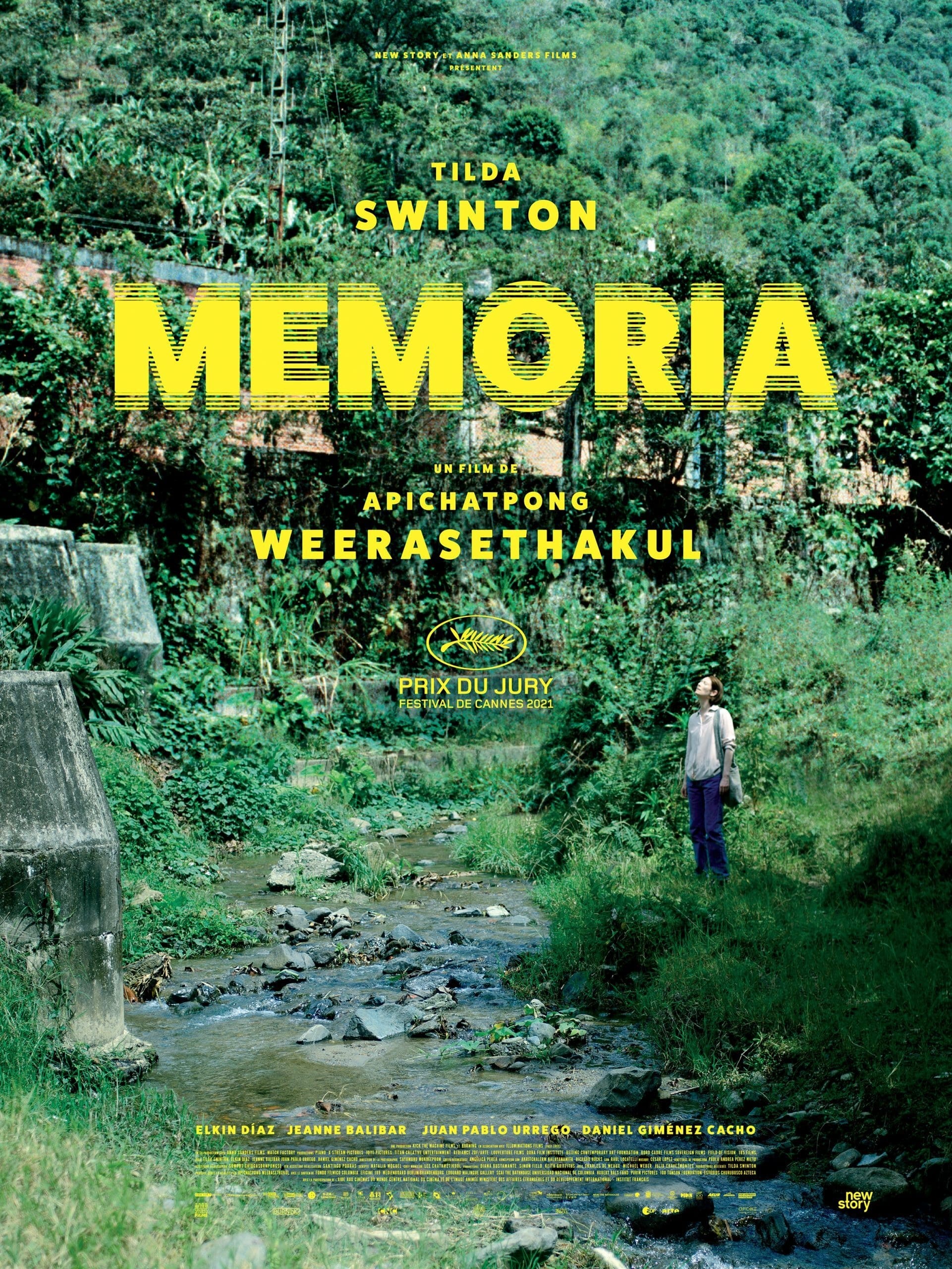
Illustrator of the invisible, Apichatpong Weerasethakul returns for his ninth feature film, Memoria. Winner of the Jury Prize, one of the most eagerly awaited events of the Cannes Film Festival, was finally released this Wednesday in Swiss cinemas.
«Nothing is more complex than simplicity». What adage could better describe the cinema of Apichatpong Weerasethakul? At the threshold of his universe, the viewer swaps understanding, reflection and judgment for contemplation, feeling and meditation. In this respect, his films are a kind of radical choice of cinema. Criticism is explicit: love it or loathe it, which implies absolute rejection or boundless infatuation. These works mobilize the spectator's total sensoriality, challenging the uninitiated who might miss the breach opened onto the world revealed by this cinema.
Weerasethakul assumes the role of passer-by. He invites the supernatural into the bosom of the natural in the same space. These films become places where humans, spirits and ghosts cohabit - vital forces not perceptible in the living world. In Uncle Boonmee, the man who remembers his past lives (2010), ghosts inviting themselves to the evening meal. See Tropical Malady (2004), which, through a series of metamorphoses, progressively blurs the separation between jungle, tiger and shaman, until these three entities merge completely. He creates a horizontal space where all degrees of consciousness interweave simultaneously. Phantasmagoria and reality become one.
Between deterritorialization and connection
Memoria follows in Weerasethakul's footsteps. We follow Jessica Holland (the enigmatic Tilda Swinton) and pick up a few bits of information about her on the fly. Passing through Colombia to visit her ailing sister, she appears to be a widow and orchid farmer. But it's a sound that characterizes her! Along with Jessica, we hear a mysterious bang repeated sporadically throughout the film. The plot is not narrative, but sonic, sensory. Where does this sound come from? The answer is sought through a mystical journey from Bogotá to Medellín, ending in the Colombian jungle. His path crosses that of sound engineer Hernán (Juan Pablo Urrego), an archaeologist (Jeanne Balibar), and a mysterious shaman also named Hernán (Elkin Díaz).
Devoid of narrative materiality, Memoria inscribes its tangibility in the universal register. In the course of her research, Jessica comes face to face with her own memory, with the memory of the sound engineer, with the memory of Colombia's violent past, but above all with the memory of the universe. A bomb-like detonation is heard as a wide shot captures a crowded Bogotá street. A frightened man flees in haste, evoking the traumatic past of a Colombia bled dry after years of civil war.
Read also | Ethiopia: from promises of prosperity to civil war
Thailand's political history has always featured as a backdrop in Weerasethakul's films, but always in a subjective, speculative mode. Just think of his penultimate feature, Cemetery of Splendour (2015), in which soldiers are asleep in hospital. With the Thai military junta taking power in 2014, Weerasethakul decided to set up his cameras abroad for the first time. Without being a radical break, this new context offers the opportunity for his cinema to update itself, thanks also to his choice of professional actors this time around. What better choice than Tilda Swinton to embody the role of Jessica, the perfect balance between the elusive and the tangible?
Colombia and Thailand may be on different continents, but they offer a space where the universal can be played out. Whether Colombian or Thai jungles, they both open the door to a mystical experience. Even if Jessica is a passing tourist, she is always connected to her surroundings. Filmed only in long, wide shots, the individual and nature are constantly linked. Weerasethakul transcribes his own experience as a foreigner. He films outside his native land, with a certain vision of uprootedness. But he also captures the universality of the mystical path in a space outside time and geography.
Antenna on another world
World or worlds? The repeated noise belongs to an inner world. Jessica tries to describe the sound with the help of young Hernán, the sound engineer. How to describe the sound? «Metallic», «deaf», she answers in this magnificent scene, in which the question all artists have faced is played out: how to transpose the inner world through art? «Nothing is more complex than simplicity» begins this article. This simplicity is passed on to him by Hernán, the reclusive shaman deep in the jungle. An absolute illustration of this simplicity: he shows her how to sleep.
Jessica is not a character, but a medium sensitive to opening up to invisible worlds. Above all, she is an invitation to listen, to take part in the film, to the point where we become Jessica ourselves. By following Jessica's journey, the filmmaker shows us how open our awareness is, despite the physical exhaustion we can feel. According to Weerasethakul, she is the very embodiment of cinema: «a medium that can transport us to the outside world while sharpening our awareness of our own existence». In our contemporary world centered around the intellect, yes, it's a film that raises questions. But isn't that what masterpieces are all about?
Write to the author: [email protected]
You'll also like



 French
  German
  English
Leave a comment