

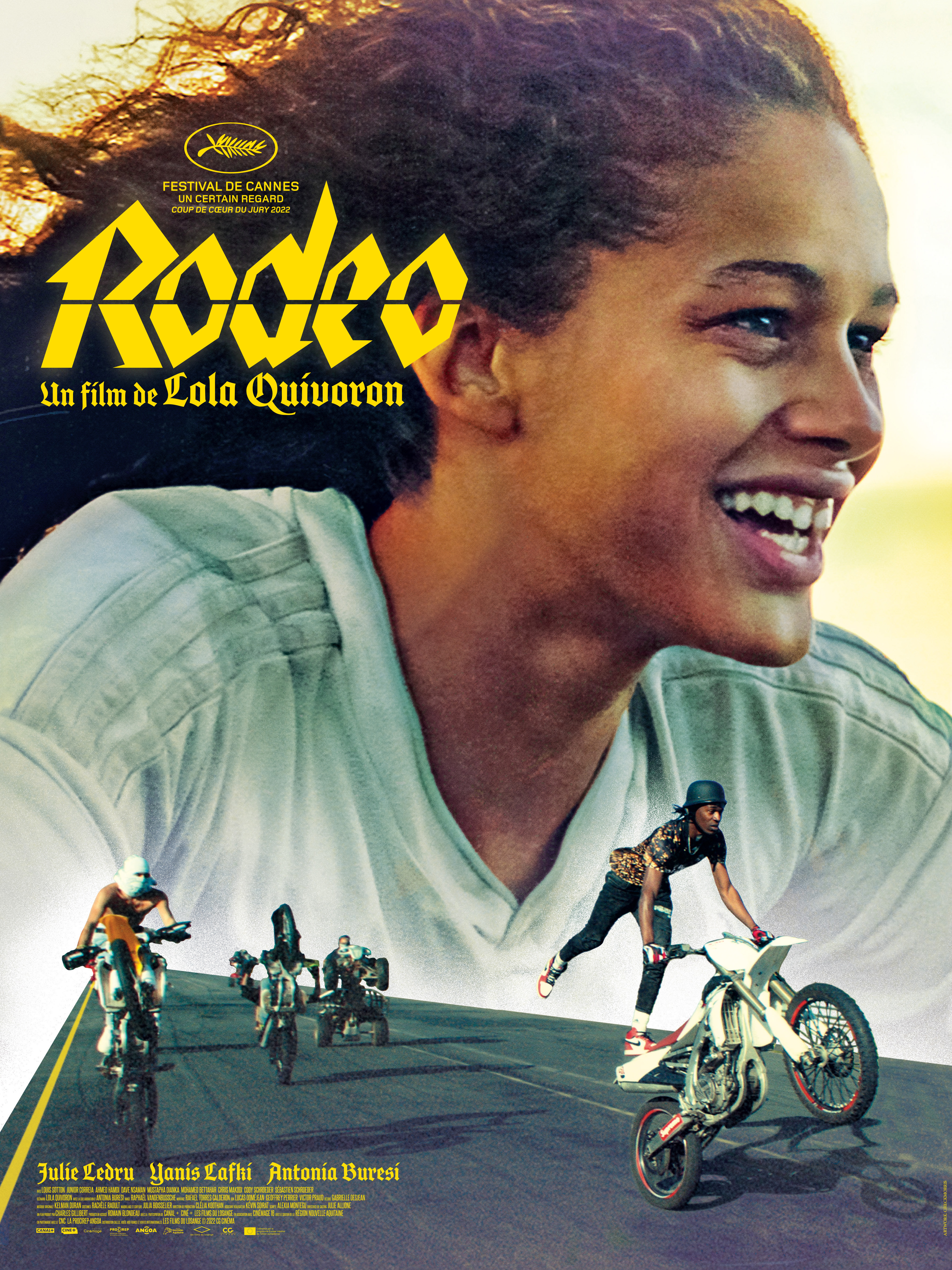
Rodeo, «Rodeo», Lola Quivoron's first feature film, was released on Canal+ on Tuesday May 23. Here's a look back at this favorite of the Cannes 2022 Festial jury, which nonetheless partially meets the public's expectations.
Julia, a young outcast, devotes her life to motorcycling. One day, she meets a group of young men involved in urban rodeo. By joining the biker gang, the young woman discovers this risky, all-male environment.
Top skid
Against all odds, Rodeo is not a film about urban rodeo. Lola Quivoron keeps its distance from the words of its lead actress Julie Ledru, The French government's condemnation of this phenomenon was seen as clumsy. In reality, this practice and its world frame the plot without being the subject of it. With the exception of a few performances at the start of the film, cross-country bitumen disappears from the narrative. The filmmaker's intention is to focus on a woman's integration and adaptation to a system that is a priori unapproachable.
The protagonist's introduction formulates this idea rather well. Julia (Julie Ledru) performs genders: she constructs and then displays a feminine gender expression by approaching motorcycle salesmen, while asserting her masculine side the rest of the time, in her tone, words and gestures. The young woman, who introduces herself to others under the pseudonym «Inconnue», adapts to different spaces and individuals.
We note the interesting oscillation between solidarity and distrust of Julia on the part of the young men. Sometimes included, sometimes rejected, the young woman never admits defeat, and the relationships within the gang are constantly changing. Despite the lack of characterization, the energy of the cast is remarkable. It's essential to salute both the direction and the acting. It seems difficult to reproduce such dynamism - whether anchored in extreme joy or under tension.
Dealing with this pressure is one of the major problems facing Rodeo. The way in which the director expresses the tension produced by Julia's arrival in the gang is never entirely complete. There are plenty of opportunities for injury, aggression and incarceration, yet these moments leave us somewhat unmoved. The reason is simple: the film offers few ideas for framing and staging. Lola Quivoron describes her film as «over-naturalist», a blend of surrealism and naturalism. However, a film close to reality is not necessarily dull in form. The hand-held camera shots, for example, make the effervescence of these young people (too) clear. The choice of image format makes up for this shortcoming. The panoramic screen gives a sensation of speed and momentum that is very much in keeping with the motorcycle rides.
Letting go
These two-wheeled shots highlight another side of Julia: her vital need for freedom. By infiltrating the gang, Julia emancipates herself from gender codes, experiences adrenalin and feels a real sense of liberation at the handlebars of her motorcycle. The pre-credits scene shows Julia riding a stolen motorcycle in slow motion, laughing with her hair blowing in the wind to a post-reggaeton beat. This moment shows the paroxysm of freedom according to the young woman. A need that is also embodied in the character of Ophelia (Antonia Buresi), wife of Domino (Sébastien Schroeder), leader of the group who pulls the strings from his cell.
The relationship between the two women is ambiguous; support, affection and attraction merge. But the nature of this bond is of little importance. In fact, the film reveals the common deliverance of these women. While Julia, a mass of pure anger, opens up and discovers herself through contact with Ophelia, the latter, thanks to the young biker, learns to detach herself from her status as docile wife.
Despite a few hints of the bizarre, suggested by Julia's dreams, the film's fantastic ending is a real eye-opener. Rodeo to renew the treatment of the themes that animate the coming-of-age, as the most accomplished Bunch of girlsby Céline Sciamma. The acting of the performers - most of whom are non-professionals - and the original soundtrack remain assets that have not been fully exploited.
Write to the author: leila.favre@leregardlibre.com
You've just read an open-access article. Debates, analysis, cultural news: subscribe to support us and get access to all our content!
 French
  German
  English