




«Room 212» and the Space-Time of Love
Cinema Wednesdays - Jonas Follonier
With Room 212, Christophe Honoré réalise un exploit: celui d’occuper l’espace comme on ne l’a jamais occupé. N’ayant pas peur des dialogues bien écrits et du refus du naturalisme, le cinéaste confirmé livre un récit théâtralisé sur la durée d’un mariage, porté par un casting breathtaking.
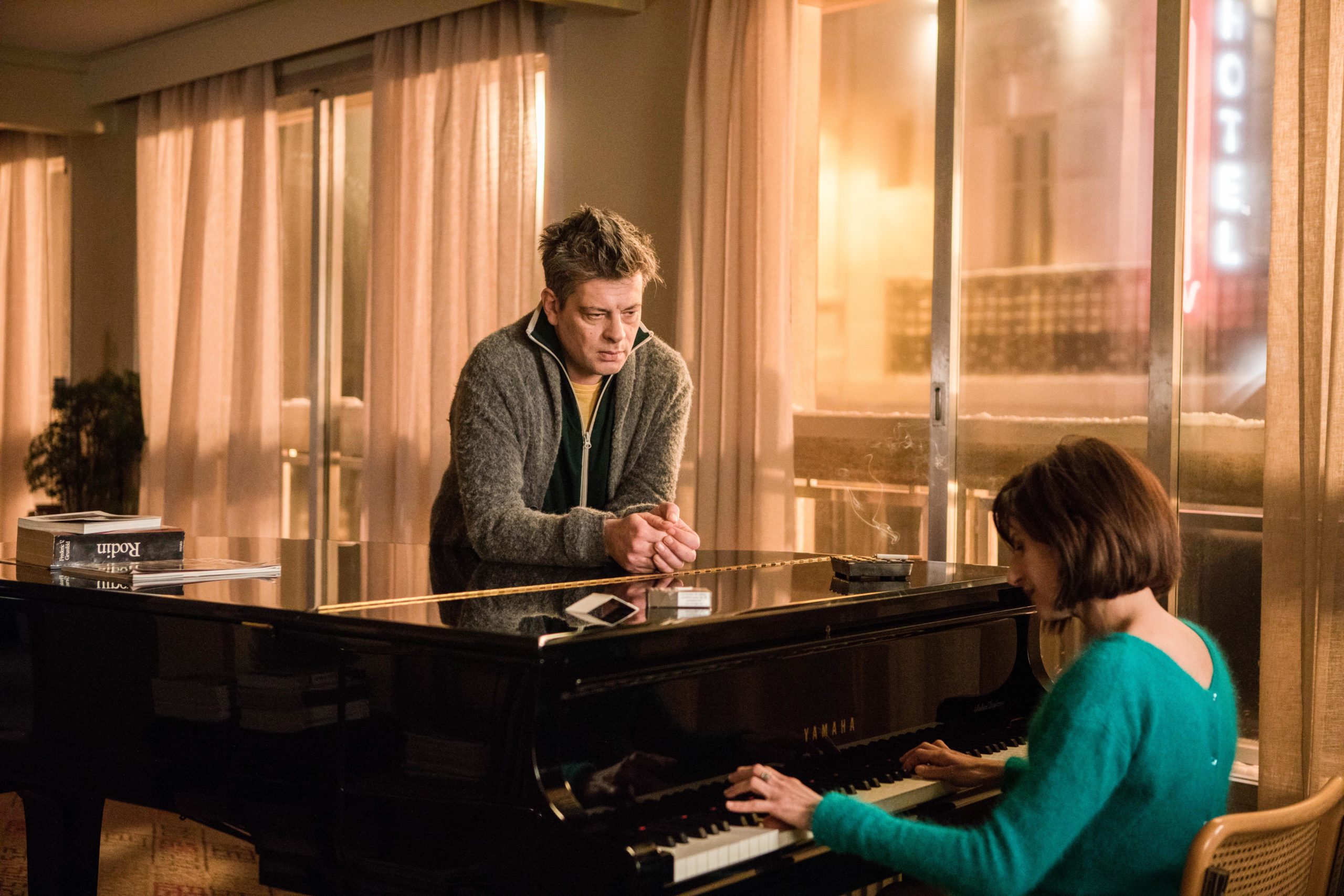
C’est l’histoire d’un couple marié qui voit son quotidien bousculé par un SMS explicite. Maria (Chiara Mastroianni) est démasquée par Richard, son mari (Benjamin Biolay). En guise de défense, celle-ci décide d’assumer sa cuisse légère, argumentant qu’aucun couple ne tient la durée si les deux conjoints ne vont pas voir ailleurs de temps en temps, surtout que ces histoires de sexe n’ont rien à voir avec l’amour. Oui, sauf que Richard, lui, ne l’a jamais trompée en vingt ans d’union. Tandis qu’il rumine dans le salon de leur appartement, Maria prend ses affaires et s’en va passer la nuit à l’hôtel de l’autre côté de la rue, dans une chambre avec vue sur leur appartement. Une mise en place de génie permettant à Honoré de déployer toute son artillerie de mise en scène, basée sur ce face-à-face spatial. Dans une rue parisienne magique, porteuse en elle-même de fantastique.
Dans sa chambre 212, faisant référence à l’article du Code civil sur le devoir de fidélité des deux époux, Maria va rencontrer Richard, mais pas l’homme de quarante-cinq ans avec qui elle est mariée et qui boude dans l’immeuble vis-à-vis, non: celui présent dans la chambre d’hôtel est le jeune Richard qu’elle a aimé naguère (Vincent Lacoste). C’est la suite de l’opération de dédoublement entreprise par Christophe Honoré, qui sera suivie par l’apparition dans la chambre de Maria de sa rivale d’alors, la professeur de piano de Richard (Camille Cottin), l’apparition également de tous ses amants, d’hier et d’aujourd’hui (ils sont nombreux) et de sa volonté, personnifiée par un sosie (à gros traits) de Charles Aznavour (Stéphane Roger). Le dédoublement est présent jusque dans les détails du film, avec la redescente d’une gamme au piano sans le toucher des doigts, ou la commande de deux verres de whisky par personne – encore une interprétation possible de ce nombre 212.
Read also: L’amant double, from sex to torment
L’espace-temps de Now
Dès les premières minutes du film, après une scène d’amour clandestin où est déjà présent le motif du dédoublement, retentit la song Now de Charles Aznavour. On ne s’attendait pas à entendre si tôt ce titre culte présent dans la bande-annonce très efficace du film. Mais Christophe Honoré semble toujours se trouver là où on ne l’attend pas, et donc au bon endroit. Non que la surprise se justifie à elle seule; lorsqu’on est face à un artiste de talent, on sait qu’elle sera à la hauteur de l’habileté de ce dernier à lui donner du sens. Et alors cette chanson Now qu’on aurait sans doute attendue à un moment de grande rupture amoureuse apparaît au terme d’un simple coup d’un soir. C’est que l’amant d’une femme mariée, cela reste toujours son époux, mais son époux tel qu’il était, son époux tel qu’il pourrait être ou aurait pu être, son époux tel qu’il n’est pas.
«From now on / My heart will live under the rubble / Of this world that resembles us / And that time has devastated...» Tout est déjà dans la chanson. Le temps qui passe, faisant passer l’amour. La dimension du temps matérialisée dans le film par les trois dimensions spatiales. «From now on, I'll keep my door closed».»The door, the main character of Room 212. La porte fermée qui symbolise les écarts que l’on se cache, le mur qui s’érige entre deux conjoints devenus étrangers l’un à l’autre; la porte ouverte qui invite au pardon, à la reconstruction, à la dernière chance. A l’espoir d’une reconquête. Car l’amour n’est pas que conquête; il est reconquête continuelle.
A French neo-Hollywood
Let's talk about the actors too. True prodigies of the seventh art. Christophe Honoré's delightful dialogue seems tailor-made for them, and their talent makes us believe it. «How long have you been living on your tiptoes, darling? - I don't know anymore.» Chiara Mastroianni as maestra de l’incarnation; Benjamin Biolay au sommet de sa facette d’acteur, qui prend de plus en plus d’importance au fil de sa carrière pour venir se confondre avec sa casquette d’auteur-compositeur-interprète. L’artiste a d’ailleurs entrusted to the magazine Number qu’il est en train de préparer un film s’inscrivant dans le genre de la comédie musicale. «How did you get so convinced that only your interest mattered in life?» – Un Vincent Lacoste bluffant, doublé d’une Camille Cottin parfaite.
In the end, Room 212 fait partie de ces films où il y aurait énormément de choses à dire mais qui, si elles étaient vraiment dites, gâcheraient le plaisir du futur spectateur. Allez le voir, c’est tout ce qu’il me reste à vous dire. Réservez-vous la soirée pour pouvoir accompagner cette sortie d’un bon repas et d’une bonne discussion (avec votre conjoint-e?), et digérer cette expérience inédite de cinéma qui ne vous laissera pas de marbre. Parce que c’est un film qui arrive à être tout à la fois original, novateur et esthétique, alors même qu’il a pour objet l’amour et le temps, thèmes ancestraux présents dans tout le répertoire d’Aznavour. Et dans nos vies.
Write to the author: [email protected]
Photo credit: © Xenix Films / Jean- Louis Fernandez

You'll also like

 French
  German
  English
Leave a comment