


At a time when «trial films» seem to be making a comeback, Cédric Kahn plays the radical card with a solid, brilliant and funny film about the French judicial machine of the mid-1970s.
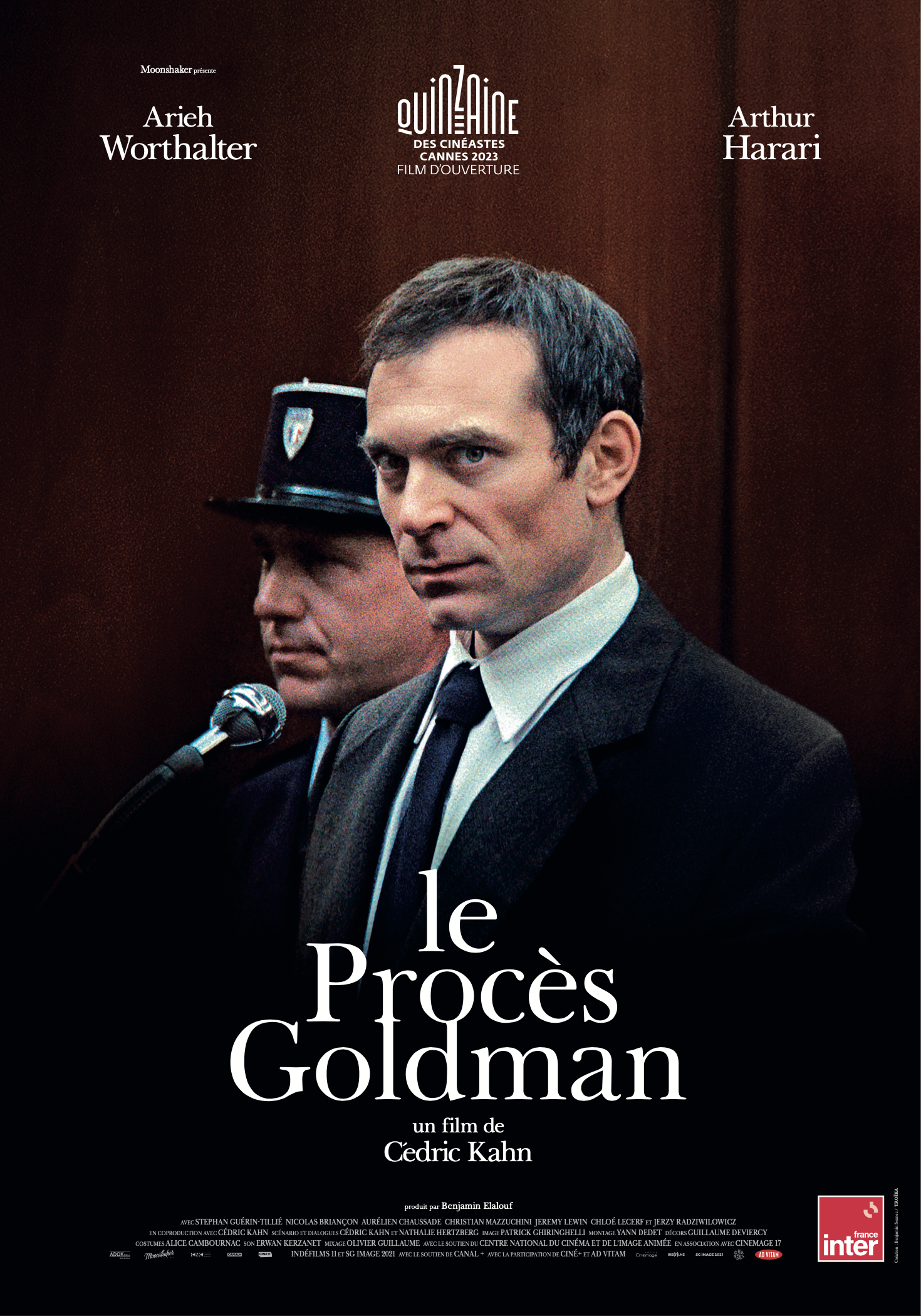
Presented this year at the opening of the Directors' Fortnight at the Cannes Film Festival, The Goldman Trial looks back at the appeal hearing of Pierre Goldman, far-left activist and bank robber, accused of a double murder he denies having committed. If this case caused a stir in Valéry Giscard d'Estaing's France, it was not so much because the accused was related to the singer Jean-Jacques Goldman, but because of the scope of the trial and its political impact. Of the two adjectives used to describe Pierre Goldman, it was not «bank robber» that made the police suspicious, but «extreme left-wing militant». For in the midst of communist revolts in various countries, and with the «red menace» still very much alive, it was not a suspected murderer they were trying to lock up, but a political activist.
From Resistance fighter to revolutionary
Initially presented as the son of Polish resistance heroes, Goldman went on to become an academic, a bank robber, a guerrilla, a violent, funny and communist. It's this last point, in fact, that seems to hold the attention of the jurors, and that of the police, who are very present on the relatives' bench. Because Goldman doesn't look like the ideal criminal, and that bothers the court. Not only is he very precise and erudite in his choice of words, totally moral and irreproachably transparent, but he is above all very vindictive towards all forms of authority, and a fortiori the police system.

This rejection of a police force he considers «racist and fascist» is combined with his past as a revolutionary in South America, to turn him into a kind of left-wing terrorist (like the Baader gang) who would threaten the equilibrium of the entire state: if Goldman is acquitted, it's the death of the French nation as we know it, in short. Yet, paradoxically, Goldman has a great deal of support. By those closest to him, but also by a public with ideals close to his own. This divide on the witness stand creates an almost fairground spirit in the courtroom, and allows Cédric Kahn to underpin his point of view on today's society.
The trial of an era
As Cédric Kahn directs his main character (the staggering Arieh Worthalter), it's not so much the real man he's talking about, as the echo of a generation. If the film seems so fluid and telling, it's because it's saying something about our times. As Goldman loudly proclaims to a roomful of officers that the police are racist, it's all the more impactful because little has changed today. The constant tension in the room - and in the film - is also reflected in the direction.
Goldman's sense of confinement is immediately transferred to the audience. Apart from a brief introductory scene, the entire film takes place in the courtroom. Throughout the trial, viewers witness the reconstruction of Pierre Goldman's life, through exchanges and readings of letters, as if they were jurors themselves. Of the facts, only the testimonies are «shown». This process allows immediate identification with the story, and shifts certainties as new evidence and announcements unfold before Kahn's static camera. The unusual choice of 4:3 (the almost square format used by old-fashioned television) also creates a compartmentalization of each character addressing the jurors, while recalling the media aspect of the affair, which in 1976 France was only able to hear about through the small screen.
Brilliantly staged and written, The Goldman Trial is also eminently political and topical. Cédric Kahn's response to the fear that a two-hour judicial lock-up can arouse is to direct the actors and keep the pace on a knife-edge that never bores; a kind of good response to the first half of’Anatomy of a fall (Justine Triet, 2023), which struggled to get off the ground before tackling its real subject.
Write to the author: mathieu.vuillerme@leregardlibre.com
You've just read an open-access review. Debates, analyses, cultural news: subscribe to support us and get access to all our content!
 French
  German
  English