



«This is Not a Burial, It's a Resurrection»: when the dead wake the living

trigon-film.org
Cinema Wednesdays - Alice Bruxelle
Presented at the 15th Festival Cinémas d'Afrique at the Cinémathèque Suisse on August 22, This is Not a Burial, It's a Resurrection by Lemohang Jeremiah Mosese is released this Wednesday, January 1.er September 2021. South African actress Mary Twala plays a widow who saves the sacred. A work combining political and social issues, but above all philosophical and spiritual ones, it questions dualities such as life and death, modernity and tradition, or Christianity and spirituality in a subtle and complex whole. Lemohang Jeremiah Mosese is poised to become one of the new generation of African filmmakers.
«You can’t heal a ghost, much less a living dead person. You can only heal those who belong to the earth and still have roots there, however shallow they may be.» (Cioran)
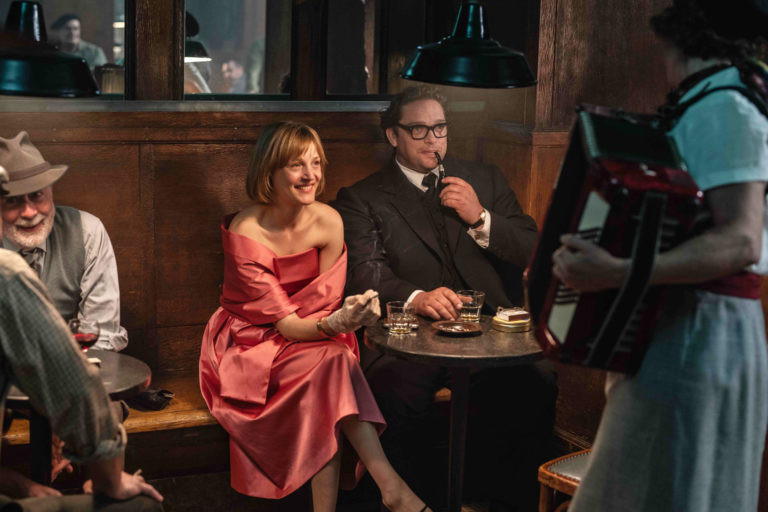
In a bar, an African storyteller recounts the life of Mantoa (Mary Twala). To the sound of his almost mystical voice and his lesiba—a traditional Lesotho instrument—we enter the village of Nazareth, overlooked by the mountains of Lesotho, where a spiritual drama is about to unfold. Preserving the sacred is the final act that separates Mantoa from her death. Because her son never returned from the mine where he worked—and already devastated by the deaths of her daughter, her husband, and her grandson—she longs to join them. Her face etched with profound sadness, she learns that her village will be flooded by a dam project.
The cemetery where the bodies of those who died in the Boer War and the Black Death are buried is to be «relocated,» to use bureaucratic jargon. But to Mantoa’s keen mind, this is a profane affront to the peace of the spirits already on the other side. As she dons her mourning dress—which she will not remove until her final act of protest—workers in garish yellow overalls invade her land. Her sudden realization of God’s indifference to her pain will not deter her rebellion against this onslaught of modernity. This rebellion is not really a rebellion at all, for exhuming the dead stirs up evils that transcend the political—that is, spiritual and metaphysical evils.
While Bernanos said that modern civilization was, above all, a universal conspiracy against all forms of inner life, Lemohang Jeremiah Mosese depicts this conspiracy extending even into the coffins. Paradoxically, these coffins will manage to breathe a final breath of life into Mantoa.
Fighting the Long March of Time
While the film tells the story of Mantoa’s resilience and rebellion, it is also the story of Nazareth—inspired by a real village where Mosese’s grandmother lived—who herself embodied Mantoa’s struggle against a similar dam project. This may explain the accuracy with which the director brings his story to life. It is the story of a small enclave deep in Lesotho that, having weathered the trials of time, has been transformed. First called the «Plain of the Weeping» following the deaths from the Black Death, then «Nazareth,» in reference to the new God brought by Christian missionaries, which would give rise to a blend of spirituality and Christianity. This syncretism, characteristic of Africa, is also evident in the film, where shamanic rites coexist alongside crucifixes. But it is a new God who is portrayed here—a nameless God, the God of capitalism, replaced by the more seductive term «progress.».
In this fable about the passage of time, Mantoa rejects this perpetual renewal. The village is the very essence of her identity, and replacing the cemetery with a crude dam signifies a metaphysical death. What can David do against Goliath? A David who has replaced his connection to God with a desire for death, a David who has chosen to desecrate by digging his own grave in the hope of returning to the earth. Taking root to fight against uprooting—that is the ultimate solution.
The feature film itself embraces the theme of rootedness, particularly through its many charged silences, which more accurately express infinite sadness or silent anger than any superfluous words. The invisible bonds between God and the dead are so powerful that it becomes unnecessary to burden them with any additional weight. The image of Mantoa as a disheveled mystic, coupled with the absence of any precise temporal or geographical references, maintains the connection to the realistic tale set in the mountains of Lesotho.
Faces and Landscapes
A native of Lesotho, Lemohang Jeremiah Mosese draws inspiration from his family history and his homeland, as well as from his work as an artist—a filmmaker, visual artist, and poet. Through his camera, a perfectly mastered aesthetic is on full display. With the help of his director of photography, Pierre de Villiers, the filmmaker does not simply shoot his scenes—he paints them. By bringing together the colors of nature, the landscapes unfold in time with the storyteller’s voice-over.
By confining the shots to a 4:3 aspect ratio, he avoids the pitfalls of the postcard. Characters and landscapes become one, each taking on the significance of the other until they merge. The close-up of Mantoa’s wrinkled face evokes the mountains surrounding the village. The characters are deeply earthly beings. Everything serves to underscore this: regular close-ups of hands in direct contact with the material world. They tend, knead, dig, and gather, woven into this cinematic tableau.
As the local priest quotes the Bible, speaking of the day when «every tear will be wiped away, and there will be no more death, mourning, crying, or pain» (Revelation 21:4), the village’s imposing weeping willow is being cut down. Is this a sign that God has abandoned the damned of the earth? Mosese does not settle the question. But Mantoa, for her part, chooses to seek him out, perhaps. A rebellion? No, sir, a resurrection.
Write to the author: [email protected]
Photo credits: © trigon-film.org
You'll also like

 French
  German
  English
Leave a comment