



«Rolf Lyssy's »Die Letzte Pointe": a dangerous illusion

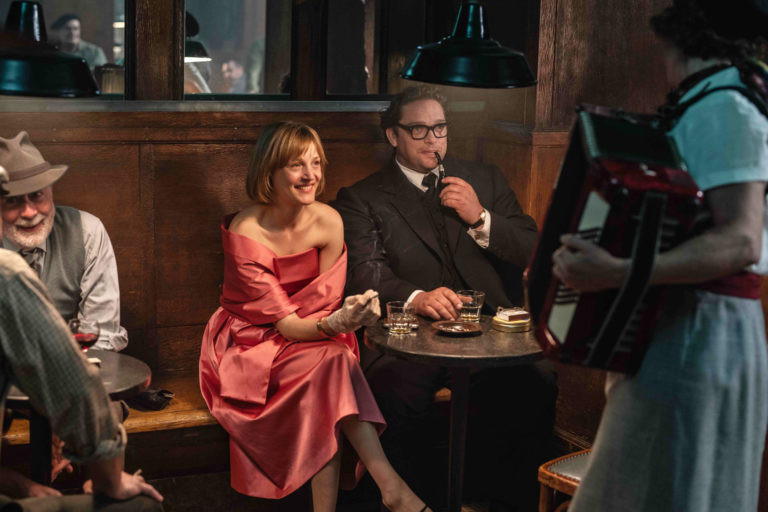
2016, Letzte Pointe, Regie: Rolf Lyssy, Produktion: Lang Film, Kamera Elia Lyssy
Cinema Wednesdays - Thierry Fivaz
At the height of his eighty-two years, Zurich director Rolf Lyssy delivers with A final touch (Die Letzte Pointe) a comedy with delicate themes: old age, love and death.
For several years now, Rolf Lyssy has focused his production on documentaries - think of Ursula Leben in Anderswo (2011), in which the director followed the daily life of a blind and mute woman from birth, or to Wäg vo de Gass! (2004), which dealt with the controlled distribution of heroin - but with A final touch, the director breaks with his recent habits and returns to fiction, and more specifically to the comedy genre. But how can we understand such a turnaround?
Perhaps, the fact that the director's greatest success - The Swiss Makers (1978), a marvellous satire that highlighted the ridiculous procedures foreigners had to (and still have to) undergo to obtain their red passports with white crosses - is celebrating its fortieth anniversary this year may explain this return to its roots; or could it be because fiction, unlike documentary, has the virtue, like fairy tales, of being able to exorcise fears? For with A final touch,Lyssy tackles delicate subjects: old age, love and death, a triptych that must make particular sense to a man his age.
The old lady's visit
Gertrud Foster (Monica Gubser) is eighty-nine years old. Widowed many years ago, her husband was a successful musician who bequeathed her a comfortable life, which is why she enjoys her retirement in a large, beautiful house. But while Gertrud is remarkably self-sufficient and retains an extraordinary vitality, this great-grandmother is not lonely: her daughter Chantal (Suly Röthlisberger), in her sixties, telephones and sees her regularly; as does her granddaughter Meret (Delia Mayer), in her thirties, who wants to break into the music business and rehearses with her musicians in the basement of her beloved grandmother's house. All in all, it's fair to say that the old lady enjoys a devoted and caring entourage. But one fine day, a visit disrupts this fragile balance.
Then one day, much to the old lady's surprise, a man named George Grant (Michael Rutman) - an elegant Englishman of the same age as her - knocks on her door and claims that Gertrud has invited him for tea. To Gertrud's puzzlement, George reminds the old lady that she had contacted him a few days ago via a dating site for senior citizens. However, Gertrud has no recollection of writing to George - which is to be expected, since it was her great-granddaughter Lisa (Stella Mayer), a little girl of around ten, who wrote to George pretending to be her great-grandmother, something Gertrud is obviously unaware of.
Unaware of Lisa's shenanigans - she only wanted to do her great-grandmother good by finding her a «lover» - Gertrud is convinced that she is losing her mind. Stunned, the old lady sets out to end her life, fearing that she will soon be placed in a specialized institution. Determined, Gertrud contacts an association that puts her in touch with Balz Sommer (Peter Jecklin), a suicide counselor.
A golden old age
If the theme of A final touch remains particularly heavy, the genre under which Lyssy sees it, comedy, proves to be rather light. So, despite the heaviness of the motif, A final touch remains a true comedy - not a dramatic one, but rather a family comedy. Lyssy's film is full of good feelings and is particularly tender; the love and attachment shown to Gertrud by those close to her is obvious and very touching. Added to this good humor is a certain serenity - but perhaps it's the director's own serenity in the face of his fate that shines through here. Nevertheless, despite this idealized fresco, a strange feeling washes over us: could it be a refusal to adhere to this idealized vision of old age? The story is indeed too beautiful.
It seems obvious that with A final touch, Lyssy delivers a highly personal film that touches on profound themes that should be particularly meaningful for someone her age. In an interview with the newspaper Le Temps, Lyssy pointed out that he was a member of the association Exit since 1995, showing that death has been on his mind for some time.
Cevertheless, the director can be criticized for depicting an idealized old age. Few people, even in Switzerland, can boast as much vitality as Gertrud. Likewise, the family nucleus formed around the old lady proves too solid, too close-knit, too caring to be true - what great-grandmother is lucky enough to see her children, grandchildren and great-grandchildren so often? And let's not even mention Gertrud's financial affluence, given the number of AHV recipients struggling to make ends meet. Finally, while it's indisputable that Switzerland remains a very beautiful country, in Lyssy's film it seems sanitized, cleansed of all rough edges, bland.
But while idealization, especially in a comedy, is by no means problematic - after all, isn't cinema all about escaping from reality? - what's disturbing is the impression that the director has come to believe in the veracity of the fresco he's depicting; hence the calm and serenity with which he presents us with his film.
To put an end to death
A documentary is an unfiltered, minimally contrived look at a complex reality. Fiction, on the other hand, allows us to escape the ethical and objective constraints imposed by documentary. With fiction, anything seems possible. Of course, the relationship between reality and fiction is often a close one; fiction can mirror reality, highlighting its flaws, harshness and cruelty, but it can also distance itself from it. Whatever happens, fiction is always measured against the yardstick of reality: it necessarily involves the negotiation of certain beliefs that we hold to be true in our world. But Lyssy's demand for this negotiation of beliefs is too demanding. Old age is not what he shows us. Haneke, for example, gives us a deeply moving vision of it in Love (2012), which remains tragically true.
Of course, there's no desire for realism behind Lyssy's film, but it's possible that the reason he returns to fiction is because dealing with these issues through the objectivity of documentary would have been too harsh - hence the return to fiction. Hence the impression that with A final touch, Lyssy exorcises his fears and fantasizes about an ideal end to life. Because the end he shows us is the most beautiful: a natural death, without morphine and slow agony; death in all its beauty, or rather in all its simplicity: where one morning, when you weren't expecting it, you wake up dead. But who'd believe it, except him?
Write to the author: thierry.fivaz@leregardlibre.com
Photo credit: © Vinca Film
You'll also like

 French
  German
  English
Leave a comment