




The gradual emancipation of the Principality of Neuchâtel
Le Regard Libre N° 22 - Jules Aubert
To understand the background to the slow emancipation of the Principality of Neuchâtel, we first need to understand who ruled this small territory bordering the Doubs on one side and the lake on the other.
The history of the County of Neuchâtel is unique in that, over the 837 years from 1011 to 1848, it has seen a succession of rulers, and we won't list them all here. We'll start in 1707, a crucially important year, when Marie de Nemours, indirectly of the Orléans-Longueville line, died and was denied the right to pass on her authority over the principality by the tribunal of the Three States. With La Duchesse de Nemours, the Orléans-Longuevilles saw their claim to Neuchâtel die. The principality, now devoid of a sovereign, had to decide who would succeed the French family. The Court of the Three States alone had the power to choose the new prince.
The Conseil d'Etat is therefore calling on all families with claims to the succession to assert their rights by submitting evidence to verify the basis of their claim. There are many who aspire to the throne of the principality; all of them come with documents attesting to their more or less distant genealogical links with one of the families who have reigned in Neuchâtel. Out of twenty contenders, the court selected only nine. And on November 4, 1707, the trial ended and the principality was officially granted to the King of Prussia, Frederick I.er of Hohenzollern.
Throughout the 18th centuryth In the 19th century, relations between Neuchâtel and Prussia were more or less cordial, with a few exceptions. Indeed, when Frederick II decided to change the way taxes were collected in the principality, he encountered a wave of discontent. A long struggle between Neuchâtel and Berlin ensued; without a solution, arbitration was sought in Berne, where representatives from both sides defended their claims. Claude Gaudot, representing the interests of the King of Prussia, prevailed over Bern's impartiality.
Neuchâtel, although owned by the King of Prussia, was closely linked to the Confederation, as this mediation event testifies, but there is other evidence of the closeness of the two states. The Battle of Rossbach, for example, saw the Helvetic Confederation, made up of battalions from Neuchâtel, fighting alongside the Holy Roman Empire, the Kingdom of Austria, the Kingdom of France and Prussia.
The people of Neuchâtel, loyal allies of the Swiss cantons, found themselves at odds with their sovereign. Boyve, a Neuchâtel historian of the 18th centuryth century, defined it in these terms: «Can we imagine a stronger federative bond than that which obliges a state to follow its allies in war against its own prince?»
A major event in Europe was about to shake things up: the French Revolution! It was the first time that the winds of democracy had reached the Principality. Like a storm passing in the distance, it did not cause lasting damage, but it did imprint a certain desire for freedom on the minds of the people of Neuchâtel.
The aftermath of the French Revolution led to a period of instability in Europe, as monarchs tried to contain any hint of emancipation in their countries. In France, all that remained of the Republic were the sombre memories of a bloody period, but no institutional traces. Napoleon had toppled the Republic, and with it all the dreams of freedom it had brought to Europe. The Emperor wanted to conquer new territories. This desire for expansion had immediate repercussions for Neuchâtel, as Napoleon attacked Prussia in the famous battle of Austerlitz. At the end of this conflict, Napoleon and Frederick William III met again to redefine European policy. Napoleon ceded Hanover to Prussia, while Frederick William III relinquished Neuchâtel to the Emperor.
In 1806, the principality of Neuchâtel, decreed inalienable and indivisible at the 1707 trial, passed into French hands. The reaction of the people of Neuchâtel was rather mixed: some saw this exchange as an abandonment, a betrayal and above all a usurpation of rights. Others felt that a peaceful transfer of ownership was preferable to a military invasion. Nevertheless, the act left a lasting impression on the people of Neuchâtel, and was remembered by many in 1831 and 1848.
When Napoleon's army suffered a crushing defeat at Leipzig between 1813 and 1814, the cards were reshuffled, as the emperor was forced into exile. The situation in Neuchâtel was confusing, to say the least, and two camps soon emerged: on the one hand, those who saw Napoleon's fall as the right moment to join Switzerland, as the King of Prussia had abandoned his claims to the principality in 1806; on the other, those who believed that Neuchâtel could not do without a sovereign at the head of the state, and who would even consider the return of the Hohenzollerns, who were known to be in favor of a rapprochement between the principality and the neighboring Confederation.
Frederick William III forced the decision by sending an emissary, Jean-Pierre Chambrier d'Oleyres, to defend his interests and discuss a possible rapprochement with Switzerland. It was not until the Congress of Vienna, which took place from April to August 1814, that the future of Neuchâtel was decided. After lengthy discussions, Neuchâtel was granted dual status: it would become a Swiss canton and the property of the King of Prussia. To this end, the sovereign of the principality ceded all powers to the Council of State in matters concerning the Confederation. The Congress of Vienna thus redefined Neuchâtel's political situation and considerably altered its future. It will have far more far-reaching consequences than could have been foreseen when the treaty was signed.
Finally, in the early nineteenth centuryth This was an eventful century for the small principality of Neuchâtel, as it passed from hand to hand with little regard for what the population thought, before finally regaining stability by joining the Helvetic Confederation. These changes marked an irreversible break in mentalities. The marriage with Switzerland, and indeed with its democratic institutions, gradually but definitively pushed the territory from the status of principality to that of republic. It took three revolutions, two in 1831 and one in 1848, for the separation from the King of Prussia to be completed. The stability that followed this emancipation was the fruit of a long process of emancipation from a regime that had become incompatible with the collective conscience. Neuchâtel, which had always been under the sway of a sovereign, was now to discover the flavours of the sunshine of freedom.
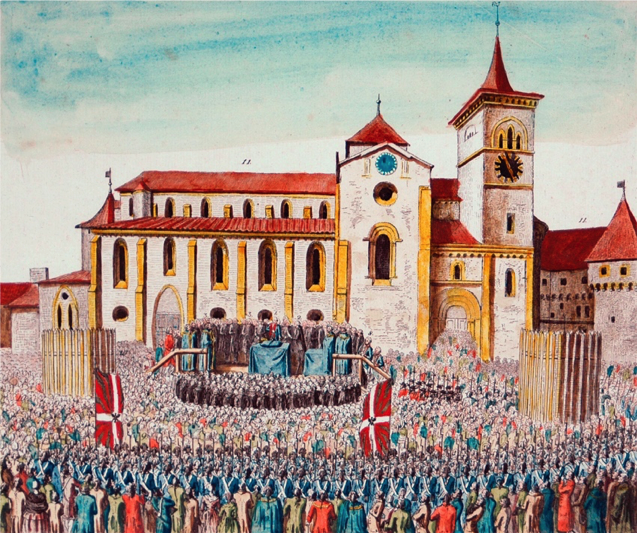
Image: Taking of the oath in 1786 on the Place de la Collégiale

You'll also like



 French
  German
  English
Leave a comment