




The New Silk Roads and the weight of history
Le Regard Libre N° 36 - Clément Guntern
A few years ago, the Chinese government initiated what was just one of many projects. It aims to revive the ancient Silk Road, linking China to Europe. This project, like others, is symptomatic of the permanency of Chinese history.
China is a country thousands of years old. This land, so long traversed by the currents of history, has its own identity and characteristics that have endured for centuries. The form taken by Communist power in the twentieth century, however, is still very much alive.th Is not the continuity of imperial power? Numerous examples can demonstrate the extent to which constancy of form, thought and strategy characterize the Chinese world. Reliable parallels can be drawn between yesterday's behavior and yesterday's objectives. The Silk Road is a recent example of continuity in the Chinese world; a burden of history and at the same time an opportunity.
An ancient road
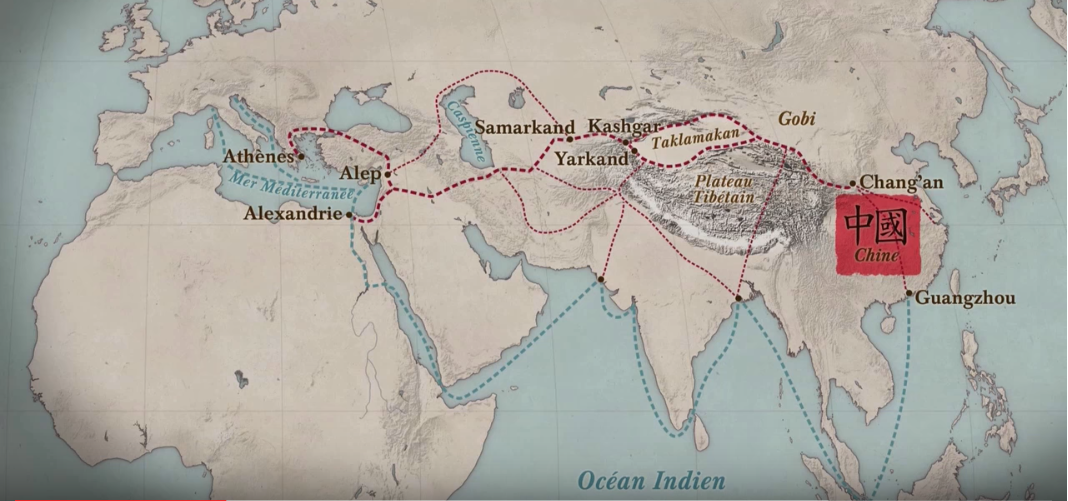
Trade between China and Central Asia seems to have developed from the 4th century onwards.th and IIIth centuries BC. Between the Yellow and Yangtze rivers, the first Chinese kingdoms developed in northern China as early as the Bronze Age. However, the Chinese kingdoms were not unified until 221 BC, under the reign of Qin Shi Huangdi. From then on, the Chinese Empire lasted for over two thousand years, one of the longest political continuities in history. It was under the Han dynasty, which first ruled unified China, that the Silk Road was first established. Indeed, during the 2ndth In the 16th century B.C., the Chinese government sent an emissary to Central Asia to make contact with its populations. Once he had arrived in the cities of Central Asia, the emperor's legate realized the interest that existed there for Chinese products, particularly silk. This potential profit coincided with a strategic interest in allying with these regions to counter the steppe peoples who caused the Chinese so much trouble. At the same time, a silk trade already existed between China and India, through Burma. This gave rise to the word Cîna, which in India referred to the land of silk.
The expansion of the Han Empire westwards, north of the Himalayas, corresponded with the growth of trade. Indeed, Chinese domination from Korea to Central Asia ensured control over the routes taken by merchants, which was favorable to trade at the time. The route ran from the imperial capital of Chang'an through Persia to the Mediterranean. However, this route was not only used by merchants as we think of them today, going from one city to another to collect their wages. One aspect of Chinese diplomacy was what we might call gift-giving. These, of unimaginable pomp and exorbitant cost, were intended to dazzle neighboring countries and secure their loyalty to the empire. To win over or defeat its enemies, China of the time showered foreign sovereigns with gifts, notably silk. So much so that the price of silk plummeted as a result of the abundance of silk. All these commercial and diplomatic relations were driven by significant economic growth, which demanded exports to all neighboring countries.
Gifts and investments in infrastructure, such as relays or markets, as well as the need for outlets for growth, can be seen as usages in Chinese history, in the image of the centralized imperial regime. To illustrate this, we will present the current New Silk Roads project.
Roads and history
In 2014, China announced two projects: the UNESCO World Heritage listing of part of the ancient route, and the New Silk Road. Further proof of China's history, whether conscious or not. Since then, the project has grown to become the largest investment plan in history, exceeding 1,000 billion dollars. The New Silk Road will consist of a land route through China, Central Asia, the Middle East, Russia and Europe. On the other hand, a sea route is planned from Chinese ports to India, Africa and Europe. China plans to build ports, roads, railroads and oil pipelines in many countries, some of which are among the most unstable in the world.
The new Silk Roads are considered by some to be China's biggest push since the Mongol invasions in the 12th century.th century. We can identify several political motivations for launching such a project. Firstly, China wants to promote trade between Asia and Europe. In reality, it is mainly planning exports to the Old Continent. The Chinese president is also keen to exploit the resources of western China, which remains unstable for the time being. His wish is therefore to sinicize, through massive investment and the arrival of Chinese workers, this Turkish-speaking and Muslim region, the Uyghurs. Beyond China's borders, the exploitation of raw materials remains on Beijing's radar. Economic expansion will also involve speeding up trade, which will now bypass the Suez Canal inland. Last but not least, these massive works are a means of using China's industrial surplus to build infrastructure. Just as in the China of the Han Empire, economic growth prompted the search for new trade routes. Like imperial China, Beijing is spending colossal sums in Central Asia to ensure the deployment of Chinese power, this time by investing in concrete rather than silk.
Secondly, the Communist government is seeking both military and economic security, by ensuring a reliable supply of raw materials. The land route will bypass the problem of piracy in the Straits of Malaka in Indonesia and the Gulf of Aden in the south of the Arabian Peninsula. To this end, a secondary corridor will be set up through Burma towards China, avoiding Southeast Asia by following the ancient silk route to India. Both the sea route and the land route also aim to secure and diversify oil and gas supplies. What's more, the new Silk Roads put themselves beyond the reach of US fleets in the Indian and Pacific oceans, which could impede trade in the event of conflict, a prospect less remote than before Trump came to power. Security of supply can be likened to an imperial struggle against the Xiongnu barbarians living in the vast steppes of Central Asia.
As we can see, China, a country thousands of years old, always carries its history with it, sometimes as a burden - as in the debates on what communism has borrowed from empire in this country - but also as a long-term strategy. The permanences inherited from history and geography seem to be guiding the Middle Kingdom in the background.
Write to the author: [email protected]
Photo credit: © ARTE, «Le Dessous des Cartes» (YouTube)
You'll also like




 French
  German
  English
Leave a comment