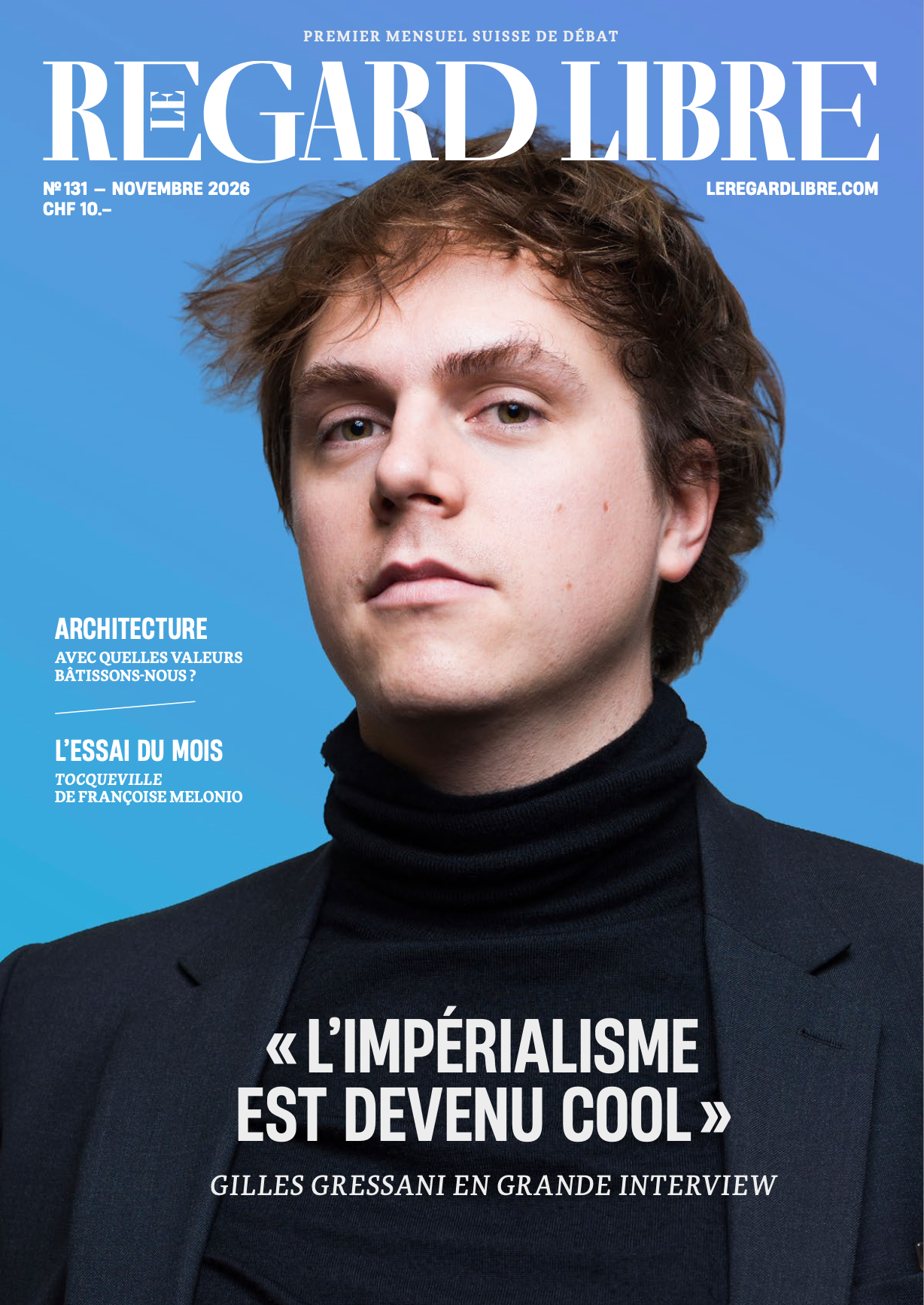




Philippe Testa's version of Lausanne's dystopia

Tuesday's books - Ivan Garcia
With The Obscure, Philippe Testa delivers a new tale in which a marginal anti-hero living in Lausanne tries to escape the end of the world. An intriguing, readable novel of anticipation. At the same time, however, it lacks spice and leaves the reader wanting more.
In recent years, dystopia has been the literary genre on the rise. From The Handmaid's Tale by Margaret Atwood (adapted by Netflix) to Simili-Love by Antoine Jaquier—screenwriters and writers are very fond of it and demonstrate remarkable creativity. So when Philippe Testa, the author of Western Male (Hélice Hélas, 2018) and the Twilight of Mankind (L’Âge d’Homme, 2014) presents a new novel in which his philosophical pessimism blends with collapsology—it’s certainly intriguing.
A very, very dark dystopia
«The old world is dying, the new world is slow to emerge, and in this twilight, monsters arise.»
Antonio Gramsci
Testa does not quote Gramsci—even though he has been the philosopher in vogue lately—in his book (as an epigraph, the reader will find a quote from the Marquis de Sade), but one senses the Italian thinker’s presence. On paper, the book has plenty to offer, starting right from the novel’s opening lines:
«I lead a very conventional life, without surprises or drama, even though—as the news reports constantly remind us—the world seems to be getting more and more turbulent.»
Marvel, the first-person narrator, works for a company that sees him as nothing more than a pawn, always at risk of being «reassigned.» He lives in Lausanne, and his favorite pastime on his «days off» is strolling along the Montreux waterfront and the shores of Lake Geneva. Aside from his uninspiring job and his solitary pastime, our hero is «disconnected.» He scores a big fat zero when it comes to social relationships; he doesn’t get along very well with his brother Formose or his sister Opeleptica. The only people for whom he feels even the slightest bit of emotion are Moro, his survivalist «co-worker» who lives in Echallens, and Pia, his ex-girlfriend. But the future is bleak, very bleak…
In this future—which isn't all that far from our own time—people are addicted to «social media» and eat synthetic meat (sometimes «real meat», but that’s rare…), are inundated with entertainment from «Unterhaltung Indus» and dream of colonizing Mars. Only a handful of privileged individuals live in wealth and security in ivory towers, while the majority of the population struggles to make ends meet and, caught between social narcissism and medication, is mentally breaking down. For the luckiest retirees, like Marvel’s parents, there remains the option of moving to ’gated communities« to live out their golden years as wealthy elites hated by the locals.
As the reader will have realized, in The Obscure, hope hangs by a thread; the dystopia the writer portrays is extremely bleak. That, in fact, is where its main appeal lies. Indeed, the author offers neither a breathtaking plot nor a style worthy of Flaubert. Instead, he evokes a distinct atmosphere: the end of the world, darkness, and the uncertainty of tomorrow. The title likely refers to the numerous «blackouts» that occur throughout the story, one of which will trigger global chaos and a struggle for survival. The collapse has happened.
Philosophy and Raw Vegetables
«Because of the blackout, we’re hearing the news several hours late. The shock is felt around the world. The Mars expedition has failed. The droid has just landed; it has sent back the first footage. It’s horrific: the colonists are all dead. […] The shock is all the more severe because so many people had placed disproportionate hopes in the success of this first extraterrestrial settlement. Mars represented the prospect of a fresh start, of beginning anew on a new world, untouched by pollution and contamination, free from mistakes that would never be made there.»
As in The Twilight of Mankind, Philippe Testa—through his narrator—embarks on philosophical and critical digressions about contemporary lifestyles, particularly regarding the alienation caused by materialism and the loss of meaning. In this regard, the text is peppered with Anglicisms («day off,» «co-worker,» «socials,» etc.) that demonstrate how the language of the narrative has been standardized and corrupted by global giants.
However, the reader has a hard time immersing themselves in the world described by the author, sometimes due to a lack of information about how the society depicted in the story functions. This is the most difficult aspect for authors of dystopian fiction to master: giving readers the means to enter a world they don’t know while ensuring that the experience feels «natural» rather than artificial.
The author’s style—which tends toward long sentences and is rich in detail—has the merit—ironic given the title—of shedding light on elements rarely described in dystopias: the survival of these «everymen» in a world in ruins. Thus, in a very direct and raw manner, we are presented with scenes in which Marvel and Pia, as seasoned survivors, resort to cannibalism. To survive. These richly described moments provoke an emotional reaction from the reader, who, torn between disgust and curiosity, cannot help but think that this may be the future that awaits our species.
«I then cut the meat into strips and wrap them around an iron rod. It’s not a success: in some places, the meat is charred; in others, it’s undercooked. And that’s not even counting the flies that go crazy over the meat and end up between my teeth, with a final crunch of chitin. In any case, the flavor enhancers mask everything. In the end, the taste is almost pleasant. Not to mention the sense of calm this food brings.»
Despite a few flaws, Philippe Testa’s new novel is a fairly enjoyable and intriguing read. We appreciate the atmosphere Welcome to Zombieland that is presented to us, as well as the fact that—for once—the protagonist is a «pretty normal» person with a sharp critical mind. This, incidentally, makes him likable, despite the novel’s somewhat clichéd ending. The only intellectual in the midst of a devastated world.
Write to the author: [email protected]
Photo credit: Wikimedia CC 4.0

Philippe Testa
The Dark One
Propeller, Alas
2020
248 pages

You'll also like

 French
 German
 English

Leave a comment