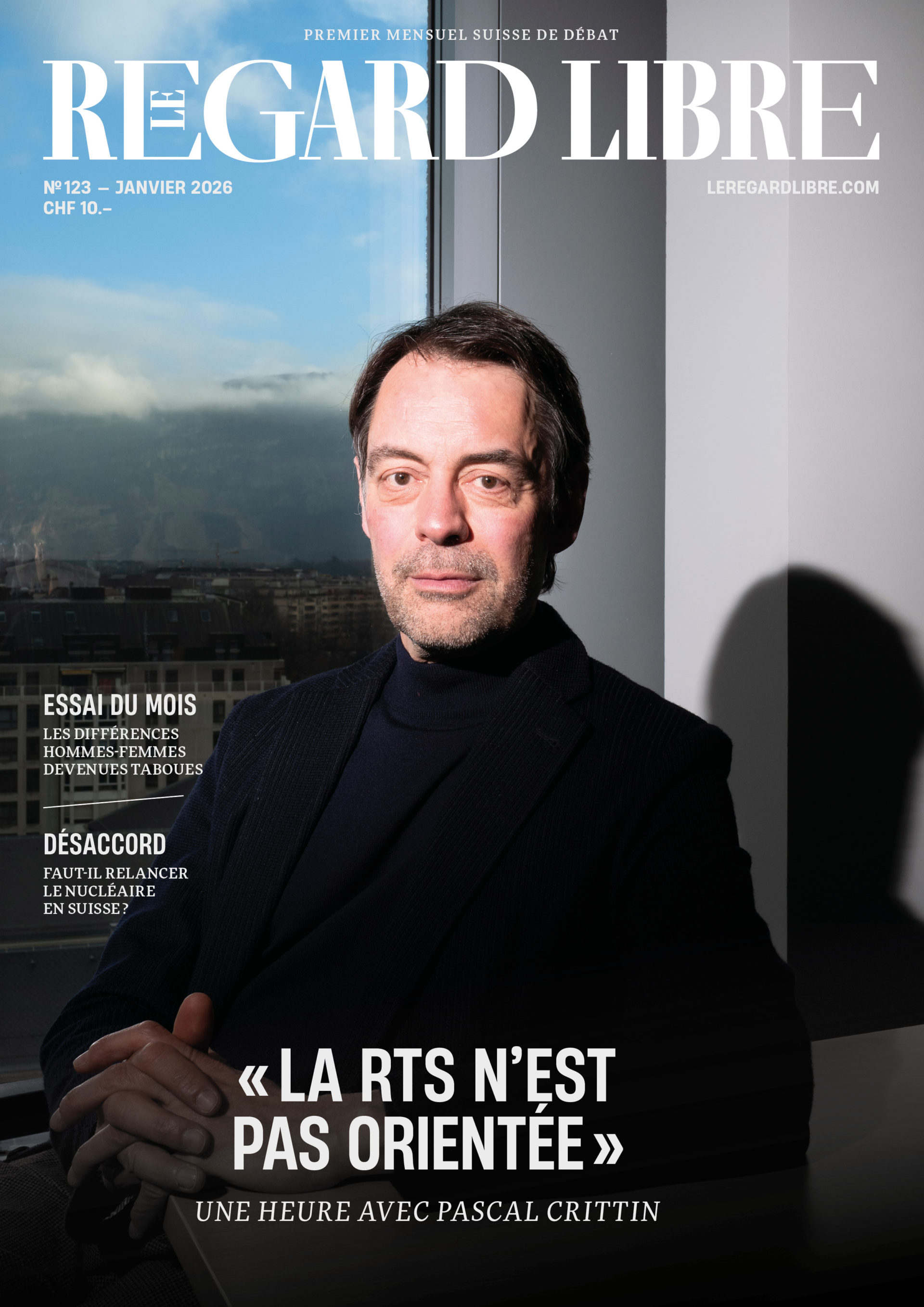






«Deflagration»: Serge Bimpage's prophecy

Tuesday's books - Jonas Follonier
It's an impressive experience to read Deflagration. Written by former French-speaking journalist Serge Bimpage, it tells the story of the eruption of a volcano in northern Switzerland, which leads to flooding... and widespread lockdown. The book has been accepted by publisher Michel Moret on January 6, 2020. It was written in the three years leading up to the pandemic. As the author notes in a disclaimer, not a single word has been changed or added to the original text. A stunning coincidence with the present, and above all a poignant, intelligent and moving story.
The story is original, to say the least. You had to have the idea, as they say. Serge Bimpage got the idea while sipping a glass of white wine on his terrace in Sicily. In front of him, the smoke of a volcano. «Was it the sun beating down hard, or the Malvasia wine? I looked at the volcano, and the clouds seemed to be growing and darkening: I was afraid for my country! A fear all the more irrational, of course, because there was no volcano, but strong enough to impose the metaphor. If we weren't careful, invisible perils threatened the tiny nation at the center of Europe.»
The novel is this metaphor. Using the image of a volcano erupting, it shows what would happen if the unprecedented, the unforeseen, the unthinkable and the undesirable were to erupt in a country like Switzerland, which often, too often, feels immune to all dangers and excesses. Yet it is already an excess not to feel concerned by adversity, and already a danger. Deflagration is also a novel about tragedy. Death, the injustice of nature, interconnectedness. In short, that which is beyond us. And this reality is brought to life in a very concrete and often funny way through the main character.
«The knights are alone. They're sinking into the night, like Corderey now. We don't know where they're going, where they're sleeping in this cold, but we do know they're not the type to throw themselves into the lake, oh no! Having stopped briefly in front of some stall, here the chestnut seller, with her big stinking wool sweater, they set off again with their heads held high, taking with them her smile and the vision of her generous breasts that suffice for their temporary sleep.»
This hero, as he would no doubt like to be called, is Julius Corderey, a university professor who is a bit of a recluse, a bit of a doughboy, but who shares with his colleagues - whom he despises - the quintessence of the uni prof: an oversized ego. Corderey is a man who drinks to his own health. His life consists of musings on the theme of his next best-selling essay (’All we had to do was unroll the ball. Recall our values. Dénoncer Schengen et en route pour le best-seller«), on how to charm his young assistants or counterparts, on what his colleagues will think of his outbursts on Swiss exceptionalism. In short, a guy who likes to use his power. But who's been dumped by his wife. And who receives a complaint from a student. The context of the book is a proud Switzerland. it's also #MeToo.
«He looked at his watch. It was only three o'clock. Two more to go, and the audience would be drinking in the words of these clowns.
Try a hand on his knee. It was dark in the back row, so no one would notice. But how would she react? Perhaps positively, as Ghislaine had confessed her fantasy of finding herself in such a situation... (editor's note: this is Consuela, another one).»
And the best thing about this story is that, just as the flood shakes the «Little Country», Corderey's accusation of harassment - which she is, because the plaintiff turns out to be a liar - delineates a «life before» and a «life after». In fact, the long novel is divided into three parts, «BEFORE», «DURING» and «AFTER». A further correspondence, obviously, with the pandemic we're going through and the vocabulary we've adopted, seemingly out of the blue, in everyday life. Covid, the world before, the world after, containment, quarantine... Even Macron's phrase is prophesied, with a character claiming that he and his fellow human beings are «like in wartime».
«Her old life. The dean presented it to her on a platter. With an apology from the dean's office, along with the promise of full powers to reshape the department, so what do you say?
Corderey remained silent. Was life returning to the way it was before a tsunami? No, of course not, the dean must have suspected as much. It would take time to restore his tarnished reputation. And he himself wasn't sure he'd ever be back to his old self again.»
When we say that literature tells the world more than any other medium, well, here we are. Read Deflagration will convince anyone not yet convinced of the power of novels. «Thought doesn't work miracles. [...] Art goes faster or deeper. It only makes you think by making you feel, love and admire,» writes André Comte-Sponville in L'inconsolable et autres impromptus, in the chapter on Beethoven. In other words, art anticipates thought. Serge Bimpage, it's official, had the intuition for the great event of the twenties, and even of the twenty-first century.th century.
Read also: The eternal return of novels
But which media in French-speaking Switzerland reported on it? So few! No doubt they prefer to invite people to do yoga with Emmanuel Carrère, rather than reflect with Serge Bimpage on the’exception Swiss, whose two meanings «singularity» and «prowess» still need to be explained, criticized and put into perspective... and what better way to do this than with a novel! The reader encounters things - a rifle, a chalet, borders... a syndic - that condense the great national debates, and witnesses the psychological evolution of a character, moving from cynicism to melancholy, from amoral unconsciousness to awareness of the tragic. With the idea of «not being the only one to be alone.» And he finally reads what is perhaps Bimpage's most incredible premonition:
«The Little Country was no longer God's darling. It was the opposite of what citizens had expected. And what had we expected? Anticipation! Condemned to anticipate everything, our Little Country excelled in anticipation, to the point where we had come to look down on things from such great heights that we no longer knew how to be down-to-earth.
And the higher the water rose, the less the country anticipated. The evil contaminated them all. Even the young people, anxious about nothing, began to question the elders, and when their questions met only with the desperate echo of helplessness, the blues eventually overwhelmed them too.»
Write to the author: jonas.follonier@leregardlibre.com

Serge Bimpage
Deflagration
Editions de l'Aire
2020
544 pages
-
 Le Regard Libre - Nº 67CHF10.00
 -
 Support subscriptionCHF200.00 / year
 -
Standard subscription (Switzerland)CHF100.00 / year
-
Digital subscriptionCHF50.00 / year
-
Youth passCHF25.00 / year

Vous aimerez aussi


 French
  German
  English
Laisser un commentaire