



Entering Kabul on kites
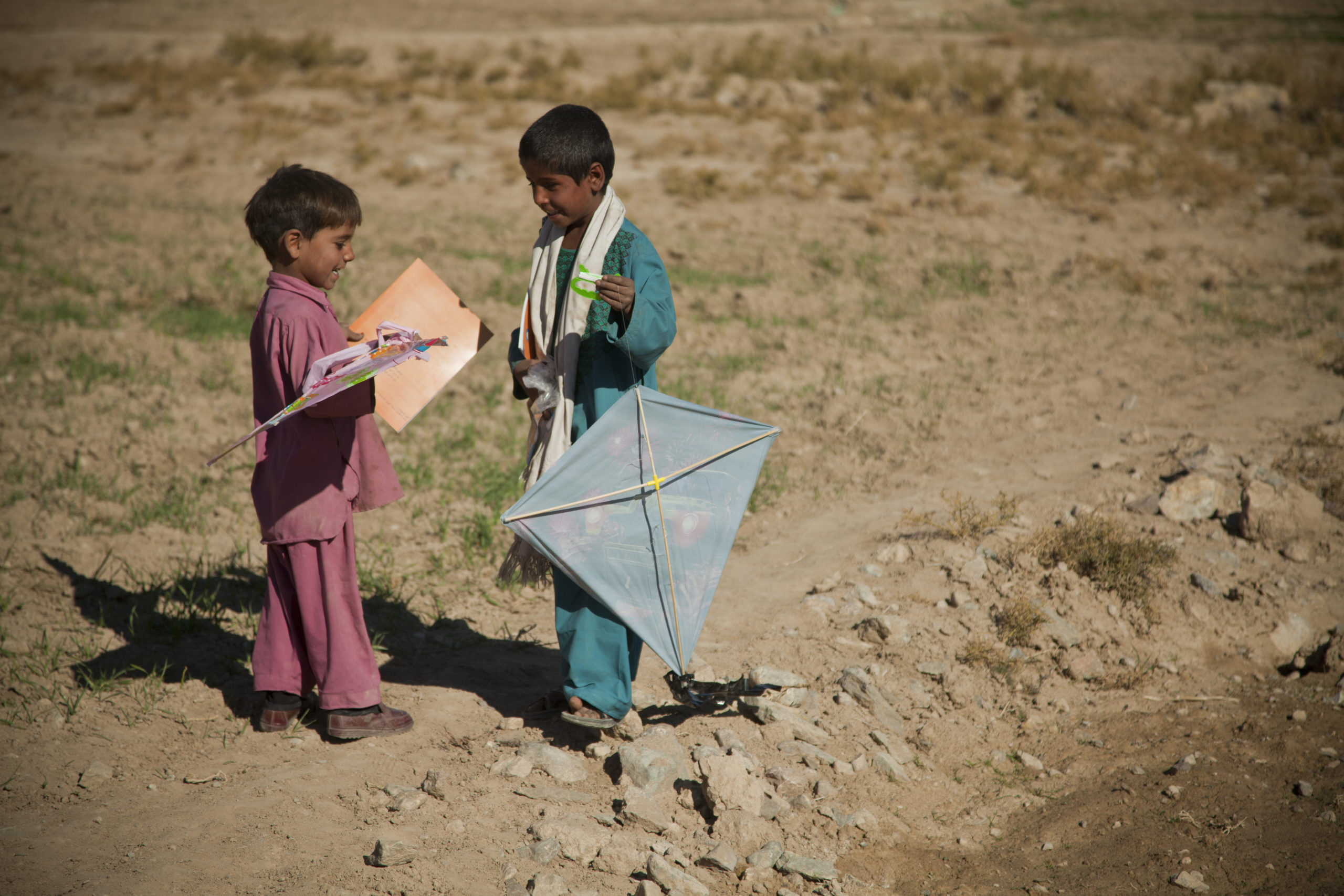
Children play with kites given to them by Afghan Local Police officers in a village in Farah province, Afghanistan, Dec. 9, 2012. (DoD photo by Sgt. Pete Thibodeau, U.S. Marine Corps/Released)
Tuesday's books - Diana-Alice Ramsauer
In Kabul Kites, the life and tragedy of Amir, a little boy from a middle-class family in Kabul, is an illuminating allegory of the war in Afghanistan. But make no mistake, it would be an exaggeration to call this a political book. What we have here is a carefully scripted novel that can be read - as its success testifies - on a chaise longue. All in all, an enjoyable book for the general public. What's in it for you? It may well awaken in those who read it some interest in a geopolitical history that is not yet over, and in which the West is still embroiled.
Amir, the main character, is a dreamy little boy from Afghanistan's majority Pashtun ethnic group. He plays all day with Hassan, the servant's son, a Hazara - a persecuted ethnic minority. Amir is a poet, which earns him a few looks of disdain from his father. His father would have preferred an upright, courageous son like Hassan, who wields a slingshot with brio. The two boys compete to please their father, a character who is well worth watching.
Driving his Ford Mustang through the streets of Kabul, he abhors religion. «I piss in the face of these monkeys imbued with their devotion», he declares one day, pouring himself a whisky. He reflects an Afghanistan that could be called «progressive». Afghanistan before the First World War, an Afghanistan that attracted European hippies, a rich and proud Afghanistan. But also an Afghanistan that forgot many of the more traditional parts of the country. An Afghanistan of growing dissatisfaction in the early 1970s.
From kites to war
The author, Khaled Hosseini, quickly makes it clear that a major event is about to take place, one that Amir will never forget. That winter of 1975 will mark his life forever. After a kite-fight, some children commit a cruel act. And Amir will have to live with this memory without knowing how to redeem himself. «Redeem» is a word that appears very early on in the book.
The author places this horror in close parallel with a succession of political events leading up to the war in 1979, when King Mohammad Zaher Shah was overthrown by his cousin and former Prime Minister Mohammad Daoud Khan, who established the republic with Soviet help. Before the first Islamic revolt broke out, the regime was once again undermined, tipping the country into a war between the two countries. moudjahidines (supported by the USA) and communists (supported by the USSR). The tragedy of the country is thus represented by the tragedy experienced by Amir in the depths of his being. A perfect example of a story that uses an individual destiny as a metaphor for a more global issue.
The boy, now a young man, and his father will have to flee this war. «For me, the United States represented a country where I could bury my memories,» Amir hopes. Of course, this will be completely illusory.
A monster of guilt
When a feeling runs through an entire work, it's no longer an exaggeration to consider it a character. This is the case here with guilt. Amir carries the burden of not having been able to help his friend Hassan when he needed it most. «Hassan] was wrong. There was a monster, grabbing him by the ankles and dragging him into the black depths of the lake. It was me. That was the night I became an insomniac.» Amir, a monster who cries for having been a coward as a child; an adult who mourns having been safe in the United States when his servants and friends were being slaughtered; a distraught human who regrets having closed his eyes when terrible deeds were unfolding in front of him.
To wash away his guilt, Amir will have to return to Afghanistan. From a historical point of view, at this point in the story the Communist regime has been overthrown and the Soviet soldiers are leaving (in 1989). The «winners», i.e. the moudjahidines, They then engaged in a murderous internal struggle. The country fell into civil war.
Superman in Hollywood
It's at this point, when Amir returns to Afghanistan, that the novel certainly loses its subtlety. From an anti-hero, mirroring the fragility of humanity in times of war, Amir becomes an American-style superhero. Perhaps the metaphor has been stretched to its extreme: Amir, touching California soil, becomes what America has always tried to be: the saviour of Afghanistan, forgetting that no country has superpowers, even when faced with the «axis of evil».
As a result, after Amir had allowed terrible acts to be committed in his home country, just as America had financed massacres on the other side of the world, he returned, in the aftermath of September 11, 2001, to wash away his sins. He finds Kabul devastated by the Taliban. Fighters of faith at first, but welcomed with open arms by the Afghans, as one of Amir's old friends explains.
«When the Taliban landed and pushed back the Alliance (editor's note: the moudjahidines) outside Kabul, I danced on this street," confessed Rahim Khan. And, believe me, I wasn't the only one. In the districts of Chaman and Deh-Mazang, people rejoiced and came out of their houses to welcome them, climbing over their tanks and taking photos with them. Everyone was so tired of the constant fighting, the missiles, the gunfire, the explosions. They'd had more than enough of Gulbuddin and his men shooting at anything that moved. The Alliance caused more damage in Kabul than the Shorawi (editor's note: the Soviets).»
Good guys and bad guys
But it's a Taliban that Amir will be fighting to heal his guilty conscience. A half-German, half-Afghan Taliban, who wears John Lennon-style glasses, but above all a Taliban who praises Hitler's ideology. Probably a way of underlining that there are good guys and bad guys in this whole story.
Kabul Kites is indeed a book that attempts to show the complexity of the world. Its bittersweet ending bears witness to this. Yet it does not resist falling into certain clichés. And that's what makes this not a politically engaged novel, but a mainstream tale. In any case, it remains an excellent gateway into Afghan history. And those who have turned the last few pages may well be tempted to go beyond the entrance hall to find out more. We can only encourage them to do so.
Write to the author: daramsauer@gmail.com
Photo credit: © Wikimedia Commons/U.S. Department of Defense Current Photos
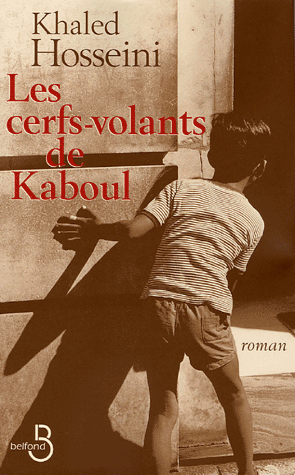
Khaled Hosseini
Kabul Kites
Translation by Valérie Bourgeois
Editions Belfond
2005
383 pages
You'll also like


 French
  German
  English
Leave a comment