




Matthieu Corpataux's poetic sweets

Tuesday's books - Ivan Garcia
With Sugars, Matthieu Corpataux, a writer from Fribourg, has written a playful and mischievous first collection of poems. A gentle entry into the great family of literature. romande.
What's better than sugar? What could be sweeter than poetry? On the face of it, mixing the two should satisfy me and erase the bad impressions of my poetry classes, between Mallarmean hermeticism and Baudelairean depression. To be seen. So it's with a great deal of trepidation and a lot of bad memories that I set out to read Sugars by Matthieu Corpataux. Matthieu Corpataux, a doctoral student in French literature at the University of Fribourg and founder of the literary magazine The Epistle, as well as President of Textures[1], is an emerging figure on the literary scene in French-speaking Switzerland. This first publication in the «Métaphores» collection from éditions de l'Aire, a collection reserved for the poetic genre, gives the Fribourg-born poet the opportunity to give us a «taste» of subtle, narrative poetry, without (too much) literary pretension. But let's have a closer look, shall we?
«My poems, like sweets?
Sweets, soft toffees?
Mous? Mockery sticks?
No. Sugars, yes, which attack
The white teeth that attack
Nice civilians, wealthy gums
Slowly attacking at the root
With the help of the tongue, that infinite muscle.»
This is the poem on which the collection opens. There are forty-two poems in all. The author is a proponent of free verse, i.e. a form of verse that is not constrained by a regular metrical structure, and varies the structures of his poems as he goes along. Readers will therefore find no poems constructed entirely of alexandrines or octosyllables, or following well-known poetic forms such as the ballad. Which is just as well. But then, how is this poetry?
About tools and style
The poet combines his metrical freedom with a continuous play on syntactic verse structures. He dislocates lines and makes use of enjambments, for example, by rejecting a line fragment at the beginning of the following line, as in «[...] qui attaquent / Les Blanches dents», or by anticipating the transition between two lines to highlight an element, as in «[...] qui attaquent / Les civils gentils», to create parallels between his lines, or to underline certain elements of his poems. His range of stylistic tools is complemented by other poetic devices such as anaphora (repetitions and repetitions of words or rhythms, such as «[...] qui attaquent / Les civils gentils»), which recurs three times in a row.] qui attaquent«, which appears three times in the poem), rich rhymes (»sucreries / railleries«) and poor rhymes (»nantis / infini«), as well as various sonority effects, such as the poem's »- en/an« assonance (»Blanches dents / gentils / gencives / nantis / lentement / langue").
The most interesting thing about this collection is the dislocation of syntax achieved by the poet, who often emancipates himself from all punctuation. As if to create a continuous flow. Even though punctuation is still present in other poems in the book, to give rhythm and mark caesuras. Sugars is mainly made up of short poems, and occasionally some longer ones that the reader can read linearly or in fragments. They oscillate between poetry, autobiography and even philosophy.
Grains of poetry
From the outset, the lyrical subject provides a key to reading this poem 0, which the reader can follow throughout the work: his «Sugars» are corrosive, they «attack the kindly civilians, the affluent gums», whose phonetic and rhythmic inversion we note in passing. The writer's skill lies in the fact that the reader can choose how he or she wants to savor his or her work. Sugars. Indeed, the book weaves an atmosphere linked to the world of childhood that can touch us all. It's all about memories, opening up a parade that includes a school teacher, love, a soccer match, injuries, games consoles, cafés, and a farandole of other themes, all of which have in common that they were, at one time or another, part of the life of the subject expressing themselves through these poems (that could be you, by the way).
The word that comes up most often - and on which Matthieu Corpataux plays light-heartedly - is grain. Depending on the poet's use and the reader's interpretation, this polysemic term designates memory, sand («Des Sahara entiers»), or «sugar grain». Poem 39 extends this polysemy to include the expression «grain of madness»:
«At eighteen
What madness
Takes me from
Create a magazine?
Circumstances again
In memory but the grain
I don't know where
He has come.»
As we said earlier, the poet dislocates syntax and punctuation. The absence of the latter leaves the reader free to focus on the element that most «speaks» to him or her within the text. There seems to me to be a certain desire to imitate oral language (or the flow of thoughts) in this poem 39, which lets the lines follow one another, without punctuating them.
Coffee and games
In this poem (and others in the collection), there are probably some autobiographical allusions by a lyrical subject who, as in a kind of confession, invites the reader to share a few «grains» of his existence. Sometimes dedicated to well-known personalities such as Laurent Cennamo, a writer from the French-speaking part of Switzerland. Sometimes dedicated to people closer to the author, such as «Camille S.», or «To you at last». Memories, impressions, moments dear to his heart. To express all this, the poet mixes different typographies in certain poems, or plays on sonorities. Remarkably, poem number 36 is a magnificent calligram on the subject of the black hole. A wonderful exercise in circular reading that makes us realize the power of words and their meaning. A personal favorite is poem no. 20, which, with its aphoristic airs, brings a smile to the face and brings home many truths:
«From the first coffee
Despite thousands of other
A bitter taste remains».»
Sugars is read in the company of a good cup of coffee. Here and there, we pick up a poem, two, three, ten... and meditate, between each granule, on what we are given to see, smell and taste. For our taste, the longer poems are less striking than the shorter ones. The charm of the collection lies in the author's playful way of breaking down syntax to create effects, or playing on the thematic richness of the word «grain» to create a lively, pleasing universe. A bit like a child or an adult contemplating a cup of coffee with pleasure.
Sweet constellation
There are some curious poems in this collection. But one of the most intriguing is number 33. And why is that? A hitherto unexpected reference enters the poetic-gustatory scene:
«I searched through the telescope in so many books
Constellations and cosmos to understand them:
Our mechanisms, our disasters. In summer
2010 - at last - under the Perseid rains,
I discovered March de Fritz Zorn.»
Deux isotopies se voient, en quelques lignes, mêlées: le monde astral et le monde des livres. Tout cela, cristallisé à la fin de ce poème, par la figure de Fritz Zorn. «Je découvris March de Fritz Zorn.» Tiens, tiens, tiens, Fritz Zorn. Pseudonyme utilisé par Fritz Angst, écrivain suisse alémanique, à qui l’on doit l’écriture de March, un livre autobiographique au sein duquel l’auteur dénonce son éducation bourgeoise et considère que son cancer est lié à cette mauvaise éducation. Révélation des astres pour le poète? Peut-être bien.
En tout cas, avec ce poème numéro 33, l’auteur réconcilie, en un seul vers «Je découvris March de Fritz Zorn», l’enfer et les cieux. Les images déployées par le texte sont puissantes; elles résonnent en chacun pour donner vie à un imaginaire enfoui. Le pouvoir de la littérature est tel qu’il peut concilier les deux opposés: le télescope et les livres. Les cosmos et les désastres. L’été et la pluie. Les Perséides et March. Du sucre et de la poésie, voilà la constellation de Matthieu Corpataux.
[1] Textures – Rencontres littéraires est le nouveau nom du Salon du livre romand de Fribourg qui se tiendra du 23 au 25 avril 2021 à Fribourg.
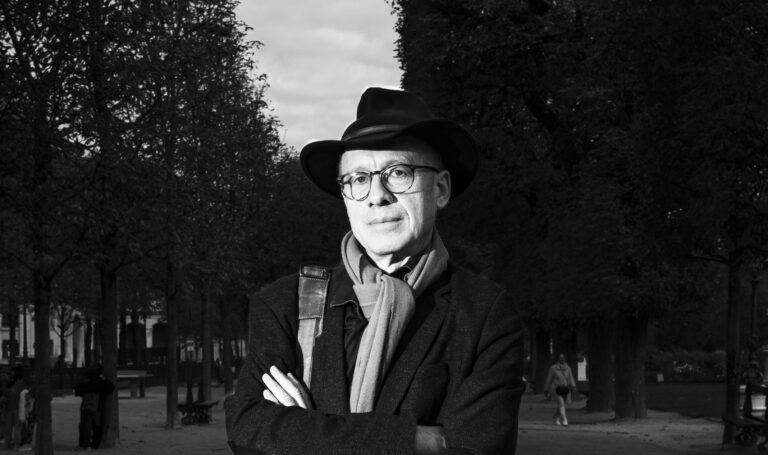
Photo credit: © Ivan Garcia for Le Regard Libre
Write to the author: ivan.garcia@leregardlibre.com
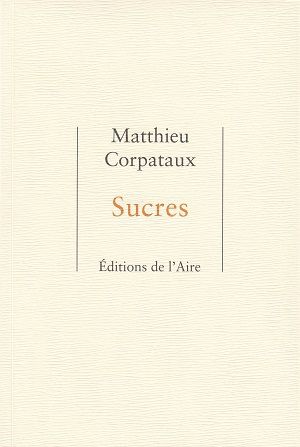
Matthieu Corpataux
Sugars
Editions de l'Aire
2020
56 pages

You'll also like



 French
  German
  English
Leave a comment