




Marc Lamunière, 100 years and as many philosophical lessons

Le Regard Libre N° 73 - Jonas Follonier
He was Chairman and CEO of Société de la Feuille d'avis de Lausanne et des Imprimeries Réunies SA, and then of Edipresse, the company founded by Paul Allenspach, the publisher of The Notice Leaf of Lausanne, now 24 heures. Thriller author Sharon's skin (2000) under the pseudonym Ken Wood, he previously wrote under another pseudonym, Marc Lacaze. Under this identity, he published short stories, columns in Le Nouveau Quotidien - now Le Temps after its merger with Le Journal de Genève - by Jacques Pilet and an anthology, Indian dessert (1996). But it's under his real name that Marc Lamunière, a leading figure in the French-language press of the 20th century, has been able to make his mark.th century, has just published a book celebrating the hundred candles it blew out in early 2021. Conceived as a series of interviews with journalist Jacques Poget, The Garden of Stings. A centenarian's view of his life, the century that has passed and the days that remain offers us a veritable philosophy of life, inspired by his own reading. Interview.
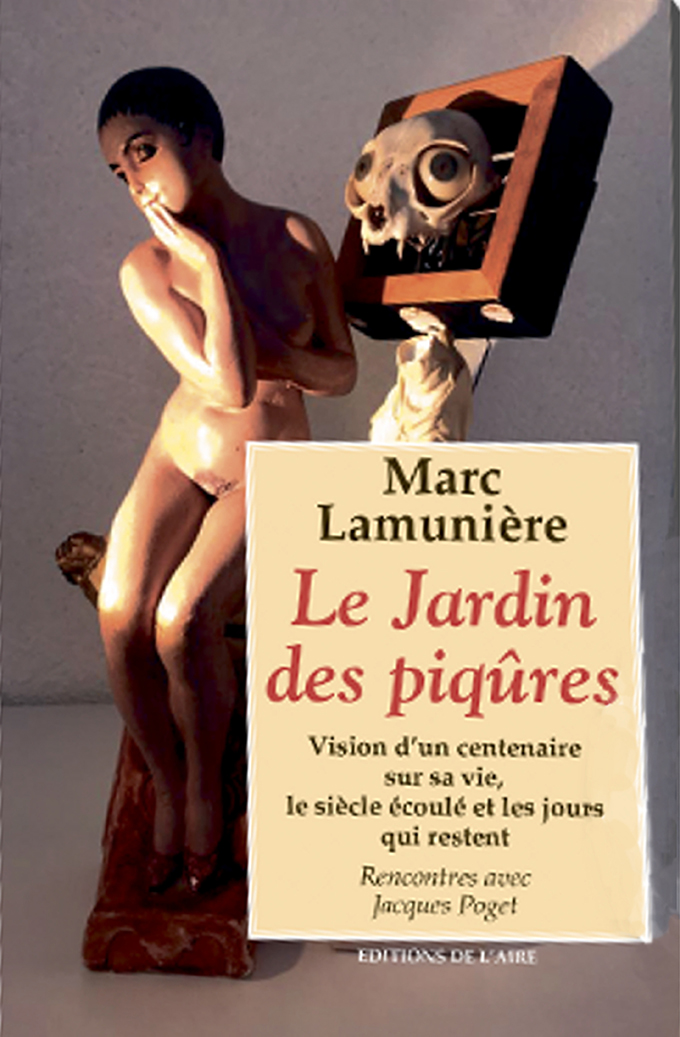
«We never stop to think that, at any moment, we could fall into nothingness.» This sentence is not taken from the book that Marc Lamunière has just published with Editions de l’Aire, The Garden of Stings, but from our interview at her apartment. It’s the middle of March. Her assistant, Carla Rua, opens the door for my colleague, photographer Indra Crittin, and me. In fact, it was Carla Rua who handled the book’s digital aspects, as acknowledged in the acknowledgments. She points out to me that the objects featured on the book’s cover are to my right as I enter, placed on a small sideboard.
Marc Lamunière, for his part, is on the left, sitting in a yellow-orange armchair in the living room. He has a mischievous, commanding, and lucid gaze—or perhaps all three at once; I’m not sure yet. I’m immediately struck by his imposing figure and commanding presence. A hundred years old, yet his mind is still sharp, a brilliance that shines through his body.
Aesthetics
He speaks of his own body in his book of conversations with Jacques Poget: «At ninety-two, I was truly the embodiment of the person I had always wanted to become. At that time, I sincerely believe people thought I was twenty to thirty years younger.» Recalling the rest of the quote when I read it to him, he adds: «This desire to stay in good shape undoubtedly stems from a certain form of narcissism. Jean-Pierre Moulin (the journalist from Vaud) once called me an ‘intelligent narcissist.‘ I don’t know if I’ve remained intelligent, but I’m less narcissistic.’ If proof of his intelligence were needed, here it is.
But Marc Lamunière first explored aesthetics through newspaper layout. «As a media executive, I set specific requirements for visuals. I’m very particular about beautiful typography.» In fact, he is the one responsible for the «V» in the logo of the New Daily or the special image from the Morning (old design) – «It broke my heart when they changed it.» Marc Lamunière acknowledges that he «was born with some talent.» But he also owes this passion to his father’s side of the family, where people have been miniaturists for generations.
The conversation turns back to his appearance. «I was inspired by characters from American movies. I really liked the idea of trying to look like them. I’ve almost succeeded—I don’t know why.» That’s a nice way of putting it for someone who was eliminated in the second round of the competition to find Switzerland’s best athlete.
Secondary School
Sarcasm. Marc Lamunière is so fond of it that he devoted an entire chapter to it in his interviews with Jacques Poget. To understand Marc Lamunière’s relationship with sarcastic humor, we have to go back to his childhood. «I came from a family that was a little too serious. My father was from Geneva and had a Protestant upbringing. He made life seem more burdened with responsibilities than anything else. As for my mother, she was too anxious.» That’s when the free-spirited world of jazz came into his life. «It was through jazz that I began to free myself from a certain difficulty in being.» A counterpoint, in short—a dissonance that finds its counterpart in humor with a second degree.
«It’s a way of testing people. It’s a subtle hint that lets you figure out who ‘it’s going to be difficult with.‘’ This practice greatly puzzled those around him, who weren’t prepared for it. Yet, ’if you don’t have the swing, you’ve got nothing,» as pianist Duke Ellington put it—a phrase Marc Lamunière likes to repeat. Of course, he does so with what’s barely more than a hint of a smile.

Journalists
The conversation then turns to journalism—since he has, in a sense, devoted his life to it—and we talk with a view to a profile to be published in Le Regard Libre and on top of that, The Garden of Stings It, too, took the form of a question-and-answer session with a professional in the field. «I enjoyed spending time with journalists more than I did with the Rotary Club, from which I was kicked out very quickly,» says the former publisher.
For Marc Lamunière, a journalist is, in essence, the same as a citizen—namely, someone whose role is to challenge preconceived notions and whose tool is curiosity. Needless to say, people fulfill this mission to varying degrees. But Marc Lamunière still believes in it. He is what can rightly be called—despite the term’s all-too-frequent and often questionable use—a humanist.
Philosophy
It’s no surprise, then, that when asked about his favorite thinker, the former media executive immediately names Montaigne. «What stands out about this author is his freedom and his modernism. Montaigne had an utterly innovative and timeless vision of religion, the education of children, happiness…» Among Marc Lamunière’s philosophical influences, Buddhism also ranks near the top. More than just a way of thinking, it’s a practice—a sort of compass he discovered «too late.» Its main lesson: the present moment is the only thing we truly experience and the only eternity. «This idea gives me comfort. It is the very foundation of meditation, which is the same everywhere: it’s about seeing things as they are and staying in the present, without distorting it.»
This is how Marc Lamunière finds a certain sense of serenity. «What appeals to me about Buddhism is that it isn’t a religion. Buddha said, ‘Forget me, but spread my teachings.‘ Obviously, the opposite happened. Religion sprang up like a mushroom—I wouldn’t say poisonous, but at least strange—consisting solely of rituals.’ Lamunière goes on to point out that Buddhism had a profound influence on ancient Greek thought, thanks to the contacts between the two civilizations. ’Marcus Aurelius, Epictetus, and Epicurus were deeply influenced by it.» That’s no small thing.
Life
Finally, when asked which events in his life have left a lasting impression on him, Marc Lamunière first mentions his wife’s illness, which he personally cared for over the course of several years. In fact, every chapter of his book features a photograph showing one of the decorative arrangements that accompanied «Pomme’s» (her nickname), which the devoted husband wanted to brighten by taking those few minutes to prepare each morning before leaving for a long day at work.
Other moments that left a lasting impression on him were those when he came close to death. «I’ve nearly died fourteen times,» he says, looking amused, «but I don’t remember all the details, because that’s a lot.» One anecdote worth noting—told in the book—is that of Marc Lamunière, who finds himself trapped on a plane that refuses to fly in the right direction.
His face always wore that deadpan expression. «I have a natural mask that leaves room for all kinds of interpretations. This natural impassivity has actually served me well: I was able to hide my incompetence, and then hide other things, which meant my competitors didn’t catch on until it was too late.» That’s it—Marc Lamunière flashes a smile, and not just any smile. He then invites us into the next room, where he sits down at the drum set. «I play every day. When I put down my drumsticks, it’ll be time for me to go.» After a five-minute session that leaves us speechless, it’s time to wrap things up. «See you soon,» he smiles.
Write to the author: [email protected]
Marc Lamunière
The Garden of Stings: A Centenarian’s Reflections on His Life, the Past Century, and the Days Ahead; Conversations with Jacques Poget
Editions de l'Aire
2021
224 pages
Photo credits: © Indra Crittin for Le Regard Libre

You'll also like




 French
  German
  English
Leave a comment