




Take a walk in the woods while the mystery is in full swing

With poetry and accuracy, Alexandre Voisard reveals the presence of the forest and the river in a short, lightning-quick book whose characters move us as much as they remind us of our own human fragility.
There are authors like Alain Fournier, Harper Lee, Lautréamont or Emily Brontë, and then there are the on the other hand, there are others, whose pens are constantly flowing, like Alexandre Voisard, whose thirty-eighth book is published here. We innocently think that a writer who has published so much would have gone round and round emptied his memories, exhausted the reservoir of his intuition or dried up the source of his dreams. in short, that he wouldn't have much left to say. No more log to put back on the fire. No more stories to tell. But no, that's wrong thinking, for here Children in the trees gives us a fresh, pulsating account of a nature trodden by children in the land of Ajoie. Which proves that for some for some writers, there's always something to write about, memories to disguise and between the lines of the blank page.
The book's only setting is is represented by the forest, or rather by the world of the forest, with everything forest, with everything that makes it up, down to «the smallest interstice of bark». And also by the river, the Allaine, which links Porrentruy to Belfort without the Franco-Swiss border:
«The Allaine whispers, hums and sings in its bed, sometimes lingering or, on the contrary, bursting into spirited scales.»
The forest makes up the first part of the story, and the river the second. The characters are few, and the focus is on the children: Jacotte, Coco, Ramon and Rosine, who are never far from their father, who teaches them to recognize nature's wonders on Sunday walks. He lectures them on the importance of naming these wonders, like flowers for example:
«The important thing is to have a name. Something you can't name, you're entitled to ignore, though turning your back on it just long enough to feel embarrassed. Remember that a flower without a name is like a child without a father.»
The importance of naming of naming flowers goes hand in hand with the importance of pronouncing them, those flower names that fit them like a glove. Especially when you don't pronounced in Latin, as Maeterlinck said in Le Double Jardin:
«Call before you the Daisy, the Violet, the Bluet and the Poppy: the name is the flower itself. What a marvel, for example, is this sort of cry and crest of light and joy «Poppy!» to designate the scarlet flower that scholars overwhelm with this barbaric title: Papaver rhoeas!»
But let's leave it belongs to the reader. Or let's step out of the forest for a moment to better discern its halftones and its periphery in the landscape. The tour de force of Alexandre Voisard's writing, poetic, clear and flourishing, is to make us appreciate nature in its entirety. Through writing, without but by feeling it to the very depths of our being. Like a walk in the forest, when you know what makes an aspen an aspen, branches branches, smooth bark, rounded leaves and long stalks, but you're still but you're still stunned by the wind's chatter as it shakes the leaves of this aspen on a sunny afternoon. This mystery of nature is at the heart of of this book:
«Is everything, from what hides, buries, simulates, or oozes explicable?»
A mystery that conceals both life and death, that amuses children on a stroll but also kills, drowns and engulfs, as when the Aillaine violently sweeps away little Marco. And here we are brought back to our own human frailty, the fragility of not understanding everything, of weeping with joy and dying. As a reader, we find ourselves in the shoes of little Marco's drowned father, a victim of chance. Here we are as adults, full of fear. Here we are, sanguine, seething, searching among the living for culprits, the better to accept that there is a cause for death. A logic, a reason, an explanation, an answer to bad luck:
«Why don't these highly-paid fisheries wardens go and see what the children are risking on the dykes?»
After being «tenderized like every spring with the arrival of the swallows», and after being stripped like the mourning autumn tree, this weeping father could thus embody, once Alexandre Voisard's book is closed, the buds have become fruit and the children have become adults, the last tercet of the poem Sadness by Alfred de Musset, which puts our bewilderment on hold for two or three seconds, and pays homage to the truth without research or detours:
«God speaks, he must be answered/The only good I have left in the world/Est to have wept sometime.»
Write to the author: arthur.billerey@leregardlibre.com
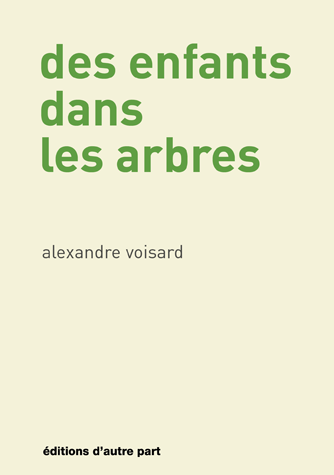
Alexandre Voisard
Children in the trees
Editions d'Autre Part
2019
100 pages
You'll also like


 French
  German
  English
Leave a comment