


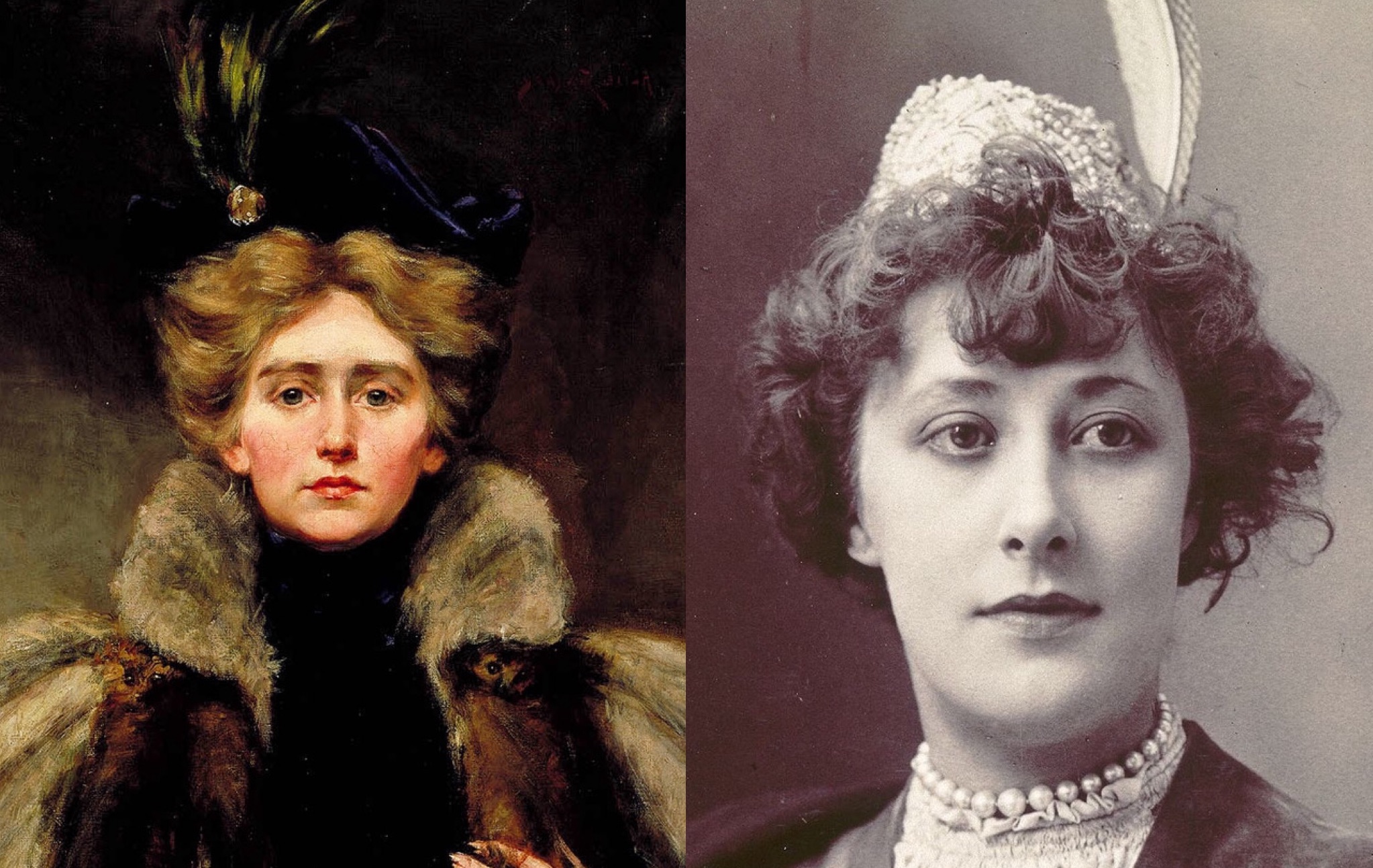
The last year of the 19th centuryth century, a passion was born between two women in the French capital. And not just any women: one a wealthy heiress from across the Atlantic, the other a courtesan, among the most famous of the age. And since this amorous fire found its way into letters exchanged between the two ladies, what a pleasure to see them published by Gallimard over a century later.
Anne-Marie Chassaigne, whose stage name is Liane de Pougy, is a dancer. She leads the life of a «demi-mondaine», that is, a woman maintained by a wealthy Parisian; a horizontal life, in short. After freeing herself from her first husband, who shot her in the back following an infidelity, she pursues parallel loves, with both men and women. A self-confessed bisexual, if such labels have any meaning at all, she chooses the most prestigious lovers from among this hypothetical public. Called «the prettiest woman of the century» by Edmond de Goncourt, her charm, tinged with Spanish origins, is certain - more than certain.
Read also | Happy days, our series on the correspondence between Corinna Bille and Maurice Chappaz
This beauty, so commented on by turn-of-the-century authors and the press alike, does not leave a new, discreet admirer, Natalie Clifford Barney, indifferent. Natalie is a well-to-do twenty-three-year-old American who has just arrived in Paris and appears disguised as a Florentine valet at the courtesan's doorstep. We've seen a more conventional opening. Surprisingly or not, it works. Liane de Pougy succumbs to the charms of the young damsel's Sapphic desires. It's the start of a bonfire. The daring Natalie becomes her «very own lover».
Two foreigners
The most precious thing about this love is the way the two women felt and expressed it. These famous letters, collected under the title «Love correspondence». Beyond the singular and thrilling romance, the literary fiber of this collection is indeed there. If the theorists of ancient Rome had already racked their brains to determine the legitimacy of the epistolary genre and the point at which a letter becomes literary, there's no doubt about it here, insofar as Natalie Clifford Barney's vocation as a poet and novelist is already within her, as she would later become. Although Liane de Pougy responds with words that also touch the reader, it has to be said that her young lover has much more style.
«I'm a stranger to you, but you're my beloved because - and keep my secret well - on evenings when you're alone with sleep I ride on a moonbeam (the steeds of my distant country) that leads me in haste to the prettiest flower in the world.»
Love is strange in that it binds two strangers together. This is exactly what this young lady, who everyone would love to have as a sweetheart, feels. Contrary to what you hear at dinner parties, loving each other isn't about getting to know each other. It's about learning to live with the fact that the more you know the other person, the less you know them. In other words, love and misunderstanding have been married since the dawn of time. Hence the sometimes pleasurable nature of the unattainable. Especially the kind of inaccessible that can one day become accessible. Liane de Pougy is desired by Natalie Clifford Barney simply because she is so far away, so high up. And yet...
«Yet you exist, for it was you who wrote me these letters, and if you exist there is only one path for me in life: the path that leads my kiss to your mouth!»
Natalie Clifford Barney uses her letters to Liane de Pougy to take us into the depths of her intimacy with high-flying reflections. Her missives are philosophical and grounded. They remind us that the paradox of love is the paradox of what is fundamentally one. travelthe road to the destination, is the real destination. But this road is for something. And this something, the destination, seems to break the magic of the journey as soon as it is reached. But the discovery of a new land, virgin or otherwise, can and must follow. That's what love is. That's what life is all about.
A life of court rather than a life of love
«I almost hope that when I see you, I'll forget you; then I can continue my monotonous chant: “She doesn't understand and I'm passing”. I'm looking for the elusive? Too bad or too good, I'll never have the sadness of realizing my ideal, so maybe I'll give up idealizing reality!»
The mutual discovery of these two women will first unfold in the most flamboyant of passions. They listen to each other fall asleep. They wallow in their desires. They'll love each other to death. They'll suck their souls dry. Alas, this is what had to happen to a couple so fused and conditioned by the beauty of secrecy and the originality of their spiritual, sensual and sexual lovemaking. The depression of the descent follows the illusions of a fleeting drug. Liane de Pougy won't respond to her lover's emancipatory calls, and will remain in her ridiculous aristocratic world, a world that has in common with love its ephemeral nature, but without its simple, true side.
But Natalie, who sleeps with the roses Liane didn't give her, isn't going to be discouraged. She'll have one love affair after another, creating a life of many romps and earning herself the name of Amazon. And because she was a young woman at heart right up to her death - unlike the Emma Bovary that Liane de Pougy was from birth - she could do whatever she wanted with this story, which, even having been what it was, has been. And just as Liane herself kept a grandiose memory of this one-year love affair, which she would later describe as having been her «greatest sin», these love letters will have found their fullest reality with their publication in 2019 by Editions Gallimard, and upset readers who are by no means lesbians.
«When are you coming back? Ah, but I forget that it shouldn't matter to me anymore. Adieu Liane, since you force me to the echo of a meaningless word when one feels in oneself a goodbye forced by so many memories. But this can happen far away and I only have to evoke you to find you again!»
My love, we'll meet again.
Write to the author: jonas.follonier@leregardlibre.com

Natalie Clifford Barney and Liane de Pougy
Love correspondence
Gallimard
2019
368 pages
 French
  German
  English
1 comment
[...] Read also: When lesbian passion becomes epistolary [...]