


Le Regard Libre N° 21 - Jonas Follonier
Silence is gradually disappearing from our world. Although I hate «c'était mieux avant» (it was better before), nostalgia doesn't bother me: when it's justified, it's the most beautiful feeling there is. And so it is with my regret for silence, man's friend that will soon be a distant memory.
We could say that silence is to noise what holes are to matter. There are currently fascinating discussions in philosophy institutes about whether holes exist or not. This metaphysical question requires much more than an article. The difficulty is obvious: holes seem to be nothingness, the absence of matter... in other words, nothing. How could they be anything at all? Silence, on the other hand, certainly exists.
What does it consist of? That's a question we're not going to answer. Once again, such an ontology would be out of place here, as it requires so many lines. Let's try, however, to consider not what silence consists of, but what it refers to, or if you prefer, what it evokes, what makes it interesting. «Man is the measure of all things», as the other said: so let's consider silence... in relation to man.
First of all, as silly as it may sound, silence is rooted in the night, whereas restlessness is the hallmark of the day. The night, of course, is not always calm, it can even be extremely restless, and a Sunday can be stiflingly dull. Quite simply, for a long time, and even now in general, human beings have been active during the day, only to rest in bed. The silence of the night gives way to an inner life.
And if silence is becoming increasingly rare, it's perhaps because the inner life no longer means much in our post-cultural society. Post-cultural, in the sense that frequenting literary texts is no longer on the menu of our existence, nor is the admiration of our teachers or personal reflections other than «I love yoga!.
We could define the inner life as a dialogue, intimate and rigorous, with ourselves, but also with the dead. And with good reason: daytime, the seat of work and leisure, brings us into contact with living people: colleagues, family, friends, acquaintances, strangers and so on. We converse with them through the spoken word. With the dead, on the other hand, we can only speak in silence.
Silence, then, is an environment that allows us to draw inspiration from lost personalities, to remember a departed loved one or to laugh at a moment from the past. Noise, on the other hand, constantly brings us back to the present. A present that means absolutely nothing, because like elevator music, it becomes nothing more than an unbearable flow, a flow that tires us and makes us hate life.
To love life, and in particular the future, which is the most important time because it is the time of our freedom, confrontation with the past is essential, and it requires silence. Noise, which conveys temporal horizontality and is the voice of the body, must find its balance with silence, which conveys temporal verticality and is the voice of the soul. Which brings us to the question of music.
In fact, isn't music one of the purest expressions of the soul? Whether composed, listened to or played, music is a privileged experience which, like speech and writing, always emanates from silence. So we shouldn't set music against silence, but rather recognize their conjugal relationship. It's often in solitary places that ideas for projects come to me, and it's often during the night that the best artists find inspiration... All this is not the result of chance, but shows that music and the inner life in general are opposed to noise and are rooted in silence. In short, «asceticism could well be the secret of creators», as the title suggests. Le Temps a few weeks ago.
People are becoming less accustomed to silence, but that doesn't mean they like noise. Background music, which is gradually invading all our public places such as restaurants and stores, is the subject of more and more complaints. But let's not fall into the trap of emotion. Our praise of silence should not lead us to wage war against noise. On the contrary, we need to «love it better», so that we can also love its opposite, namely that famous silence.
How can we love noise better? By giving it back its rightful place. The sound of bells announcing the hour in the countryside soothes, while the noise of roadworks irritates. Why is this? Because the former succeeds silence, while the latter succeeds itself. Noise has become incessant. Let's try to imagine a moment in our day when no sound can be heard; there isn't any. This omnipotence of the sound flux, which is obviously linked to urbanization and growing demographics, even has repercussions on our own psychology: I feel as if I'm constantly playing music, never feeling strong enough to clear my head and settle down, quietly, in a bed of silence.
So let's rediscover the taste for silence, that conditioning that has become a luxury! Faced with the «undermining of the eye that looks», let's sympathize with the «overmining of the ear that doesn't listen», to use Jean-Michel Delacomptée's expression.
Write to the author: jonas.follonier@leregardlibre.com
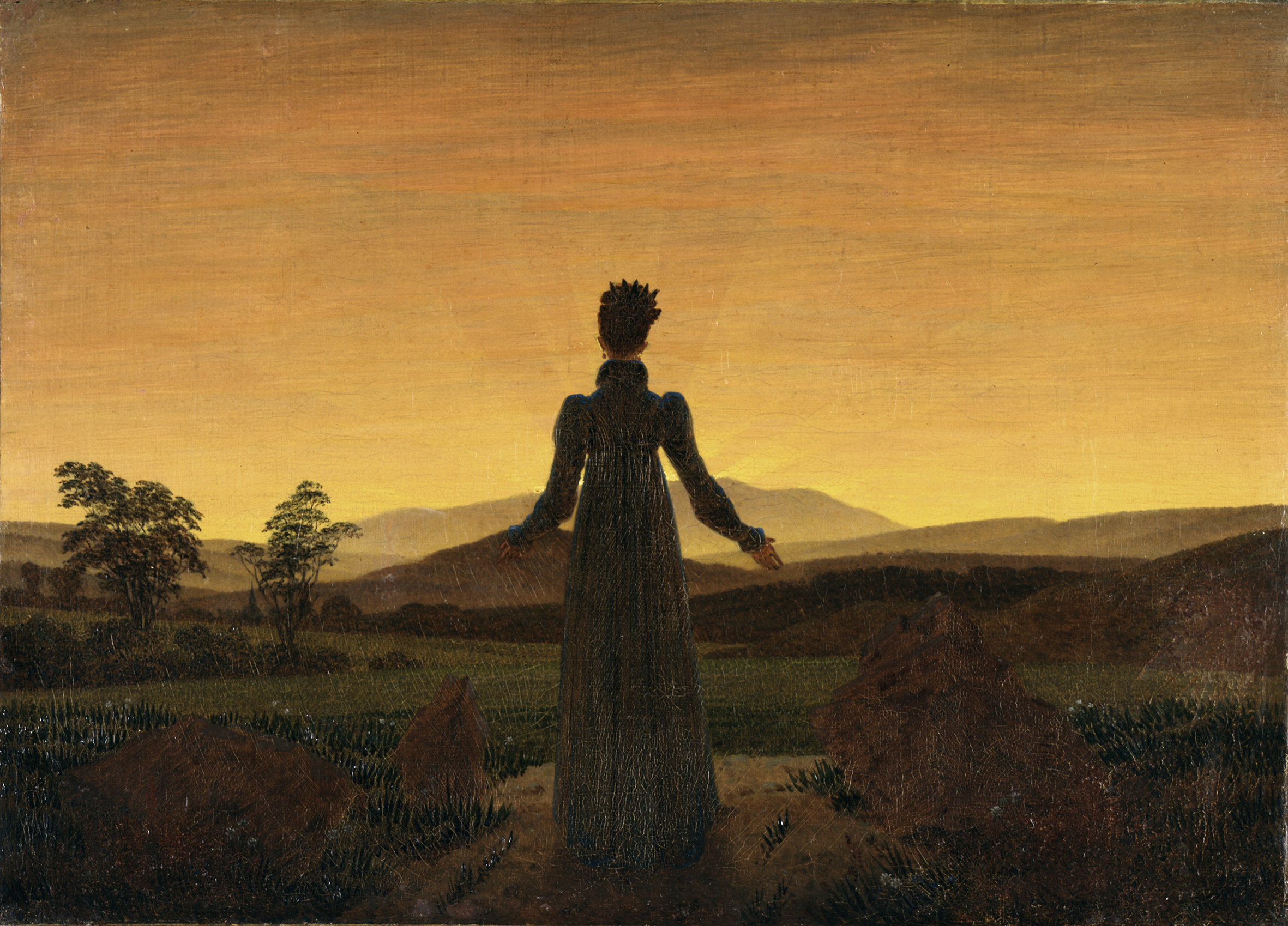
Image: Caspar David Friedrich, Woman in front of the sunset (1818)
 French
  German
  English