



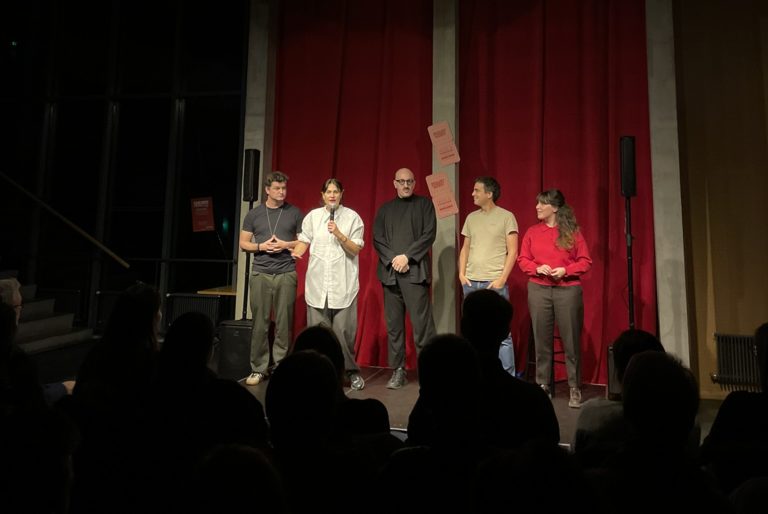
Meet a funny company: the Kokodyniack

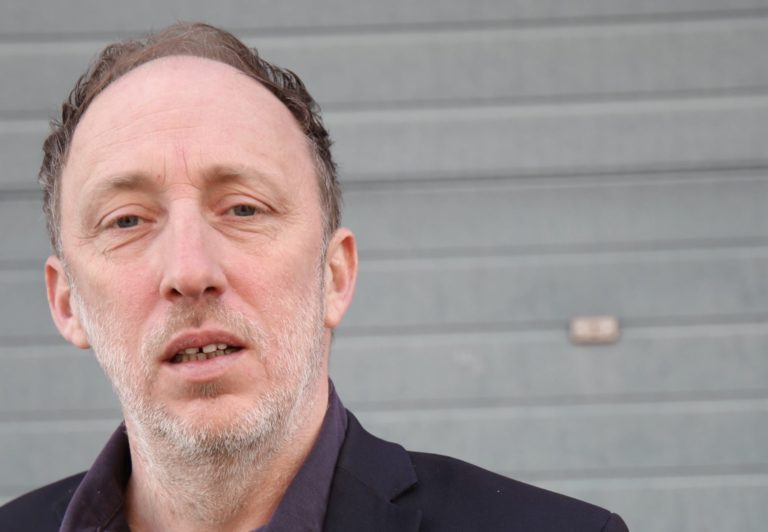
Kokodyniack © Indra Crittin
To tell the truth - Ivan Garcia
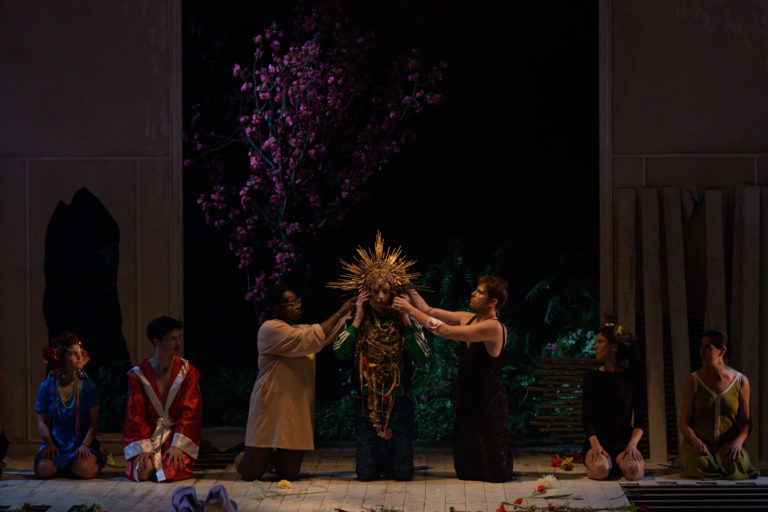
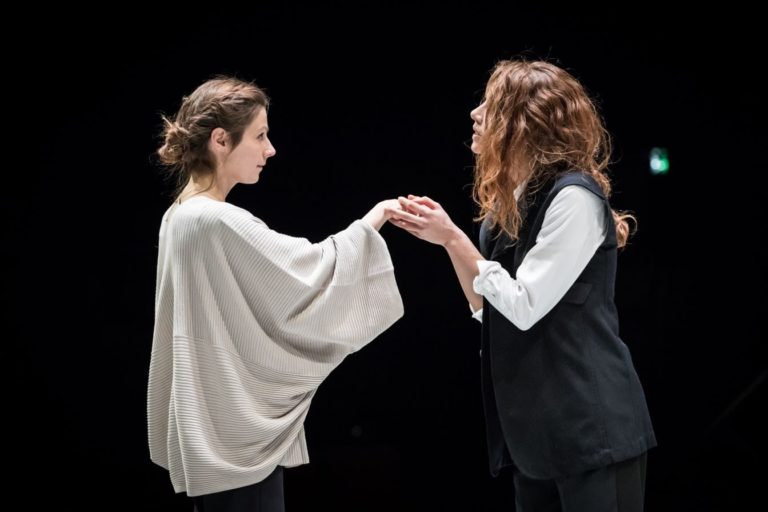
In residence at the Théâtre Benno Besson, Cie Kokodyniack gets ready. A theater company founded by Jean-Baptiste Roybon and Véronique Doleyres, Kokodyniack's working method is based on conversation and orality. Their show, Faces, is divided into seven portraits («visages») of seven local residents whom the company met, and whose testimonies it collected and transcribed. Cie Kokodyniack will give two performances at «A Vrai Dire», the festival of autofiction organized by TBB, from March 13 to 22. Meet the company's two founders at the theater, to talk about what they're up to at the festival and how they work.
Le Regard LibreHow did you come up with the idea for the show? Faces, divided into seven parts, and composed of portraits of local people you went to meet?
Jean-Baptiste Roybon (JBR): First of all, our duo has a certain uniqueness: we're a couple, have children and create shows together. We arrived in the region in 2013, and since then we've adopted this singular method of writing that characterizes our shows. In fact, we love history, particularly territorial history. Our dramatic approach looks at how history can be told through the specific way in which each of us inhabits the world. In other words, ideally, if we could tell the story, not by getting a thousand people to agree, but by getting these thousand people to testify about their differences, so as to ultimately see the same thing.
So it's micro-history.
JBR: Yes, it's micro-history. And it's about the ideal of learning history. As artists, we can venture to try and achieve this ideal. The idyllic territory for exploring these ways of inhabiting the world is the territory around us, that of our region. Living in the Nord Vaudois region and loving it so much, we wanted to make it known and defend it. The field of investigation and writing around us is immense. Finally, I'd say that the Faces was really born when we met Georges Grbic, director of the Théâtre Benno Besson in Yverdon-Les-Bains, who supported and encouraged us. He was interested in the idea of a local company getting involved, and asked us what we had to offer. And that's when we started accumulating ideas.
Véronique Doleyres (VD): We live in a small village in the region. At the time, we produced a show entitled The Line in Geneva. We thought it would be superb to do a show on the train line between Yverdon-Les-Bains and Sainte-Croix. We had thought, for example, of doing a show about the people who used this train line. We wrote to the director of the Théâtre Benno Besson, which effectively created a bridge between this institution and our project. And so the project began. Faces.
JBR: In the meantime, before this question of Faces, We were in the middle of writing a show that the Comédie de Genève, directed by Denis Maillefer and Natacha Koutchoumov, had offered to produce - Denis Maillefer, who has been with us since the beginning.
You're talking about the show My little country to be produced by Comédie de Genève next season.
JBR: Yes, My little country will be co-produced by La Comédie de Genève and Théâtre Benno Besson, Yverdon-Les-Bains. It will open the 2020-2021 season at La Comédie de Genève. In fact, it is, My little country is part of this large-scale project that has developed over time in the region. We met this retired couple, protagonists of My little country, We invited them to our home, because they make an absolutely delicious roast sausage. During this meeting, which lasted for hours, something extraordinary happened; we learned an incredible story that stunned us. As we ate, they gradually revealed their story of being foster children. Véronique and I decided that we should write a play about it. After months of reflection, we made the proposal to them, which they accepted, and we conducted several hours of interviews with them, transcribing everything. We then met Georges Grbic and began to build a vast project encompassing the region. At the time, we were waiting for an opportunity to work on the land around us. But we decided to get started beforehand, and to take portraits of the people who live in the area. The idea was to go out and meet random people living in the area.
What do you mean by «random»?
JBR: We started with the first person who met and welcomed us to the region.
VD: This first person was the protagonist of the first «face» presented in October 2019. Afterwards, she advised us to go and see another person, which resulted in another «face». For one of the shows, I suggested to Jean-Baptiste that he interview someone I'd met on the bus, for example. We did another about a person who made extremely good bread, another about a fisherman, and so on.
JBR: What's more, we've tried to respect the territory's geography, as well as the parity between men and women in the portraits appearing in The Faces. We also decided to carry out shorter interviews with the same idea of people telling us how they live in the world. world. But to tell it, we always arm ourselves with pretexts. For example, for example, the fact that a person lives in a town, is on a train line and that we are therefore obliged to meet them. All these excuses are really just excuses for meeting people, and to convince them to give us a long moment of their time, to answer two questions to answer two questions. First, we ask them to tell us about their lives, from their origins to their encounter with us. In second, we ask them what has been, or is, the greatest challenge in their lives. challenge of their lives. Then, after listening to the person, we transcribe the whole thing. This gives us an enormous amount of material on which to write a show.

How do you interview the people you choose?
VD: It takes about two and a half hours to get people to open up. That's a very long time. So we set ourselves a limit of one hour per interview, to be carried out one on one, in order to reach people's innermost selves. I found myself alone in front of the different people making up the group. Faces. But to get people to talk about their private lives, we need to find people who love what they do, and they'll tell us about themselves through their work. This enabled us to see that, when someone is truly passionate about their job and talks about it, we have access to their innermost being. These people then told us about their profession, as well as about themselves. To get in touch with the various interviewees, I phoned them beforehand and we made an appointment. I found that everyone was very open and we didn't have a single refusal.
JBR: This is probably due to the fact that we have a fairly precise protocol for these interviews, which reassures the participants. I myself don't originally come from a theatrical background, but was a specialized educator in neighbouring France. The question of interviewing is a subject that has fascinated me personally for years. When I met Véronique, we continued to work on the subject of interviewing, in particular on how to conduct an interview. Based on this work, we adopted a three-way interview method (two interviewers and one interviewee) to remove any commentary. Indeed, when an interlocutor shows signs of boredom, the speaker falls into a form of empathy with the listener, blocking the speaker's opening process. It's important to say that our work is not «micro-trottoir». For us, this writing does indeed come from orality, but it has many different levels. Like a photographer who wants to take pictures of wild animals, we believe there are many ways of approaching this question of orality.
In recent years, we've seen a lot of a lot of «documentary theater» on stages in French-speaking Switzerland. But the form you use you use seems closer to reportage.
VD: It's always difficult to find a name for our method. But we'd say we do «documented theater». Of course, in our work, there is the production of a document, namely the interviewee's testimony. Then there's the rewriting of this document, in which orality is transcribed. The substance is documented, but the form is particular, because orality is our passion. Our way of making theater is interested in how we can access others through their speech, through their hesitation, or how their emotions come out through their way of speaking.
JBR: I'd also say that we do «documented theater» in the sense that we go and find a document. Then, based on this document, we write a form of fiction. Between these different stages, there's a huge amount of editing work; if we have a thousand pages of transcription at the start of our work, often only thirty or fifty remain in the final version. Editing is a form of writing. We don't write in sentence form, because our aim is to find out, for example, how the person breathes, how they express themselves. All these interactions tell us something.
About Faces, Why didn't you ask the seven interviewees to come on stage?
VD: It has to do with the way we make theater. Removing actions and gestures, as well as the complexity of the person, helps to purify the testimony. I think that when we arrive on stage and carry a word, it reveals the essence of the testimony. I like to call it the «essential oil» of testimony. It's a particle concentrate of the testimony of one's life.
JBR: In concrete terms, our approach is a humanist one. In our work, what interests us is the richness of orality. As a result, we remove the complexity of the person to keep the essential, i.e. the way in which we inhabit the world. For us, this way of inhabiting the world is based on language. It's a humanist approach to finding ourselves together. In my opinion, there's a form of reconciliation in our method.
Dates to remember:
Théâtre Benno Besson, Festival A Vrai Dire, March 13 to 22, Bookings: 024 423 65 84, www.theatrebennobesson.ch
Cie Kokodyniack, Faces, March 13, 7:00 p.m., Escaliers du Théâtre Benno Besson / March 22 at 5pm, Escaliers du Théâtre Benno Besson.
Thursday, March 19 at 8:30 p.m., Cie Kokodyniack will take part in a round-table discussion on «The writings of reality» in the Foyer of the Théâtre Benno Besson.
Write to the author: [email protected]
Photo credits: © Indra Crittin for Le Regard Libre

You'll also like
 French
  German
  English
Leave a comment