



«Philovision» at Vidy, a successful but incomplete parody

Unpublished article - Ivan Garcia
Announced as the first major event of this theatrical season at Vidy, the european philosophical song contest by Lausanne-based artists Massimo Furlan and Claire de Ribaupierre, aims to bring philosophy to the stage in a musical form, thus stimulating critical thinking. Last Friday, Le Regard Libre attended and, although the show is a masterpiece of staging, the thought seems little present, even absorbed by the form of the performance; as a result, one can't help but wonder at times, like the Pixies' song: Where Is My Mind?
Transforming a festival of so-called «popular» songs like Eurovision into an ode to thought and reflection is an ambitious challenge for director Massimo Furlan, who—for the occasion—is dressed as the contest’s co-host, alias Pino Grigio, and playwright Claire de Ribaupierre, who serves as the jury moderator. It’s worth noting that this isn’t the first time the duo has taken on this challenge; at the 2010 Avignon Festival, they created the show 1973, a re-enactment from the 1973 Eurovision Song Contest.
The culmination of a long-standing project
On his website, artist Massimo Furlan described his previous project [Editor's note: 1973]—for which Claire de Ribaupierre was developing the dramatic structure—as follows: «This project therefore examines a specific form of popular culture—a televised program aimed at a very broad audience—and in doing so opens up avenues for discussion about mass culture and its distinctive characteristics. It thus touches on two specific dimensions: one is commercial, concerning music as an economic market and as a phenomenon of globalization and standardization; the other is more symbolic and emotional: how and why do people gather around such an event, which presents itself as a kind of ritual? From an anthropological perspective, the goal is to try to understand what it means to come together to choose the best.»
The duo therefore focuses on two specific phenomena: the commercial and standardized nature of Eurovision, a phenomenon marketing highly publicized and aimed at a broad audience, and its ritual dimension, which fosters cohesion among the various participating countries, as well as serving as a catalyst for rivalries or local talent. Through the lens of this reappropriation, the european philosophical song contest can be understood as the culmination of this creative process, which aims to find—at the heart of the commercial, standardized form of «popular» music and television talent shows—a path toward thought and emancipation.
Getting back to tonight’s show, let’s quickly recap last Friday’s event: the audience watched ten musical performances out of the eleven songs entered—it’s not entirely clear why Spain was excluded that night, or perhaps this writer simply didn’t hear it… – and, after each performance, every song is discussed and judged by the juries, who assign a score, as well as by the audience. At the end, the winning country—Italy that night—is invited to perform its song again, as is traditional at Eurovision. In this case, the song had been composed by the philosopher Michaela Marzano, a specialist in moral and political philosophy, and was titled Our Vulnerabilities. It should be noted that the songs—set to music by HEMU students and performed that evening by two students from the same school, Dominique Hunziker and Davide De Vita—are sung in their original languages with French subtitles, which is quite a feat.
Since the audience and the jury change every night, the contest’s outcome—as a general rule—changes with each performance. Last Friday’s jury consisted of four intellectuals, three women and one man: Daniela Cerqui Ducret, an anthropologist at the University of Lausanne; Francesco Panese, associate professor of social studies of science and medicine at the University of Lausanne; Vinciane Despret, philosopher of science and composer of the song representing Wallonia, Belgium; and, finally, Rinny Gremaud, journalist and writer.
A magnificent set designth
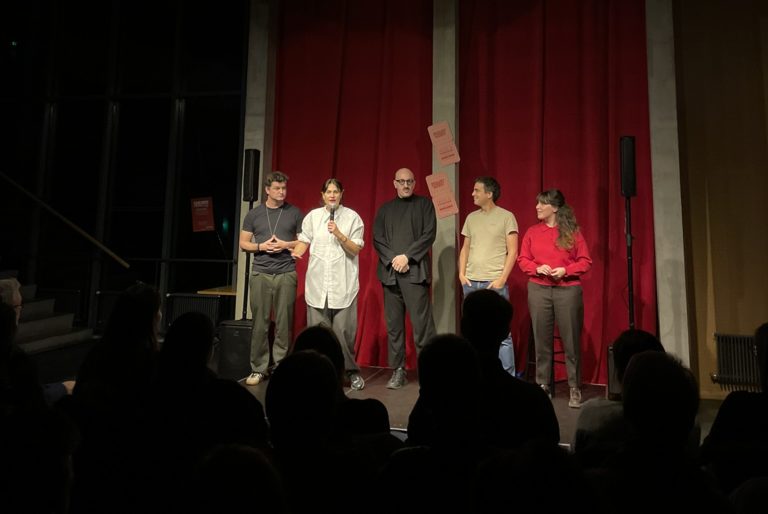
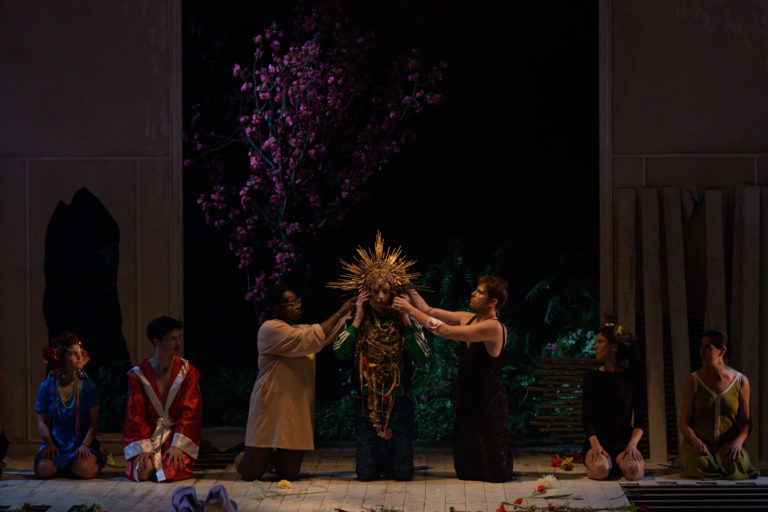
In our view, the highlight of the Furlan-Ribaupierre duo’s show lies in their mastery of stage design; from the set to the costumes to the dramaturgy, every element allows the audience to immerse themselves in the heart of a show like Eurovision. On set, the two co-hosts, Pino Grigio (Massimo Furlan) and Pinetta Mortadella (Nina Megri), dressed up for the occasion, put on a great show, but judging by their names and facial expressions, one sometimes wonders if, in an effort to ridicule the cliché, they end up becoming trapped by it. It seems, however, that the two co-hosts had to improvise—which was likely not part of the plan—last Friday, before the German song began Jesus is a soccer field, due to a minor mishap.
As for the performance of the songs, the two singers take turns, or sometimes—as with Italian music—they sing as a duet. That evening, the country with the honor of opening the show is Slovenia, with a song written by Mladen Dolar, a philosopher from the Ljubljana School of Theoretical Psychoanalysis. Titled On Being, the song—in essence—explains that Thales defined the concept of Being by viewing it from a male, rational, white, Greek, etc., perspective—as the driving force behind Western exclusion. Of course, we expected nothing less from the jury, which agreed without any real critical discussion, awarding scores ranging from nine to ten—with the exception of one person who gave a lower score.
As for the jury—all of whom are renowned intellectuals in their respective fields—they find themselves in a difficult position: they are intellectual figures, yet during this show, they are also, after all, actors. Our criticism of them is that they often hand out high scores—such as tens or nines—one after another without any real critical discussion. Worse still, they claim they don’t want to «monopolize» the conversation, yet they are the only ones who can truly comment on the content of the songs…
To that end, one member of the jury that evening ended up exclaiming—or «slipping up,» depending on your point of view—a rather surprising statement about people who vote for populist leaders and the leaders themselves: «I don't think there are that many idiots in the world.» (sic). This is surprising, especially coming from an intellectual who wants to engage in debate; however, given the nature of the contest, this is unfortunately impossible.
The European Philosophy Song Contest is seen as an alternative or an improved version of Eurovision; however, the audience doesn’t really have a say in the matter, except when it comes time to vote. Moreover, for a contest based on intellectual discourse, the fact that the audience has to vote by shouting, clapping, and stomping their feet to boost the applause meter seems, to say the least, paradoxical for a play that critiques the rise of populism…
As for the set design, while it is a marvel, it relies on digital screens—suspended from the stage cage—that, depending on the vocal performances and the rhythm of the songs, move forward or backward and shift across the stage, which poses a real problem. Indeed, when a viewer watches the competition on television, they benefit from a sense of detachment—provided by the medium (the television)—that prevents them from becoming completely immersed in the pathos. However, the fact that we were watching this performance in a theater—and, what’s more, with, at times, screens that come close to the audience—this greatly undermines the possibility of maintaining a critical stance toward the lyrics of the songs and the jury’s comments, which, as we will emphasize, offer analysis and commentary but rarely express philosophical thought.
Where is «thought»?
In the concept note for their new production, available for download on the Vidy-Lausanne Theater’s website, the two artists explain their creative approach, which aims not merely to recreate an edition of the Eurovision Song Contest but to create a new version—a philosophical one this time—entirely from scratch, one that leaves room for reflection and criticism at a time of rising populism in Europe:
«Drawing on the Trojan Horse stratagem, we sought to reintroduce philosophical thought and reflection into the very heart of entertainment by creating a musical work that is entirely credible by the standards of popular music (slow, Latin, disco, rock, ballad…), yet one that simultaneously gives thought an essential role through the lyrics. What matters to us is bringing thought into the public sphere so that it can be heard, shared, and understood. To achieve this, we have also placed thought and thinkers in a position where they must question popular culture, take it seriously, and engage with it intelligently.»
However, the advantage of the commodity form, as argued by thinkers from the Frankfurt School and critical theory (including, among others, Theodor Adorno, author of the A Iconic Figure in Music, and Herbert Marcuse, author of "The One-Dimensional Man: An Essay on Advanced Industrial Society"), is that it manages to absorb the contradiction and smooth it over—even in thought. And it would seem that, unfortunately, this is the case with this show…
Just as in opera, on stage, the combination of words and music greatly compromises the intelligibility of the text. Furthermore, presenting the audience—even through thinkers who have made a practice of popularizing complex ideas—with texts containing extremely dense contemporary philosophical content does not seem to be a successful approach. Simply put, because most audience members—alas!—possess only a meager knowledge of philosophy, which plunges them further into a passive stance of reception rather than a critical engagement with the sung lyrics.
To assist the audience, the creators have provided subtitles, but these do not seem sufficient, especially given the variety of languages and the complexity of the ideas that the thinkers are attempting to explain in simple terms. It should also be noted that the competition Eurovision is, for the most part, not subtitled, which may reflect the artists« desire to make things understandable. However, in the absence of a genuine space for public discourse, the audience often tends to follow the jury’s opinion—or even simply enjoy the show—rather than reflect on concepts such as »Cthulucene« or »panpsychism.”. The European Philosophy Song Contest The duo of Massimo Furlan and Claire de Ribaupierre offers interesting avenues for the future of musical theater, as well as for art’s pushback against the sacrosanct market. However, their current production has not yet reached its full potential and has not yet managed to break free from an overly restrictive dramatic form. Finding a dramatic form capable of combining philosophical content, a genuine dialogue between the stage and the audience, and a critical spirit while remaining playful—that is the true challenge for the two artists who—we hope—will ensure that this «Philovision» becomes a true ode to thought.
European Philosophical Song Contest, Lausanne, Théâtre de Vidy, through September 14, then at the Comédie de Genève, September 24–28.
Write to the author: [email protected]
Photo credit: © Laure Ceillier and Pierre Nydegger

You'll also like
 French
  German
  English
Leave a comment