




22 | Epicurus, champion of confinement and degrowth
Le Regard Libre N° 77 - Enzo Santacroce
Series «Prejudice against philosophers»Episode #2
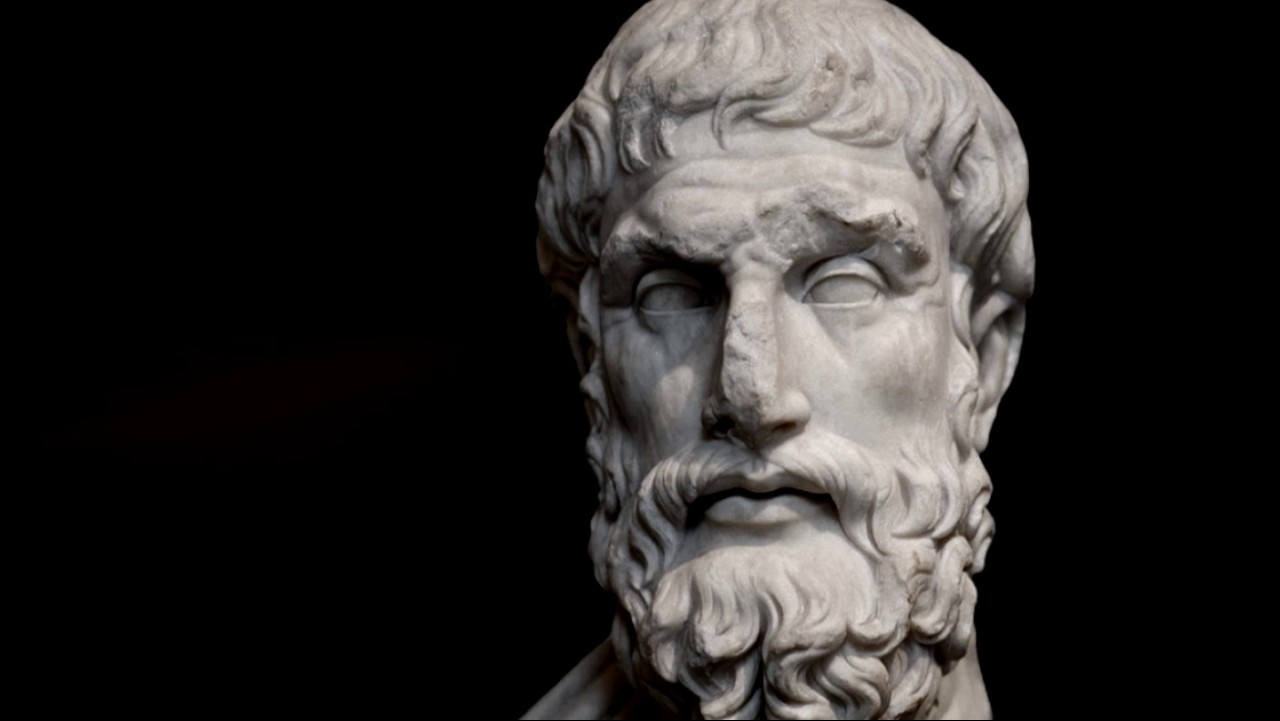
If there's one philosopher whose name is associated with a stubborn prejudice, it's the Greek thinker of the 3rd century.th century BC: Epicurus. Indeed, who hasn't heard the term Epicurean used to describe a person who enjoys good food and fine wine? In reality, the expression «to live as a good Epicurean» hijacks the Greek master's teaching that the pursuit of pleasure must be prudent and measured. More essentially, the philosopher believed that simply cultivating pleasurable sensations was a way of responding to life's misfortunes and the anguish they provoked. In today's world, his strategy of withdrawal would be comparable to confinement, and would be the envy of the "décroissants".
Misfortunes are numerous and uncontrollable. In Epicurus' time, i.e. in antiquity, men feared storms, tempests, floods, earthquakes and wars as catastrophes fomented by the wrath of the gods. Superstition was the guide, and fear of death reigned in the hearts and minds of citizens. Epicurus, armed with this diagnosis, decided to remedy this state of affairs by proposing a detonating philosophy whose principle seems limpid but which, on closer inspection, conceals an unexpected complexity: the body is the friend of the soul.
We don't realize it today, but this statement represents a genuine philosophical revolution, given the supremacy of Platonic ideas in the Greek intellectual landscape at the time, particularly in Athens. More precisely, Plato, Socrates' friend and disciple, wrote more than thirty works arguing that the body, the soul's sworn enemy, turned man away from truth and goodness. According to Epicurus, this perspective is anxiety-provoking, because what preoccupies humans, he notes, is escaping the vagaries of an often hostile nature and life, not wisely seeking truth. To tell people that they must strive for purity when they are frightened by an existence that eludes them is inadequate and confusing.
The necessary and the unnecessary
Epicurus observes that human beings, like other natural beings, have needs: hunger, thirst, sleep. The Greek philosopher takes a serious look at man's animality, and believes that his efforts should be directed towards happiness through pleasure, which is experienced by satisfying the needs dictated by biological rhythms. However, the pleasure sought is only simple if it is directly linked to the natural need to restore the body's claim to its due.
More precisely, Epicurus establishes a hierarchy of pleasures according to the criteria of the necessary and the non-necessary, whose function is to indicate whether choices that meet the demands of the flesh are reasonable or not. For example, eating a plate of vegetarian food with a glass of water at lunchtime is a healthy pleasure for the blessed, since it is balanced. On the other hand, eating two plates, drinking a soda and allowing yourself a dessert is certainly pleasant, but unnecessary, because it fills you up with superfluous calories, complicates digestion and is more expensive. Being satisfied with the minimum is the Epicurean motto.
This way of living, this ethic of simplicity, is, in Epicurus' eyes, the only possible way to soothe the pain of need. More profoundly, it's not so much the need itself as the fear of need that needs to be assuaged. Being content with the minimum is a discipline whose aim is to reduce the fear that the mind generates when it begins to think about tomorrows it doesn't know. So the Epicurean message is: let's avoid wondering what tomorrow will bring, since the present offers us something to satisfy our appetites. Living in his garden, which he had transformed into a school, Epicurus repeated in his lessons that a simple meal of bread, figs and water, accompanied by friendly conversation, opened the door to the fullness of life. like a god among mortals.
Retreat as a marker of containment and decline
This sympathetic-looking approach is nevertheless fraught with danger: the withdrawal into oneself that leads to distancing from others. This is because, according to Epicurus, the pursuit of minimal pleasure is not just about the selection of food, it is also accompanied by a social constraint imposing the exclusion of anything that does not directly concern nature, starting with personal and professional ambition. In other words, a civilizational aspect such as competition, which creates interesting stimuli for self-fulfillment, is banished from Epicurean discourse, thus advocating a form of moral confinement. From this point of view, living simply requires a renunciation of external activities, which are nonetheless so many levers for societal growth, both individually and collectively.
When the Confederation twice imposed semi-confinement, it spoke the language of Epicurus: let's avoid contamination by staying at home as much as possible, and let's be content with the essentials, i.e. family and inner renewal. The problem is that the essentials are not enough. To work less or not at all, to stop going to the hairdresser's or the gym, to stop producing culture in the broadest sense of the term demonstrates, through its deleterious effects on individual psychological health, the extent to which this diminishing lifestyle is undermining social cohesion. Everyone feels the need to get out of the house, because it's a way of getting out of oneself and thus putting the logic of one's desires on a collision course with that of the world. It's the perfect way to energize the development of our ideas and projects. So, in the final analysis, seeking appeasement through renunciation isn't all that relaxing.
Write to the author: enzo.santacroce@leregardlibre.com
Photo credits: © DR
You'll also like




 French
  German
  English
Leave a comment