




Sovereignty versus international governance
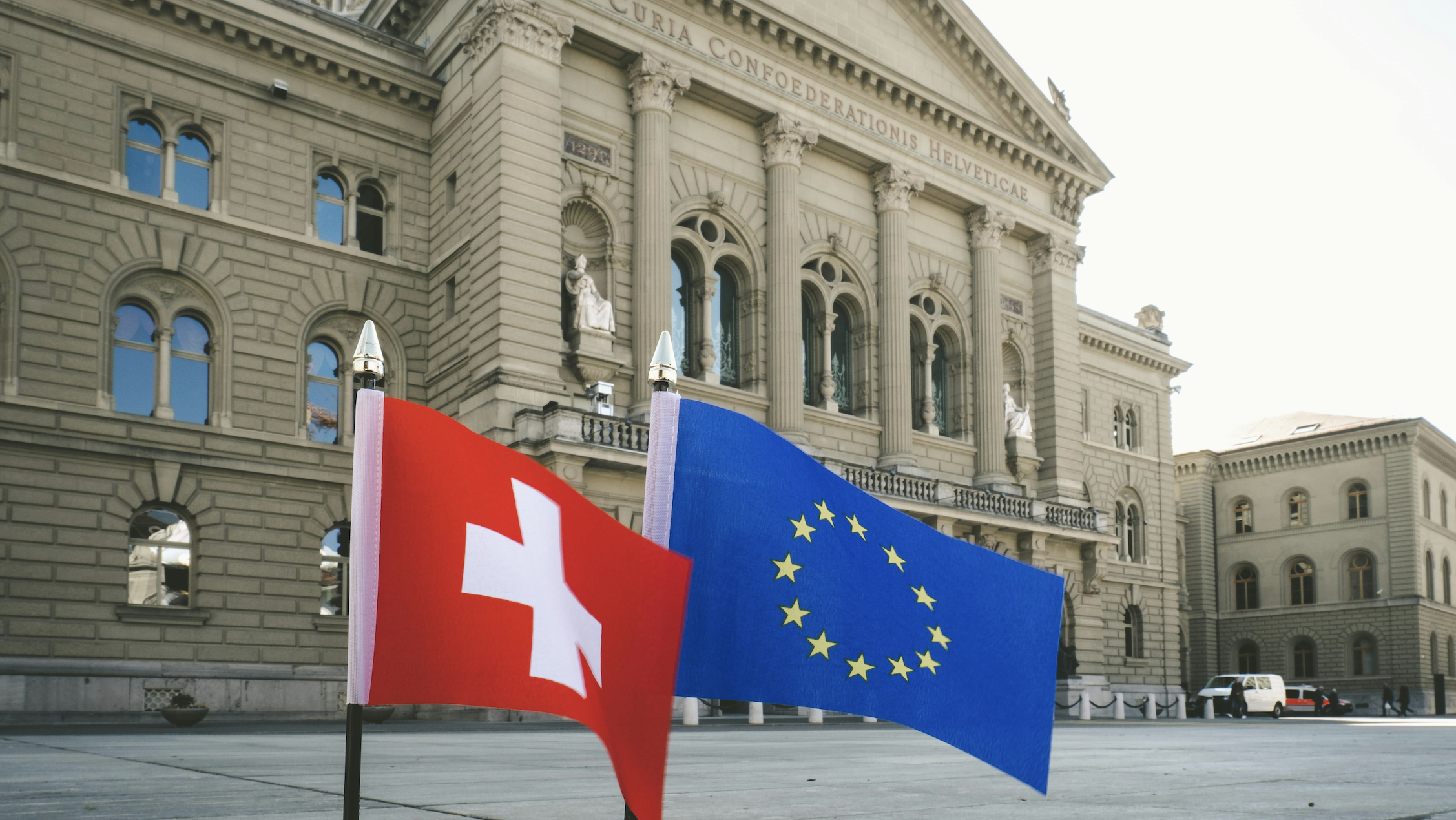
On December 20, Bern and Brussels announced the successful conclusion of their material negotiations on a package of agreements. Photo: Christian Wasserfallen (via Unsplash)
The European Union is the scene of a major political confrontation between sovereigntists and advocates of a form of international governance. A situation which raises the central and delicate question of sovereignty in the age of globalization.
What is sovereignty? Classically, sovereignty is defined as the exercise of undivided power, or the possession of supreme authority. In other words, a state is said to be sovereign insofar as it is autonomous, free to make and unmake alliances, able to cope with external constraints, and so on. The German jurist Georg Jellinek is often quoted as defining sovereignty as «competence of competence» (Kompetenz-Kompetenz), i.e. the ability of a State or entity to establish the limits of its own competences, without being subordinated to a higher authority. You get the idea.
Nation-state and sovereignty
In a democracy, sovereignty is first and foremost that of the people, who express it through voting and elections. Some regimes refer to popular sovereignty, others to national sovereignty, and the legal and philosophical debates on this distinction are complex.[1]. In both cases, however, there is a state which plays the role of central actor in international relations, and which, at this level, is concerned by the question of sovereignty.
To this we must add that states are generally not purely arbitrary constructions: they are the result of a long historical process that gave rise to them. In the case of nation-states, the individuals who make them up are deemed to belong to the same nation, i.e. to a more or less homogeneous human group, heir to a common history, culture and mores, generally a common language, attached to a territory, and from which derives an aspiration to a common life. And this common belonging legitimizes the existence of a political authority, a State, charged with defending the nation's interests both within and beyond its borders.
International relations and the balance of power
Beyond its borders, every state is a stakeholder in the complex reality of international relations, or inter-state relations, as they are called. As on the human level, collaboration is necessary. A collaboration that requires a framework, a structure: this is the central reason for the existence of international law, intergovernmental organizations, military alliances, bilateral and multilateral treaties, official and secret diplomacy, etc., sometimes in the name of shared values, secular (human rights) or religious.
However robust and effective these collaborative arrangements may be, they are nonetheless the veneer of a reality that remains fundamentally one of power relations. International justice is a clear example of this. Recently, the International Criminal Court (ICC) issued an arrest warrant for Israeli Prime Minister Benjamin Netanyahu. In theory, the 125 signatory states - including Switzerland and all its European neighbors - would be obliged to arrest the accused if he entered their territory, in order to bring him to justice. In reality, which of these countries, even if it had the intention, could assume such a responsibility - that of arresting the head of government of a nuclear power? Especially as the United States, the world's leading power and Israel's historic supporter, is not a member of the ICC and does not recognize its decisions.
This is not to debate the legitimacy or otherwise of the ICC's decision, but simply to note that it reveals an invariable feature of international collaboration: the omnipresence of the balance of power and the pre-eminence of particular national interests.
Many examples could be given. The principle of the extraterritoriality of American law is one of them. As the world's hyperpower, the United States can enforce its laws anywhere in the world, in flagrant violation of national sovereignty. Similarly, although the invasion of Ukraine is illegal under international law, Vladimir Putin's Russia, in the name of what it considers to be its own interests, has decided to engage in a military show of strength with its neighbor and with Western countries.
Generally speaking, it's not revolutionary to say that all the major powers carry out clandestine - and therefore, by definition, illegal - actions in other countries: destabilization, sabotage, arrests, extraditions, assassinations and so on. The fact is that the more powerful a country is militarily and economically, the more it is able to flout international law, treaties and the decisions of the United Nations (UN) or other organizations, which in any case have no real means of coercion.
Stiffening of international institutions
In response to this intrinsic weakness of international institutions, some of them may aspire to increase their power and means of constraint. The European Union (EU) is a paradigmatic case in point. Composed of states that are still sovereign, it faces numerous obstacles that prevent it from acting as a single state. Within the European Council, for example, member states have a right of veto. Decisions must therefore be taken unanimously. That's why many would like to see this veto right disappear, to make the EU more «efficient». Similarly, the EU is always fragile in the face of potential reversals in the domestic politics of its member states, as the Brexit example demonstrates.
But as the EU increases the scope of its power and attempts to limit its members« room for manoeuvre, it can only erode their sovereignty. The end of unanimous decision-making in the European Council, a proposal supported by French President Emmanuel Macron and former Italian Prime Minister Mario Draghi, would put countries in the position of being able to have decisions imposed on them within Europe that they absolutely do not want. Europeanists» fully accept this logic. Sovereigntists, on the other hand, oppose this type of development head-on. For them, political sovereignty cannot be separated from the nation-state, which must remain the decisive political level.
While they are not opposed to alliances, agreements, partnerships and international collaboration, sovereigntists want to retain «competence of [their] competence» at national level, and fear above all the ratchet effect that would make it impossible to go back once a certain degree of European integration has been reached.
Such opposition between supporters of national sovereignty and defenders of international governance is not unique to Europe. It recurs in various forms wherever international organizations are concerned. When decisions are taken or imposed at supra-state level, sovereignist movements that aim to preserve sovereignty at state level emerge or gain strength.
Switzerland is no exception to the rule. Surrounded by EU member countries, which account for more than half of its exports (50,32% in 2023) and imports (70,01% in the same year), it must find its place in a European space where the dynamics of interdependence often clash with the defense of its political (such as semi-direct democracy and federalism) and economic specificities. The internal debate has only just begun, following the announcement on December 20 of the conclusion of material negotiations between Berne and Brussels for a package of new agreements.
Write to the author: antoine.bernhard@leregardlibre.com
You have just read an analysis from our dossier «Who really has the power?», in our print edition (Le Regard Libre N°113).
[1]The term popular sovereignty is generally used in cases where the people express their will without intermediary by voting. The notion of national sovereignty applies more to representative regimes, where citizens delegate their power to representatives who then exercise power on behalf of the nation.

You'll also like






 French
  German
  English
Leave a comment