



Human beings are their own masters
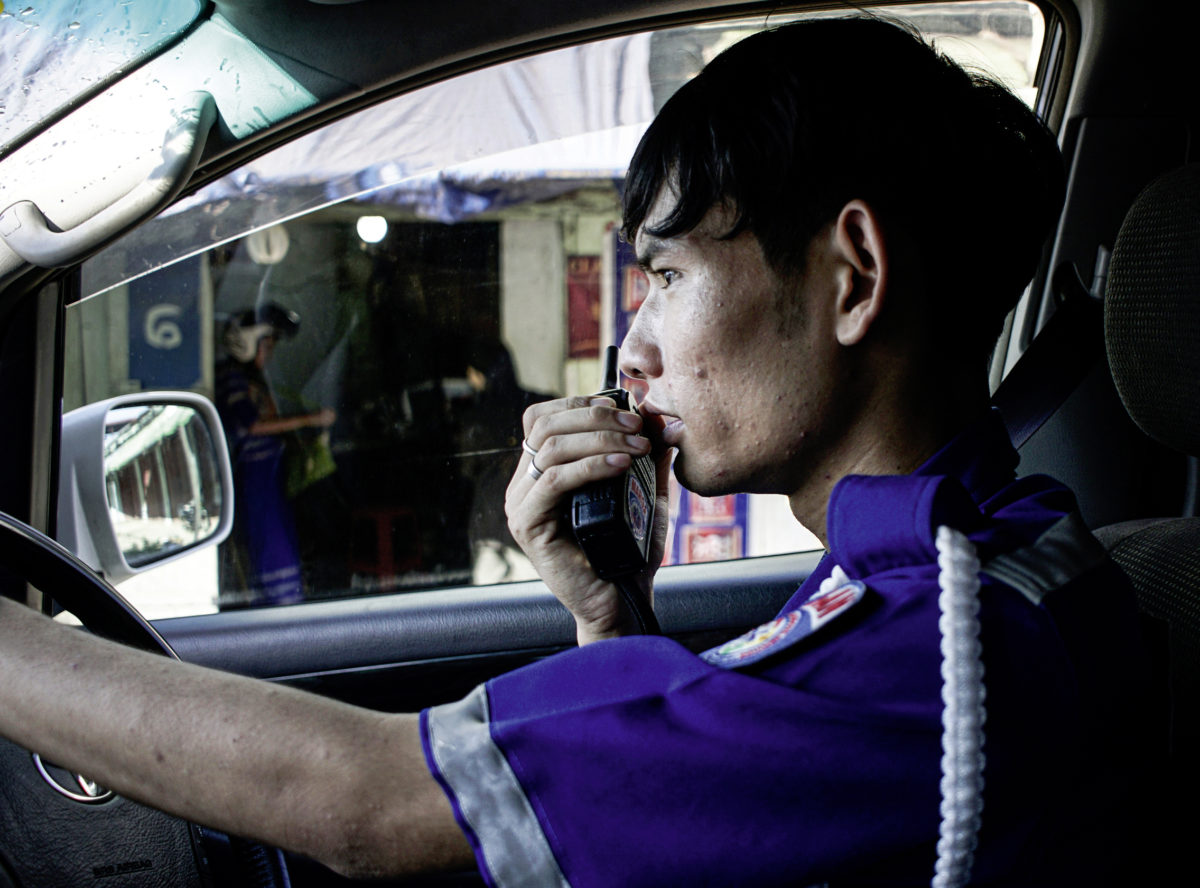
Volunteer Thu Saw Oo drives the Marga Society ambulance in Myanmar, photographed by Eva Hirschi.
In countries where the state is underdeveloped, volunteer civic engagement is flourishing, as shown by this report from 2019 in a Burmese emergency service, among section chiefs in Sierra Leone and in the search for missing persons in Belarus.
We're sitting on chairs in some sort of classroom in the town of Hpa-An, Myanmar, when Thu Saw Oo's phone rings unexpectedly. An emergency! The 22-year-old Burmese leapt to his feet, rushed to the ambulance and threw himself into the driver's seat. Three other young men in blue uniforms climb into the back of the car. Cʼest est parti: with flashing beacon and serious facial expression, the four members of the volunteer organization Marga Society drive to the home of a patient suffering from heart trouble. An emergency transfer to hospital is required.
Thu Saw Oo is not a doctor, nor even a medical student or nurse. He's a third-year chemistry student, and works for this voluntary organization in his spare time, free of charge. Marga Society is active in various fields: blood donation, tutoring, funerals and, of course, emergency services. Of course, there is a hospital in Hpa-An which also has emergency vehicles, «but people usually call us directly. They know we're faster,» explains Thu Saw Oo as he routinely passes a car. The hospital does not have the capacity to respond quickly and adequately to all emergency calls.
Burmese trust volunteers more
Arriving at the patient's home, Thu Saw Oo prepares the collapsible stretcher while the other volunteers rush to the patient in the house. A few minutes later, everyone is back in the car, and the man is taken to hospital and entrusted to the care of the doctors. «We have taken a state-organized life-saving course, and from time to time, one or two of us can attend a two-week training course in Thailand,» explains Thu Saw Oo. The training in Thailand is offered free of charge by a local hospital, with travel expenses covered by the Marga Society. «The idea is that participants then pass on their knowledge to other volunteers».
Volunteer chairman Aung Than Lwin sees Marga Society's mission as complementary: «We support the government. It can't take care of everything.» This sounds obvious, and there's no criticism in his voice. Why accept such a task voluntarily and without compensation? «Because we're an underdeveloped country,» says the 50-year-old who works as a hotel manager. He sees it as a service to the state, but even more as a service to society. Whereas Switzerland, even as a highly developed country, relies on a militia system to bring the experience of the working world into politics (see articles p. 22-24, p. 28-31 and p. 32-35), Volunteering is simply a necessity for developing countries.
In Myanmar, such involvement by civil society is a tradition. For three decades now, non-profit organizations have been supplementing or replacing services that should be provided by the state. After the collapse of the «Burmese path to socialism» under General Ne Win in 1988, small organizations sprang up, often based on religious groups, in which citizens with similar interests met and organized social or religious activities with private funding. Under the military regime that followed, even more public funds were diverted to the army, leaving the population more or less to its own devices. Civil society organizations stepped in to fill the gap in state provision.
Natural disasters have also led to an increase in the number of such organizations. In particular, the spontaneous response of the population to the devastation wrought by Cyclone Nargis, which claimed over 130,000 lives in 2008, strengthened voluntary organizations. Instead of waiting for the state to intervene, the population organized itself and began distributing aid and cleaning up, not least because the government refused access to the disaster zone to several international organizations and did not allow foreign aid, even from the UN, into the country. But local organizations and the commitment of individuals helped to keep society together.
Another reason for the tradition of free commitment is that religion has great importance in Myanmar: «I help others because I want to do good deeds as a Buddhist,» says Min Thein Htoo. The 23-year-old has been a member of the Marga Society for six years. The great generosity of the Burmese people is closely linked to Buddhism. The Marga Society in Hpa-An has around 170 donors who make a contribution every month. «The number of donations, but also of volunteers, has increased in recent years,» explains Aung Than Lwin. This shows that people appreciate the organization's services.
Chiefs instead of commune presidents in Sierra Leone
From the passenger seat of the ambulance in Myanmar, my journey takes me on a motorcycle to Sierra Leone - but which prematurely gives up the ghost. In fact, we wanted to go as far as Sinekoro, but a breakdown prevented us from continuing. So I find myself, with a driver and a guide, in a small village called Bandakarifaya in the north of the country. Before we can take care of the motorcycle, we have to pay our traditional respects to the village chief. The section chief, Moses Karifa Marah, an elderly man in jogging and woolen cap on his head, shakes our hands. He looks at me suspiciously and asks my guide if I work for a non-governmental organization (NGO). Very few people come to Sierra Leone purely for tourism; most are aid workers, missionaries or diplomats.
In fact, it was sheer curiosity that brought me to this small West African country, best known back home for blood diamonds and Ebola, great poverty and low life expectancy. Later, as I wait in the shade of a house for the car to be repaired, I'm joined by Balla Koroma, the village's vice-minister for youth and one of the few people in the village to speak English - even though English is compulsory at school. He also explains the role of Moses Karifa Marah who, as section chief, is roughly equivalent to a commune president. Indeed, Sierra Leone too has a federal system: the various administrative levels are called provinces, districts and chiefdoms.Before British colonization, Sierra Leone already had a chiefdom system, where different regions were ruled by local chiefs. The British used this basis to implement their policy of indirect control in 1896, i.e. exercising power through local leaders. This happened both in the crown colony of the Freetown peninsula and in the protectorate in the interior. Large districts were divided into smaller chiefdoms, and traditional district chiefs were renamed Paramount chiefs, which meant a loss of power and territory for them. After several military coups, Sierra Leone finally proclaimed a presidential republic in 1971. The administrative structure was largely retained.
A militia system as in Switzerland can be found here at a lower level: Paramount chiefs are certainly paid by the state for their function, but each Paramount chief can appoint local section chiefs for his regions, who - it should be noted - are not paid to run what is called a section. They are responsible for collecting taxes, maintaining order and resolving conflicts. «The section chief also assumes police duties,» the deputy youth minister explains to me. «Ultimately, our police can't be everywhere. If a crime occurs in the village, the section chief is the first person to contact. He decides whether the case should be referred to the police or whether another solution can be found. We don't have enough police officers.»
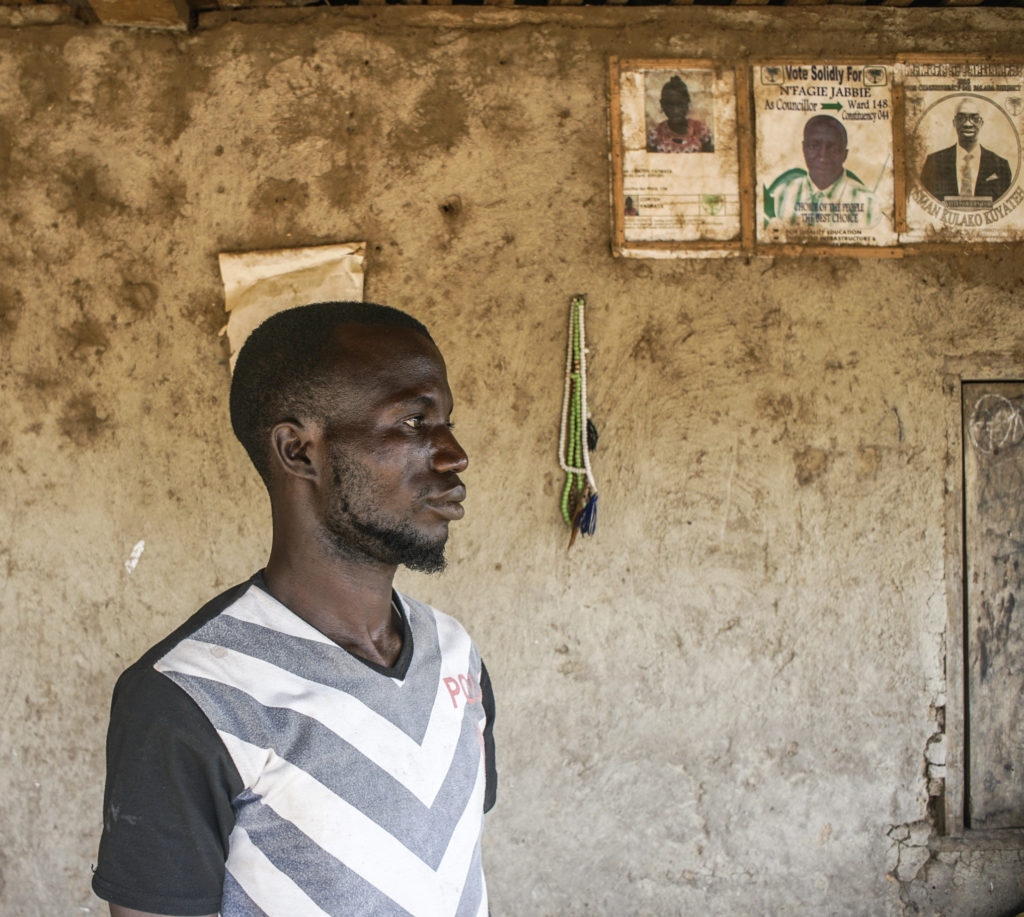
It's difficult for a section leader to have a full-time job in addition to his time-consuming militia activity," says Koroma. But sometimes section leaders like Moses Karifa Marah also work as farmers in the fields to earn money from the harvest they sell. Or they take part in businesses and earn money in the process. Often, section chiefs would also receive voluntary donations from the population, such as rice and palm oil, or would withhold part of the funds from NGOs, with the (not always valid) argument as a justified salary for implementing a new project.
The lack of human resources is compounded by the difficulty of accessing certain villages. In Sierra Leone, tarmac roads exist almost exclusively between the major towns. Villages are connected by dusty bumpy tracks, making the permanent presence of a superior police structure even more difficult. Compared to other conflict resolution institutions, traditional chiefs enjoy greater respect and trust than the police anyway. In a study conducted by the World Bank, some 80% of the population stated that section chiefs and village chiefs resolved conflicts well and promoted peaceful cohabitation. The population of Sierra Leone also reportedly had a relatively poor opinion of the conflict resolution capacity of district courts. They reported that there were often delays and that obtaining justice often depended on a person's wealth.
The politicians only come to see us before the elections,« says Koroma. »Last time, for example, they promised to build a bridge over the big river so that we could finally reach the village with normal vehicles and not always have to push the motorcycle across the river,« he recounts. You can actually see the beginnings of a bridge being built on the riverbank. »Since the elections, no one has lifted a finger - they've forgotten us again.« Last year's regime change has put many projects launched by the previous government across the country on hold. It also contributes to the fact that the community at micro-local level is considered far more important than the government in the distant capital.
Forced volunteering in Belarus
The situation is reversed in an authoritarian state, where the state apparatus is considered the sole master. In Belarus, a country of real socialism that gained its independence with the collapse of the Soviet Union in 1991, President Alexander Lukashenko has ruled the country as an autocrat since 1994 - some even call him a dictator. In Belarus, the people have little to say, and certain initiatives are nipped in the bud if they don't suit the government, such as the actions of LGBT groups. Yet there is a kind of forced volunteering, which the Belarusian state sells under the name of «volunteering». For the so-called subbotnik (which comes from the Russian word for Saturday, subbota), state employees are regularly invited to do «voluntary work» on a specific Saturday. This could be a national day of street cleaning, vote counting, wood gathering in the forest or road repair. Visit subbotnik is held once a year, usually in April. Such work can also be organized at regional or local level, at any time of year, and not just by the authorities, even by individual companies. While the state boasts that every year over three million citizens voluntarily take part in public projects without being paid, legal experts and human rights organizations regard this as pure propaganda: «La subbotnik is declared as voluntary work, but in reality it's forced labor», says Valiantsin Stefanovic, vice-president of the Belarusian human rights organization Viasna.
These unpaid working days date back to 1919, when the Russian Bolsheviks had to mobilize workers to rebuild the state after the end of the civil war - without being able to pay them for it. In the Soviet socialist tradition, work is considered a duty, not a right. «The subbotniks are, however, contrary to national law, as the employment contract does not stipulate these additional tasks», explains Stefanovic. Of course, teachers and civil servants have better things to do on Saturdays than clean the streets for the state. Participation in subbotniks is voluntary, but as state employees in Belarus often only have a one-year employment contract, this gives employers leverage: Viasna knows of cases where people who have not participated in a subbotnik have not had their employment contracts extended or received certain bonuses.
The UN human rights report also criticizes Belarus for this every year; in 2018, the UN Special Rapporteur then responsible for human rights in Belarus, Miklós Haraszti, wrote that «the obligation» to participate in the subbotniks was disguised by the government as «supportive encouragement», but was in fact «forced labor». In an economic situation where many people are already underemployed and don't want to lose their jobs at any price, this pressure tactic carries a lot of weight: «There's no compensation or anything like that when the employment contract comes to an end,» says Stefanovic. Whereas in Switzerland, according to data from the Federal Statistical Office, around 15% of employees work for the state or state-related companies, in Belarus there are around 40%.
The private search for missing persons
In Belarus, however, there are also genuine volunteer projects providing services to the community that the state does not. Such is the case of the Angel volunteer organization, which coordinates searches for missing persons. In Belarus, too, the police are in charge, but there seems to be a need for more help. Sergey Kouhan won't say exactly, but says: «The police know about our organization - they don't support us, but they don't stand in our way either.» In an authoritarian country, this is already a sign of recognition.
The idea of founding Angel came to Sergey Kouhan by chance. In 2012, the erudite accountant saw a call on TV from a woman who had lost her elderly father. He reportedly went off into the forest and never came back. «Please help me look for him,» she implored, crying into the camera. Sergey Kouhan wanted to help her. And he was the only one who came. He asked friends for help, and eventually they found the father. After that, word spread that someone was taking over the search for missing persons. «I received requests to look for other people,» he says. So he set up a Facebook page, then added accounts on other social networks, as well as a website. Today, the organization is one of the biggest and best-known in the industry in Belarus. And it seems that people have been waiting for such an organization. Today, people call Angel first and only then the police to report a missing person, because they know that Angel acts more quickly. Recently," says Kouhan, "a little girl went missing in a large park. With some volunteers, they searched the park. When they found the girl, the police had just arrived. Often, the police can't be very reactive, as they have to wait for written permission from their superiors.
Similarly, police search measures often don't seem to be enough, as Angel relies mainly on public search. «Sometimes we print posters and put them up around town, sometimes we contact the local media, but most of the time we post a message on social networks,» explains Kouhan. «Sometimes we find a person within thirty minutes because someone sees the Facebook post and happens to be near the missing person and recognizes him or her from the post,» continues Kouhan. In Switzerland, on the other hand, only a fraction of disappearances are made public by the police; as an argument for the restrictive use of public searches, the police cite the protection of the personality of the individuals concerned.
Giving back to the community
Angel, on the other hand, in some cases even organizes public searches where the public is invited to help, for example to systematically comb a forest. This works well: «Often, several hundred people take part in an operation. Last year, over 2,000 volunteers took part in a search operation, which was incredible», shares Julia Kouhan, Angel's wife and head of communications. Last year alone, Angel carried out 97 search operations. 52 people were found alive, and 26 dead.
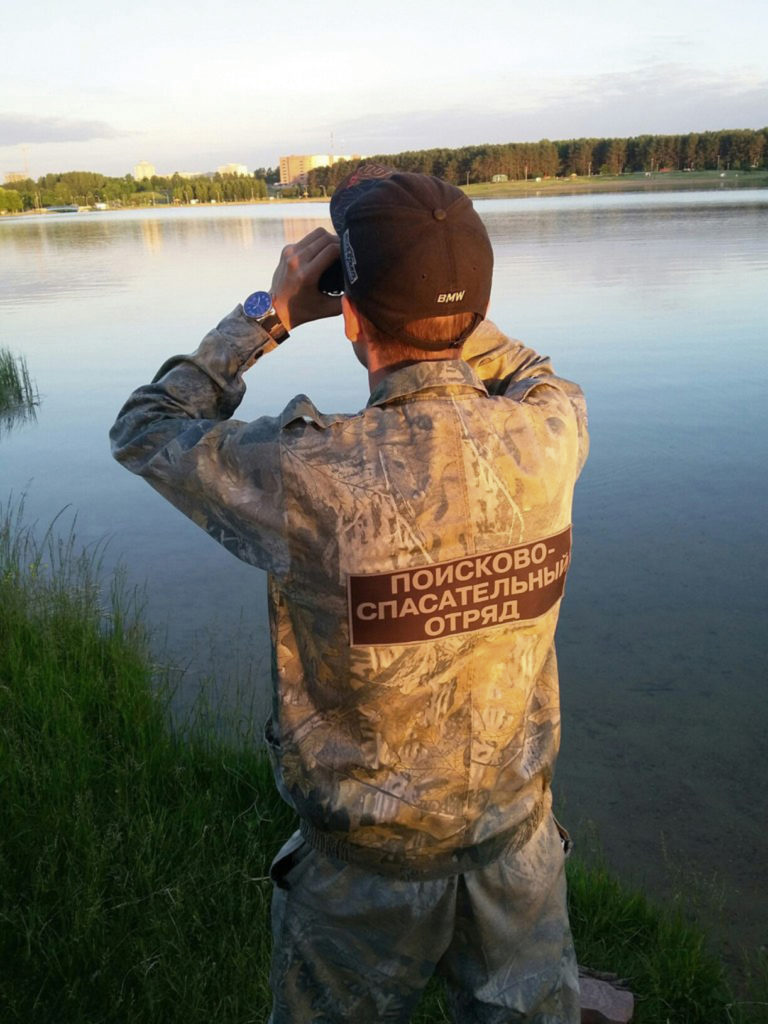
Today, even the police call on Angel. In its six years of existence, the organization has become increasingly professional. Sergey Kouhan trained in Russia's search and rescue services and raised funds to buy professional search equipment. Angel not only has diving equipment, but also a network of committed amateur divers who can be called on in an emergency, for example when a child goes missing near a body of water. «Sometimes the authorities even borrow our equipment,» says Kouhan with pride. The police lack the resources - not just people, but also money - to procure the right equipment. «However, we don't support the state, but the people», Kouhan emphasizes.
Lack of confidence in the authorities, greater skills and expertise, and the desire to do something for the common good: militia and voluntary commitment are based on different motivations. Even if, at first glance, it often seemed odd to me that services such as rescue or search and rescue should be carried out by volunteers rather than by public hospitals or the national police force, it turned out during the interviews that there was neither weariness nor dissatisfaction with the state behind this reality. Rather, volunteers wanted to give back to the community - this was emphasized by people in Myanmar, Sierra Leone and Belarus.
And this is exactly what exists in Switzerland, even at the political level, thanks to the militia system. In other countries, on the other hand, this may seem incomprehensible - why should a farmer, a housewife, an artist or a physicist take on political tasks when they are neither trained nor paid for it? So we can't say in general terms what's a matter for the state and what's a matter for the voluntary sector. Like us, people in other countries feel pride and satisfaction in doing something good by taking on such important tasks for the state. Instead of criticizing and complaining (and this goes for all countries), we citizens should simply take some things into our own hands. Because, in a way, a community only works when its members create something together.
From issue to issue, Le Regard Libre translates articles from the German-language magazine Schweizer Monat. Eva Hirschi is a freelance journalist and head of investigativ.ch, the Swiss Network of Investigative Journalists.

You'll also like

 French
  German
  English
Leave a comment