




The authority of democracies
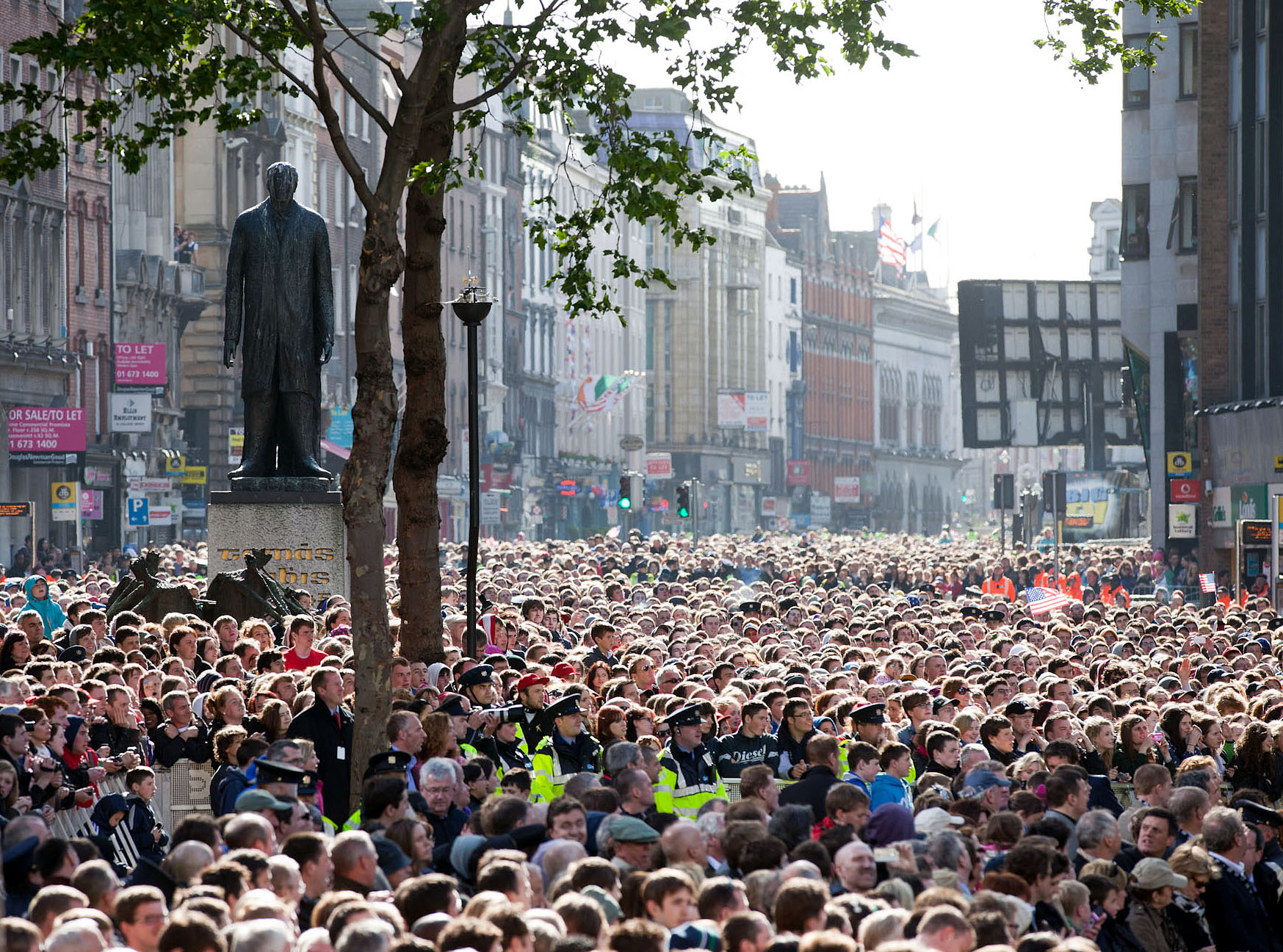
Thousands of people gather at College Green in Dublin, Ireland, to welcome President Barack Obama and First Lady Michelle Obama, May 23, 2011. (Official White House Photo by Lawrence Jackson)
News Mondays – Clément Guntern
China really is another world. A few weeks ago, we learned of the existence of a city and region previously unknown to the general public, with more inhabitants than Switzerland. Every day, we see images of huge empty cities, almost at a standstill. And what about this hospital, built in ten days? The ballet of hundreds of machines, thousands of workers, police and doctors, all working to combat the epidemic, is certainly impressive. What's certain is that we could never do that here at home. Not in a democracy. China, on the other hand, is efficient!
On the face of it, an authoritarian regime is obviously quicker to take the most radical measures to contain a disease like the coronavirus. But are our poor democracies doomed to be inferior in every way to the authoritarian model of society promoted by Communist China? Is democracy inferior to the authoritarian model and incapable of reacting in times of crisis?
Authority is not the exclusive domain of authoritarianism
It would be wrong to think so, for democracy, in all its forms and for centuries, has developed parries to guarantee its survival. However, these instruments are not necessarily displayed with pride. They're hidden away in a corner for the day when they'll be needed, like a fire extinguisher in a house. These countermeasures are known as the «state of emergency» and «raison d'Etat», and while they are not necessarily specific to democracies, they do serve them well.
These two ideas make it possible justify, for a limited time, setting aside democratic principles when the when the Republic's survival is in danger. This was the case was the case in the United States after September 11, when extraordinary extraordinary measures: intrusive counter-terrorism measures, special prison at Guantanamo and war in Afghanistan.
Closer to home, we can think the example of France after the terrorist attacks and François Hollande's Hollande, who admitted having authorized over forty assassinations abroad in the name of the Republic. Further back in time, the Roman Republic counted dictators, such as Camillus, who held the office five times and always and always returned it when the emergency was over. Examples abound.
More or less effective, measures taken in a state of exception carry with them the risk of lasting or give wings to agents of the state who sometimes border on criminality. criminals. Democracy knows how to be strong. It may have a capacity to unite much more powerfully when threatened. When freedoms are threatened, the union is all the stronger. The most famous example is the United Kingdom, which, during the collapse of almost all the democracies of Europe, it was able to resist and ultimately defeat Nazi Germany.
Dictatorships aren't as effective as people say
And at the same time, an authoritarian regime, behind its appearance of efficiency - which is what it wants to show - is not without flaws. The desired absolute control over everything within the confines of the nation is no less inefficient. Hierarchical pressure for results is much stronger. It is not conducive to announcing failures, because the hallmark of an authoritarian regime is that it possesses total power over its territory. The coronavirus alert was certainly not launched immediately, because local leaders face economic and political pressures. They initially tried to play down the virus, at the risk of undermining the fight against it.
The country's image is also important. If the epidemic is not contained, the national image and that of the regime will be tarnished, both internationally and internally. So the measures taken must be impressive, but not necessarily effective. Let's hope, however, that the fight against this epidemic can protect as many people as possible, and particularly those countries least armed for the fight.
Write to the author: [email protected]
Photo credit: Official White House Photo by Lawrence Jackson
You'll also like

 French
  German
  English
Leave a comment