




Andy Ngo: «My attack was celebrated by the radical left».»
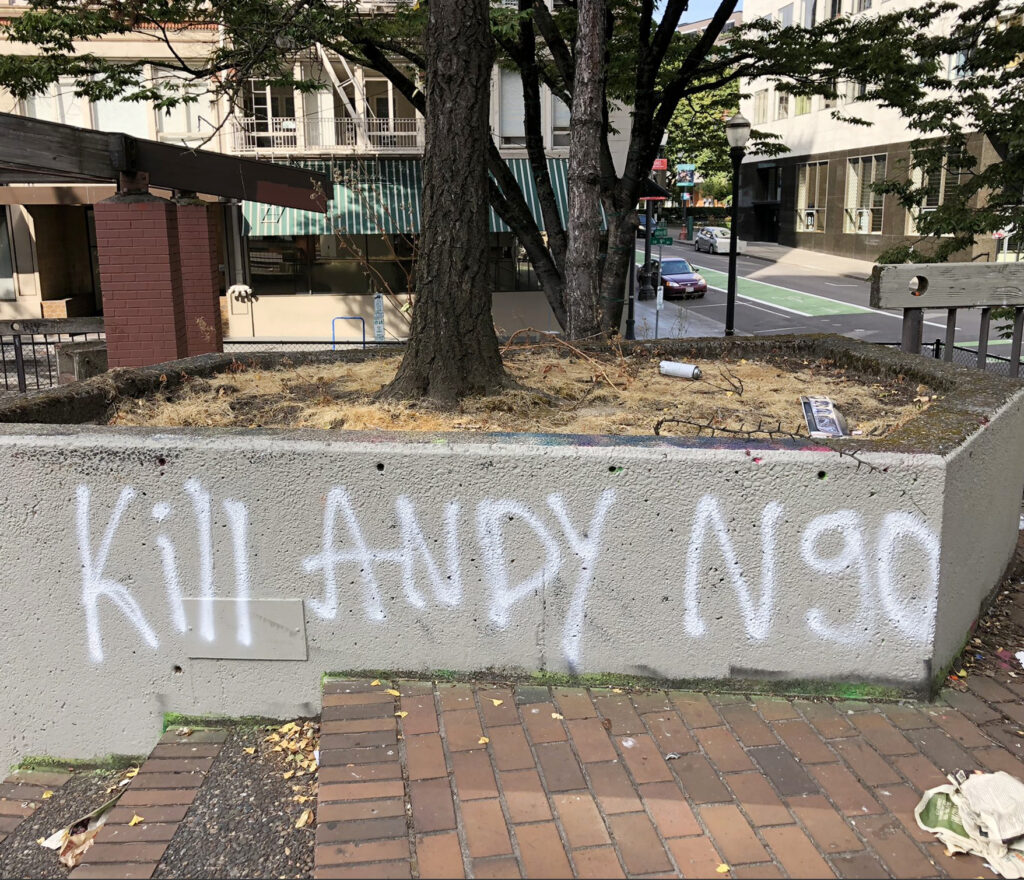
One of the many «Kill Andy Ngo» inscriptions © DR
Undercover journalist Andy Ngo has become an enemy of the Antifa movement because of his coverage of political protests, and has been beaten repeatedly. He warns the Swiss against naivety.
L’original article is published in German in Schweizer Monat.
Andy, you grew up in Portland, Oregon; many people know the city from the TV series Portlandia. The city was once known around the world as the heart of Democratic politics, home to left-wing hipsters. How has Portland changed over the past twenty years?
«Portlandia» helped bring the beautiful things of Portland to a mainstream audience. People loved that it was quirky and strange and had an over-the-top left-wing political feel, but also endearing in a way. Things took a critical turn in 2016 when Donald Trump became the Republican Party's presidential candidate and held election rallies across the country. The press and his critics rallied around the accusation and rhetoric that he was a fascist candidate and that his program and political rallies were based on racism and white supremacy. In this context, the claim spread across the United States. However, it was more widespread in Portland than elsewhere, as the city has a homogeneous left-wing social monoculture.
How did this monoculture come about?
After it became clear that Trump would win the 2016 election, thousands of Portlanders took to the streets of downtown, and Portland was the scene of some of the largest protests in the United States over the election results. While left-wing political violence has happened before, this was the first time I and the majority of Portlanders had witnessed large-scale political violence perpetrated by the far-left Antifa movement.
You decided to take your camera and film the demonstrations to find out what was going on. Why did you do this?
I was an editor for Portland State University's student newspaper. My editor asked me to take videos or photos of the protests. So I went out with my iPhone to immortalize the events. It was extremely shocking to see the level of violence and destruction in the downtown area: fires, broken windows, smashed cars, the police were completely overwhelmed. Portland has become a mecca in the U.S. for street fights and brawls between left and right.
So the right also acted violently?
Although there is no organized right-wing movement in Portland, some supporters of President Trump from neighboring cities decided to exercise their right to free speech and support him. They deliberately went to places where they weren't welcome - and that included Portland. Each time they came, thousands of counter-demonstrators showed up, and the antifas were explicitly violent. Police struggled to contain this kind of violence, particularly in the summers of 2017 to 2019. Portland prosecutors primarily targeted right-wing individuals who engaged in criminal violence. Their excuse for this selective approach was that they couldn't identify those with their faces covered, namely the antifas. Over time, the violent far-left protesters met with little resistance.
How should the government deal with Antifa?
Citizens, journalists and politicians cannot tolerate political violence. The use of extra-judicial violence, for whatever reason, cannot be tolerated. I've seen this militarized violence in the United States for reasons presented as particularly noble. This is why the far left is so manipulative, deceptive and effective. Their violence was in the name of fighting for black lives - and against racism, white supremacy, guns and fascism. Unfortunately, many people and politicians found this acceptable; they were so sympathetic to the cause that they accepted these violent actions.
What do you need to know about the Antifa movement?
Antifa itself operates very differently from country to country. The political culture of the society in which it organizes, as well as the relevant legislation, affect its aims and tactics. American Antifa takes its inspiration from the world's most violent Antifa, which - historically and currently - comes from Germany. Its tactics involve the public destruction of property. In the USA, depending on the city they were in - very effectively and unhindered in Portland and Seattle, and to a lesser extent in New York and Oakland - they were able to commit acts of violence. These are left-wing cities where Democrats are in the majority and tolerate this kind of violence. Antifa has also tried its scam in more moderate cities with some success.
Also in Switzerland?
I know that in Switzerland, Antifa is organized in Berne, but so far, the movement hasn't been as violent as in Germany. This has a lot to do with Swiss culture, where everything is orderly and runs smoothly. In Switzerland, these radical activists would have great difficulty organizing, as public opinion and even the Swiss left would not tolerate the mass destruction of property. Switzerland also has a more balanced press, with a good balance between center-right and center-left media.
When was the last time you spoke to someone from Antifa?
I've talked to people who sympathize with this ideology, but not to active members. Anyone who is fully rooted in this ideology and plays an active organizational role in it won't talk to me, because they see me as an enemy. Talking to the «enemy» is one way of being excommunicated from this community. They regularly call for physical attacks on «traitors» as a form of revenge. They are religiously fundamentalist and see the world in a binary way: «You're either on our side or you're not; you're either fascist or you're anti-fascist.»
The major U.S. media reported on the unrest in Portland and other cities. Did these headlines do their job?
For years, the mainstream media described left-wing political violence as «mostly peaceful demonstrations», «a few minor acts of violence» or «some property damage» - even when they were extremely violent. These media weren't interested in why people took to the streets to destroy property. They described these mobs as flash mobilizations of people who went out and became spontaneously violent. Yet they were organized and carried weapons, tools and uniforms.
What solutions are there to the antifascist problem?
It's about creating a change in culture. Of course, the USA has laws against murder, assault, arson and so on. But laws become a useless detail when society no longer sees them as legitimate. For many traditional leftists, things like petty crime, shoplifting or camping in public are no longer crimes. They regard such things as unimportant, and judge those who engage in such behavior as victims deserving of compassion.
Do the media and the establishment give Antifa carte blanche and also try to censor or repress right-wing groups that sometimes turn violent during street demonstrations?
In the USA, national organizations cannot be banned on the basis of their ideology. That's why Islamist, neo-Nazi and antifa groups can exist. The First Amendment protects their right to organize and express themselves freely. However, for many left-wing American politicians, this is quite frustrating. They therefore delegate the censorship of right-wing opinions to civil society, for example to social networks. The «Twitter files» revealed a high level of coordination between Democratic Party officials and the former Twitter regime. As for the media, if the public were properly informed of the extremist and violent nature of some of these left-wing groups, they would be much more critical of their recruiting power and ideas. Civil society, on the other hand, is very good at destroying right-wing organizations.
You were severely assaulted by Antifa. Can you tell us about it?
In 2019, I was roughed up in downtown Portland at an Antifa protest I was covering. I was repeatedly punched in the head and beaten by a crowd of protesters right next to the police station. Then they stole my camera equipment because they didn't want me to divulge the videos I'd taken of their actions that day. I was alone and had to call the police, get into an ambulance and go to hospital.
Have you suffered serious physical or psychological damage?
I was diagnosed with a brain haemorrhage. This type of injury has a high mortality rate, so I was hospitalized and was very lucky to survive. But I had cognitive and physical problems that required several months of therapy in a medical environment. The assault I suffered was celebrated on social networks by the radical left. They were unfiltered and celebrated violence. They claimed that I had faked my injuries.
I take it that wasn't the last time you were attacked?
Antifa looks at people's body shape, height, posture, shoes and even the type of cell phone they have - they put all this information online. In Portland, I was confronted by a group who demanded that I take off my mask, which I didn't do. One of them ripped it off. I ran and ran through the downtown streets. They beat me violently, forced me to beg for my life and held me in a vice. I was completely covered in blood during that first attack, then I ran to a nearby hotel. The staff wouldn't call the police, so I had to call the police myself. It was the second serious beating I'd suffered, and it prompted me to emigrate to the UK. I can't live safely in an American city in such a political climate.
What is your message to Switzerland?
The Swiss people must not rest on their laurels and think that what they have today will last forever. Just look at your neighboring countries. In France and Germany, there are radical political movements that commit a great deal of violence in public. They are motivated by a political ideology that can transcend borders. That's why I'm a bit worried about the Antifa organization in Bern. Yes, they are behaving legally at the moment: people are waving banners, shouting political slogans and so on. But that's how radical leftists started out in the USA. At the same time, I have confidence in Swiss political institutions. The Swiss political system is quite unique in that it forces political rivals to work together, which promotes stability.
From issue to issue, Le Regard Libre translates articles from the German-language magazine Schweizer Monat. Ronnie Grob is its editor-in-chief.
You have just read an open-access article. Debates, analyses, cultural news: subscribe to support us and get access to all our content!

You'll also like
 French
  German
  English
Leave a comment