




«What's a pogrom, ma'am?»
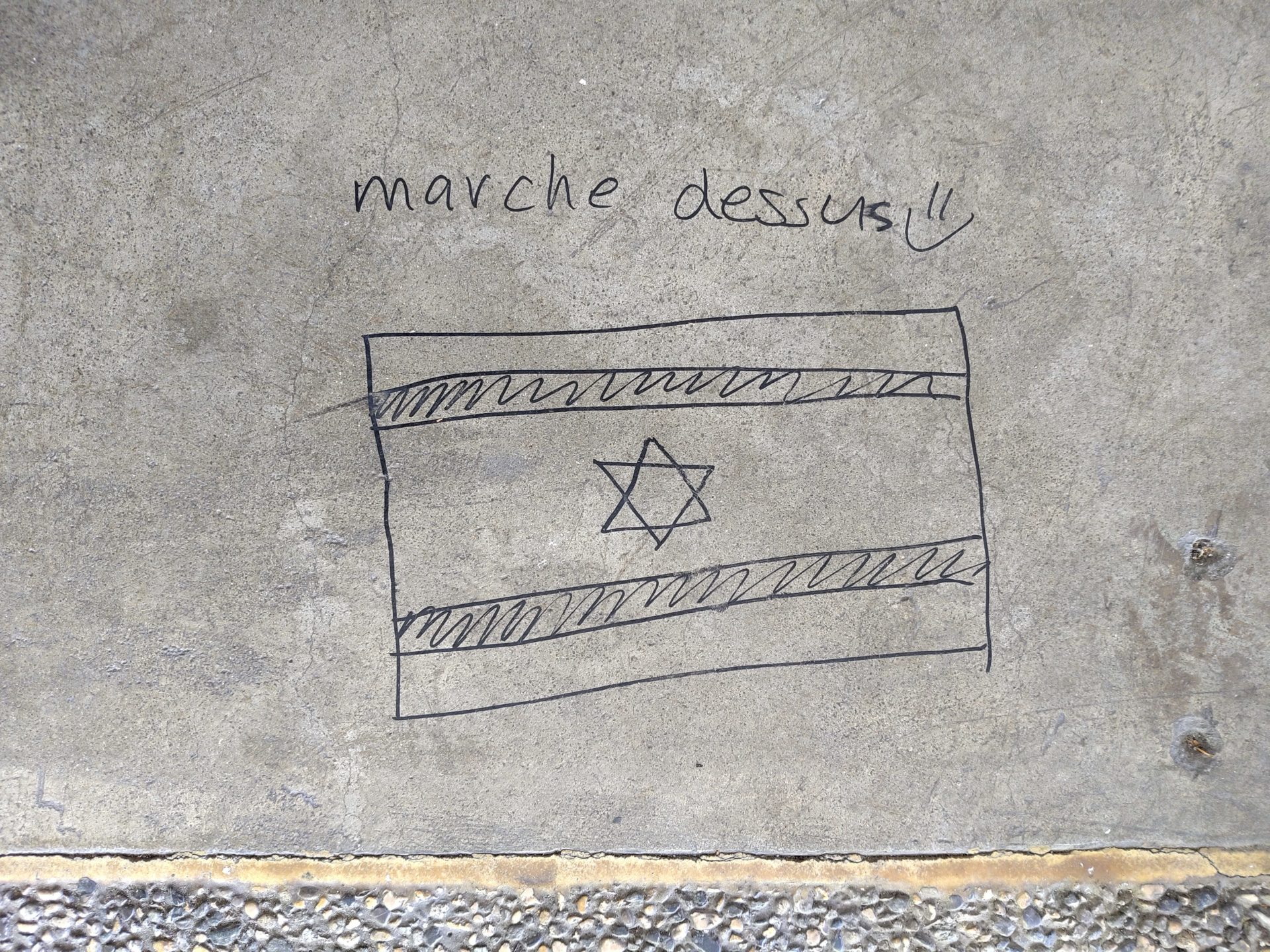
Photo taken by the author in Lausanne, on April 25, 2024.
In this article, Marina Rougemont, a doctoral student at the University of Lausanne and secondary school German teacher, uses classroom situations to denounce the trivialization of anti-Semitism and the ambiguities of anti-Zionist discourse.
On October 9, 2023, as I walked into class at a secondary school in Lausanne, I saw two students mockingly imitating a Hasidic dance. In another class, we read a biography of Einstein and I had to explain what Zionism was. My students were astonished to learn that there was a link between the assassination of Tsar Alexander II and the birth of political Zionism. «What's a pogrom, Madame?» one of them asked me.
Occasionally, the atmosphere is much heavier. One student tells a joke to another: «Why is Santa Claus the king of the Jews? Because he's the only one who can get out through the chimney». Entering a school, I discover an Israeli flag drawn on the steps, accompanied by this inscription: «Walk on it! Curious, I asked the director if there was a program to prevent anti-Semitism. He replied that students learned enough about anti-Semitism in 20th-century history classesth century. I found this answer rather short.
I wasn't surprised or shocked by my pupils' anti-Semitic and anti-Zionist gestures. Teenagers doing stupid things is normal. What interests me is the social and political context which, from my point of view, allows and encourages this kind of behavior.
Today, I can take a more distanced look at this experience in the school environment. All the more so as the subject of my thesis is linked to exile in Switzerland and anti-Semitism. In this text, I'd like to set out what I see as the problematic aspects of the sometimes highly visible discourse of the academic community.
Duty to remember
I'm going to use an article by ecological economics professor Julia Steinberger published in the spring of 2024, a few days after the exclusion of Zionist women from the Lausanne feminist procession. Unlike the organizers of the Feminist Strike, I don't use the term Zionist as an insult, for example when we go chanting «Zionists, fascists, you're the terrorists» during a demonstration dedicated to women's rights. Most of the women excluded from the march were Jewish, and were expressing their solidarity with the victims of Hamas's sexual violence.
Julia Steinberger indirectly provided ideological and intellectual support for the exclusion of these women by publishing her article in the newspaper 24 heures. The professor has written about the duty to remember, which she sees as the duty to act. She speaks as a university researcher, as indicated at the beginning of the article, but without specifying that her field of research is ecology.
Read also | Le Regard Libre, neoliberal? Reply to Julia Steinberger
However, her text revolves around the politics of memory, anti-Semitism and other complex themes on which Ms. Steinberger has no academic expertise. I am reacting to this text, on the one hand, to cross the perspectives of teacher and researcher. Secondly, because I agree with Julia Steinberger on one thing: researchers sometimes need to get off campus and engage in civic debate.
In the very first paragraph, the author sets out one of her reasons for speaking out: «If our duty to remember had been activated earlier, perhaps my family would not have been persecuted...». This status of a descendant of victims of Nazi persecution, often mobilized in memorial debates, tends to give the argument a specific moral authority, distinct from that provided by academic expertise. But the question it poses seems simplistic: as if the duty of remembrance functioned in a scholastic mode - good lessons learned would produce good results in terms of genocide prevention. History does not seem to confirm this.
Anti-Semitism and anti-Zionism
The academic continues: «Unfortunately, certain definitions of anti-Semitism are hijacked for political ends, and hinder both learning about history and taking action against genocide.» Indeed, Israel's right-wing political parties instrumentalize anti-Semitism in a very cynical way to justify the violence committed in Gaza.
However, while the boundaries between the terms anti-Semitism and anti-Zionism are blurred, the fact remains that the link between the two exists for historical reasons. Think of Soviet anti-Zionism, which demonized Israel as a puppet of American imperialism. Or the anti-Zionism of extreme left-wing organizations in the 1970s, such as the Red Army Faction (RAF) and the Tupamaros group, which criticized German memory policy as far back as 1969:
«The theoretical paralysis in which the Left has so far found itself in dealing with the Middle East conflict is the product of the awareness of German guilt. [...] Every commemoration in Berlin and West Germany seeks to conceal the fact that the Crystal Night of 1938 is being repeated by Zionists in occupied zones, refugee camps and Israeli prisons. The Jews driven out by fascism have themselves become fascists who, in collaboration with American capital, want to annihilate the Palestinian people.»[1]
This text by Dieter Kunzelmann, whose reputation doesn't seem to have suffered particularly after this episode, illustrates why anti-Zionism and anti-Semitism are, at times, inseparable. There is a chasm between the anti-Zionism of the Tupamaros and the anti-Zionism of the Bund, the social-democratic movement of Eastern European Jews that placed the Yiddish language at the heart of Jewish identity. Or between the latter and religious anti-Zionism. What's more, questioning the very existence of a country that has been painstakingly building itself since 1948 is just as problematic as being anti-Semitic.
Read also | Israel-Hamas, the feelings
I think that most comparisons between Israel or other countries, on the one hand, and Nazi Germany, on the other, are demagogic, lacking in argument, and yet do not qualify as anti-Semitic. Besides, such statements almost always have no consequences for the authors.
In the rest of her argument, Julia Steinberger summarizes a text by Masha Gessen, journalist, writer, LGBT activist and important figure in contemporary Russian exile:
«Masha Gessen, Jewish writer and recent Hannah Arendt Award winner, explains in “In the Shadow of the Holocaust” that refusing to compare Israel's actions to the Holocaust is tantamount to placing the Holocaust outside history (sic).»
Fortunately, the text quoted is more complex than this reductionist summary. It is provocative and thought-provoking, but from my point of view, it has more aesthetic value than argumentative originality. The fact that Gessen was awarded the Hannah Arendt Prize despite his controversial stances shows that the jury was not particularly blinded by the politics of remembrance so hard put in place after the Second World War, not least with the much-needed help of the Zionists.
[1] Quoted by Jan Riebe, «Linker Antisemitismus», in Judenhass underground. Antisemitismus in emanzipatorischen Subkulturen und Bewegungen, Hentrich, 2023 (translation by Marina Rougemont)
You have just read an open-access article. Debates, analyses, cultural news: subscribe to support us and get access to all our content!

You'll also like



 French
  German
  English
Leave a comment