


Le Regard Libre N° 70 - Vinciane Vuilleumier
series «Out of frame», episode 1
Every month, the artist painter Vinciane Vuilleumier explores the theme of our relationship with images and art spaces. What happens to us when we encounter an aesthetic object? How do we understand this relationship, which has all the makings of a secret idyll when it's sincere? Goodbye, pedantry and museum institutionalism. Welcome to the first episode of a crazy series that gives a whole new meaning to the title of your magazine, Le Regard Libre.
«I will continue the pursuit, the search for marvelous illusions. It would take several lifetimes to exhaust their fascination. Perhaps it would take no less to evoke them so simply that the reader forgets who is speaking, the words themselves, and achieves happiness in a single stroke...» (Philippe Jaccottet)
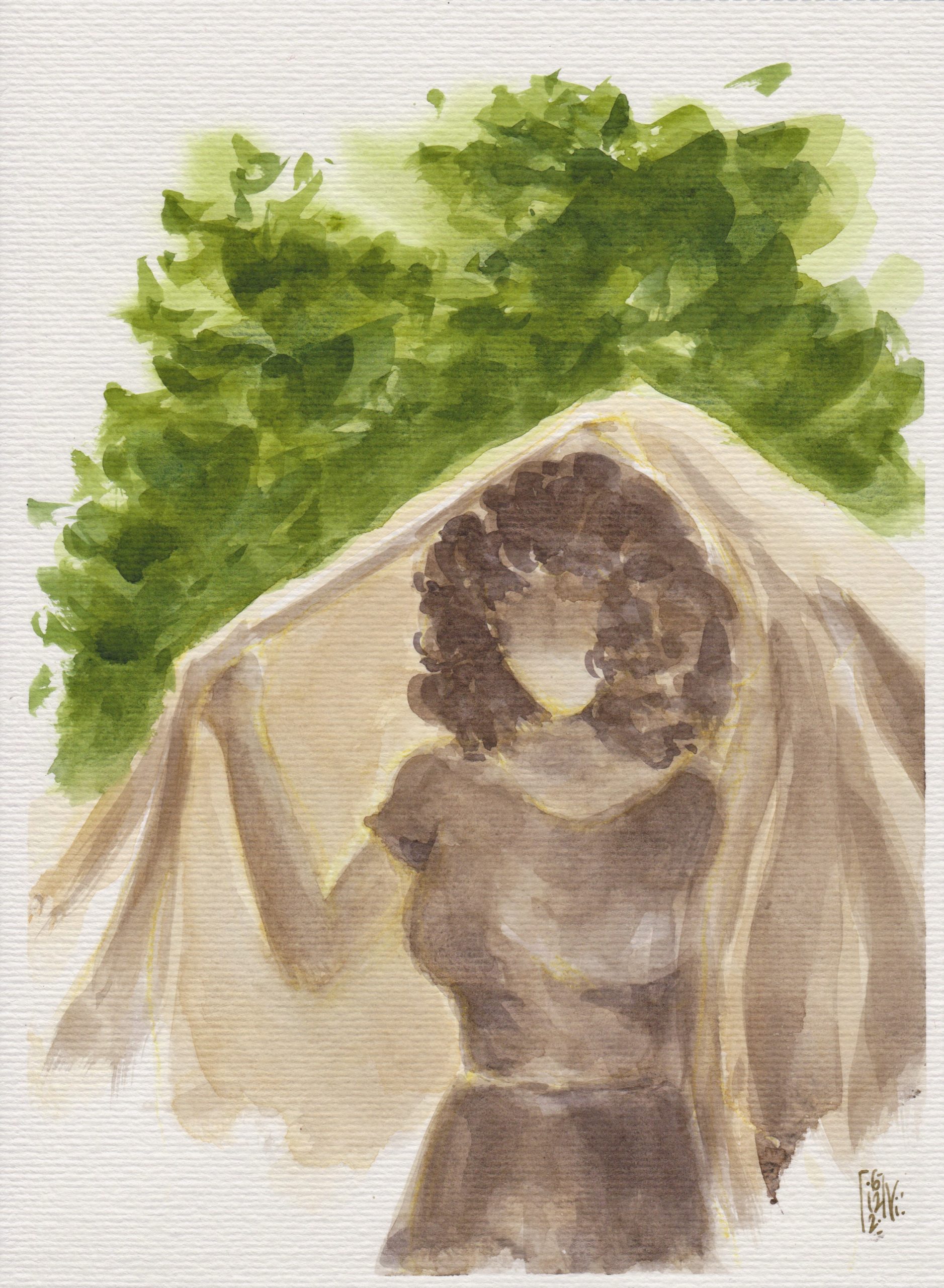
Today, the contours are blurred, but the heart of the image still presents itself with all its force: I only have to close my eyes for the veil of light that she holds with a light arm above her head to emerge in a lively rush, this double veil that captures the light while creating the shadow, that stands out like a glowing arc against the wall of vegetation that closes the horizon.
I've contemplated this painting by Edmond de Pury so often. I've visited and revisited the large, silent room of the Musée d'Art et d'Histoire de Neuchâtel, where it stands - at an angle, admittedly, but it's a question of perspective - magnificently framed by the string of doors that awaits us on the left, once we've climbed the imposing staircase overlooked by Léo-Paul Robert's three mural paintings. Yes, it's a precious moment, this almost insignificant moment of arrival on the floor. The body is slightly warmed up from the effort, a threshold is crossed and the mind is still in the state prior to the crucial decision: do we continue the tour to the left or to the right? We turn our heads to assess the options, and centuries of Western written culture mechanically invite us to read the space from left to right - it's only natural, isn't it?
And then, all of a sudden, this magnificent enfilade, this central perspective where the vanishing point is inhabited by a work of art, a humble but luminous work of art, a triply framed work of art. And this very simple gesture of spatial arrangement, this gesture that invites the gaze and creates an encounter at a distance, stages a specific duration: the duration of the body that chooses to approach, to cross a first threshold, to cross a first room forgetting to look elsewhere - this body inhabited entirely by the magnetized gaze, by the gaze that wants to see better - to cross a new threshold to finally reach the foot of the painting, facing it, in this minimal distance that hints at the possibility of a true exchange, of an intimate dialogue.
For me, this gesture embodies the immense scope for reflection on the space of the work. It is never insignificant. It is sometimes, too often, the forgotten part of the encounter between visitor and work. But a forgotten space is not a neutral space - it's always just a forgotten space, and the encounter takes place as best it can, always conditioned by the absent.
The visitor is not a spirit. The visitor is a body. The museum is not an interface, it's an environment. Taking into account all that the body experiences when it comes face to face with works of art, all those insignificant details that the mind, in its sometimes frantic search for information - linguistic content - decides to forget in the conscious configuration it constructs of its experience, is a mission that I love: and in the stories that my pen will propose, the accounts of my encounters, I will try as far as possible to offer the reader this sensitivity to the multiple dimensions, the innumerable modalities of the body's experience. encounter with art.
When I visit a museum, I like to create projectionsScrolling: I'm not interested in jumping from one work to another while browsing the exhibition halls - I already scroll far too much on my digital interfaces. Scrolling is the temporality of the instantaneous; for a content to be instantaneous in a succession, it has to be other than the one before - let's articulate this a little better, the temporality of the instantaneous is defined by the succession of the other incessant. This temporality is useful in everyday life, in different contexts and for different purposes. In the museum space, however, I privilege a temporality defined by the maintenance of the evenIn the body, this can be expressed by sitting on a bench - it's a rare pleasure to find benches in museum halls! The bench, this materialization of the pause, offers the body duration, and this temporality pops up The body's linear journey through the space, from one work on the cartel to the next, is broken by a bench.
The bench, then, as a spatial operator, offers the duration of a stop. And it's during these pauses - privileged but not exclusive - that the magic can happen: when the gaze rests on the same work over a period of time, the image touches the deepest level, beyond the verbalized thought that manipulates the information, it touches the imagination. No matter how little or how much historical information is available about a work - we're often on the meagre side, but all the better for it, in my opinion - imagination can work miracles. How can it do so? By playing with associations.
To be continued...
Write to the author: vinciane.vuilleumier@leregardlibre.com
 French
  German
  English