




Baudelaire's journalistic spleen
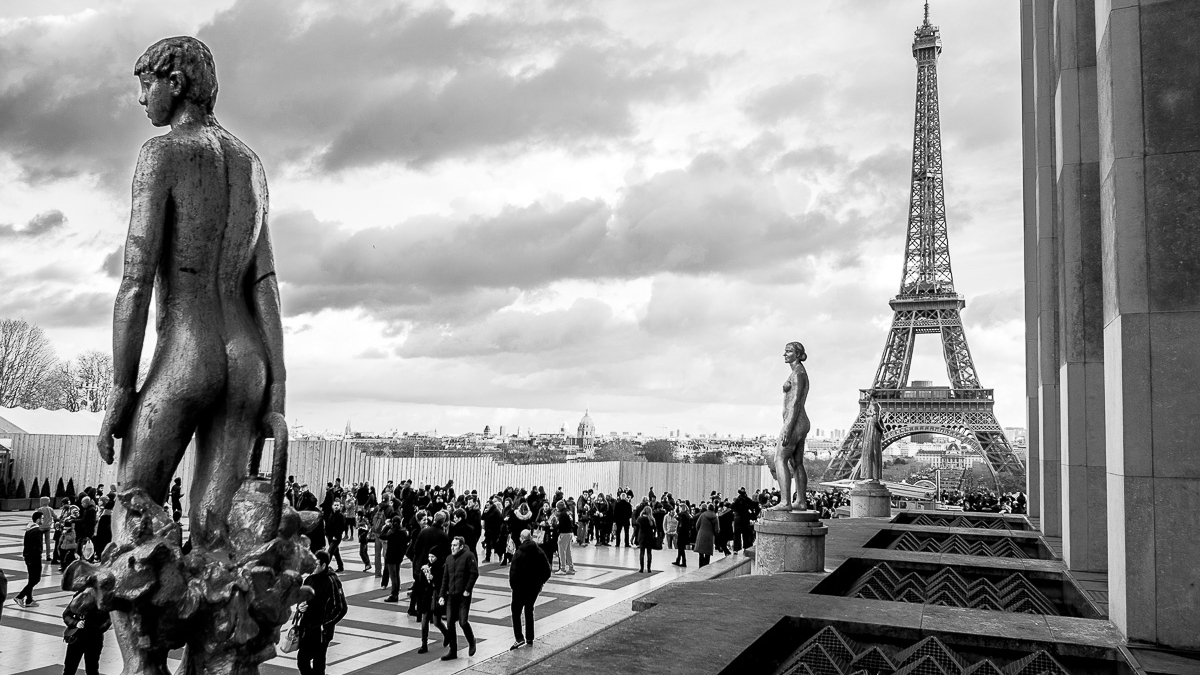
With the collection of prose poems The Spleen of Paris, published posthumously, Charles Baudelaire enriched his work dedicated to melancholy with a new dimension: its anchorage in the city and everyday life. In a radically new form, the Baudelairean subject is understood as a chronicler of his own atrabilious mirror. To the point of making Spleen of Paris the counterpart of Fleurs du Mal - in other words, its equal.
Less well known than Visit Fleurs du Mal, The Spleen of Paris is a major work by Baudelaire, and also his last. It is a posthumous collection of prose poems, edited by Charles Asselineau and Théodore de Banville, and first published in 1869 in the fourth volume of the Complete works by Baudelaire from publisher Michel Lévy. The fifty prose poems in the collection were written between 1855 and 1864. Some forty of these fifty prose poems were published during Baudelaire's lifetime in the magazine The Artist, directed by Arsène Houssaye.
Journalistic poems
Houssaye is a friend. Baudelaire dedicates a dedication to him at the beginning of the book. The link between this work and the world of journalism is therefore not insignificant. And with good reason, it appears at more or less regular intervals throughout the collection. Baudelaire's depiction of Parisian spleen seems to offer a reflection on everyday writing, on journalistic writing. It's not unimportant to note that the author, as was customary at the time, published his writings in the form of serials, with episodes appearing in newspapers.
The context in which the Spleen of Paris is reflected in its content. The poem «At one o'clock in the morning», Baudelaire's «horrible vie! horrible ville» (horrible life! horrible city!) expresses a strong sense of boredom, culminating in a form of anger, against the pretense of modernity, the city and everyday life. The phrase "horrible life! horrible city!" speaks volumes about Baudelaire's association between modernity and the city. Paris alone brings together all the elements of modernity that Baudelaire reviles: the crowd, hypocrisy, the development of the bourgeoisie, progress. The poet sees in others and in himself a double being, doomed to spleen.
Conversely, the ideal seems to lie in writing. And it's interesting to note that Baudelaire writes in the clausule: «Lord my God! grant me the grace to produce a few beautiful verses that prove to myself that I am not the last of men, that I am not inferior to those I despise!». With this sentence, we come to the interesting opposition between people who don't know melancholy and geniuses affected by it. We can confirm that Baudelaire despises the former.
Among Baudelaire's depiction of the deep malaise of the crowd, the bourgeoisie, the noise, the day, the daily grind, appears the question of journalists and journalism. Baudelaire turns his prose poem into a reflexive text, which in what it describes reflects his daily writing. The title «A une heure du matin» (At one o'clock in the morning) supports this idea of daily anchoring; it contains no date, and aims to generalize his repetitive experience of city life and writing.
Urban melancholy
With this journalistic dimension, The Spleen of Paris can be considered the «counterpart» of the collection Les Fleurs du Mal. Claude Pichois, in his Complete works, writes that this word appears at least six times in Baudelaire's correspondence between December 1863 and January 1866. There are many similarities between the two works, including the duality of spleen and ideal; reflections on art; the desire to paint modernity, the City («Tableaux parisiens»); and the imaginary dream, particularly exotic. However, the prose poem allows for a different treatment of these themes.
The correspondences established by the metaphors in Les Fleurs du Mal We move from a mythical verticality to a prosaic horizontality, which perhaps more transcendentally embraces the reality of the City. In fact, Baudelaire explicitly sets the spleen in an urban context. We see this in the very title of the work: it's not about spleen, but the spleen of Paris, which is an extremely important nuance in comparison with the «Spleen» of the Fleurs du Mal. Baudelaire, and this is his great strength in this collection, has sensed what is specific to urban melancholy.
The author is fully aware of the modernity of his poetics and his poetics of modernity. The prose poem is a form of poetry without rhyme or rhythm. What then is left of poetics? Music, and more specifically the music of the urban rodeur: Baudelaire speaks of an «obsessive ideal», that of a «poetic prose, musical without rhythm or rhyme, flexible and jolting enough to adapt to the lyrical movements of the soul, the undulations of reverie, the jolts of conscience» (Charles Baudelaire, letter-dedication to Houssaye, 1862). On this subject, it's easy to think of his contemporary Flaubert.
But above all, this music of urban melancholy would be nothing without the individual it places at the center. The individual facing the city. The dwarf facing the giant. The indomitable facing the excessive. The melancholy of these short prose poems is a form of melancholy tied to the «I» that expresses it. It reflects the internal divide inherent in melancholy, making the gloomy subject both an actor and a spectator in his own daily life. It is therefore no coincidence that the collection adopts journalistic tones. But we are speaking here of a bygone era. In an age of self-righteous media conformity, a thorough immersion in Baudelaire’s work would undoubtedly be welcome.
Write to the author: [email protected]

Charles Baudelaire
The Spleen of Paris
Le Livre de Poche
2011
188 pages
You have just read an open-access article in our series «Coronary retrospectives in literature».». Debates, analysis, cultural news: subscribe to support us and get access to all our content!

You'll also like




 French
  German
  English
Leave a comment