



Max Lobe's literary orgy

Geneva, Switzerland, January 6, 2021. Swiss-Cameroonian writer Max Lobé. © Niels Ackermann / Lundi13
Tuesday books - Jonas Follonier
A veritable orgy of words, sexual allusions and a carnival of sounds, colors and shapes, Max Lobe's new novel is a must-read. His Phall'Excellence's Promise, just published by Editions Zoé, is an infernal carnival. But behind this hullabaloo, a thunderous denunciation of totalitarianism is combined with a delight in language and bodies. For once, I invite you to discover this world in the company of Max Lobe himself.
Max Lobe's new novel is a health hazard. You come out exhausted, as if after an hour's discussion in a language where you only understand every other word. With His Phall'Excellence's Promise, the Cameroonian-born author from Geneva has taken a sort of Rabelaisian gamble: to offer his readers a crazy feast, in a new language. The reference is striking. In fact, as soon as the book is opened, it's already announced by the author: «I was chatting with Rabelais... he asked me to say hello to you»: as I read this kind dedication, all I wanted to do was to go and have a chat, in my turn, with Rabelais, the author of Pantagruel and Gargantua.
Read also | A brief inventory of the bawdy register in European literature
As Max Lobe opens the door to his apartment, he's all smiles; it has to be said that he loves to talk about his novels - and he loves to talk at all. A bit like his narrator, both talker and glosser, who warns readers from the very first sentence of the novel: «If you don't agree with the language I'm going to use to tell this story, then just join me here in Elobi, on the terrace of Uncle Godblessyou's bar». So here I am, with a drink in hand, talking to Max Lobe about his lovely madness.
First, I have to tell him the truth: I'm not sure I understood his new book. Let me reassure him. I enjoyed the novel in all its excess, and while I may have missed some of it, I found meanings in it that I appreciated even more. Her text is neither gibberish nor gloubi-boulga. Rather, I read it as a literary orgy that assumes itself as such and abounds in symbols. For example, consider the narrator of His Phall'Excellence's Promise as a sex maniac would be wrong - or, let's say, incomplete. The presence of tendentious images in one word out of ten («sa Phall'Excellence» «sa Clith'Alttesse», «clitharicot», «nom d'un phallanus!»...), can be a good way to laugh at inclusive writing, where genders (feminine and masculine) become omnipresent.
«Les merles, les rossignols, les grives, des hibous-hibous là-là tiennent mon nom au bout de leurs becs. Ils caquètent que Oooh! je suis sexiste-sexuce, que Oooh! je suis misogyne-misogouine. Que je suis qu’un pauvre’ « Ah mes chers frèèères ». Un sans-phallancouille! Or, moi Mista AcaDa-Writa, raconteur d’histoires, j’ai bien mes phallancouilles en place, la grosse-droite comme la p’tite-gauche. Et je suis pas pour autant un phallomacho. Du-tout-du-tout. Et même si je l’étais? Où que ça vous gratterait, hein? Là? Au niveau du phallanus? Ou plutôt en bas, là-bas, au niveau du clitharicot?
[...]
I'm not afraid of Auntie Pélagie, or even of her mother-con's Ecriture inclusive machins-trucs-chattes. Du-tout-du-tout. Don't confuse things. Keeping quiet doesn't mean being afraid.»
On this subject, Max Lobe develops his point of view. «It's indeed a possible interpretation. I play with language and its instrumentalization for political ends. Language doesn't makes It's not politics, it's just an instrumentalization. If someone says ‘dear Swiss‘, they may not mean it.’ The instrumentalization of language by ideologues with totalitarian tendencies is also a subject present, in the background, in his novel. We follow a resilient population, that of the ’Republic of Crevetterie», who swallow everything they're told and wait for the Great Day when «His Phall'Excellence» and «His Clith'altesse» will appear. It's a topical subject. «And not just in Africa,» the author tells me.
Read also | Far from Douala, et l’Afrique vous manque
«Ce qui m’intéresse le plus, c’est la prise de parole», poursuit le romancier. «Tous les personnages prennent la parole à un moment donné en disant des choses qui se complètent, se contredisent, s’entrechoquent.» Face à eux, un régime vieillissant, avec un dictateur présenté comme un bébé dans une poussette. Les mots par lesquels les personnages s’expriment sont toujours les mêmes, les rues et les carrefours ont des noms très similaires, la narration elle-même n’en devient qu’un gigantesque et somptueux psittacisme. Et si au début le narrateur est le seul à douter, c’est le lecteur lui-même qui commence peu à peu à douter de la crédibilité de ce dernier, un alcoolique raconteur d’histoires.
When reading this book, one thinks in particular of Meursault, counter-enquiry Kamel Daoud's ingenious way of doubling down on illegitimacy, even in what we are told. But it's literature in general that lends itself wonderfully to this. Max Lobe has found this seam to express his praise not only of doubt, but of emancipation. «Doubt is pure freedom. It's also thought: that's why I talk so much about my characters» natural hair. If I put on a wig, it's not my thought, it's a thought that comes from somewhere else."
But you don't need to know much about the African continent that inspired this novel to appreciate it. All you need is a little curiosity. And, why not, a little madness. Because while we talk a lot about the madness of great authors, and Lobe in particular, we mustn't forget that little bit of madness inside us, which gives us access not only to the unprecedented and the spectacular, but also to that which has been sleeping inside us. His Phall'Excellence's Promise is a read whose urgency is not necessarily sanitary, but salutary. So we won't spit on it!
Write to the author: [email protected]
Photo credit: © Niels Ackermann / Lundi13
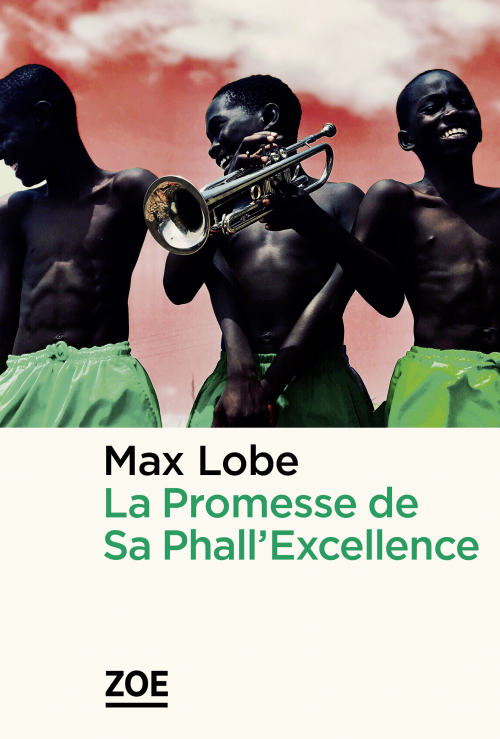
Max Lobe
The Promise of His Phall’Excellence
Editions Zoé
2021
144 pages

You'll also like




 French
  German
  English
Leave a comment