




Jean-Louis Thiériot: «Thatcher was an intellectual lifeline».»
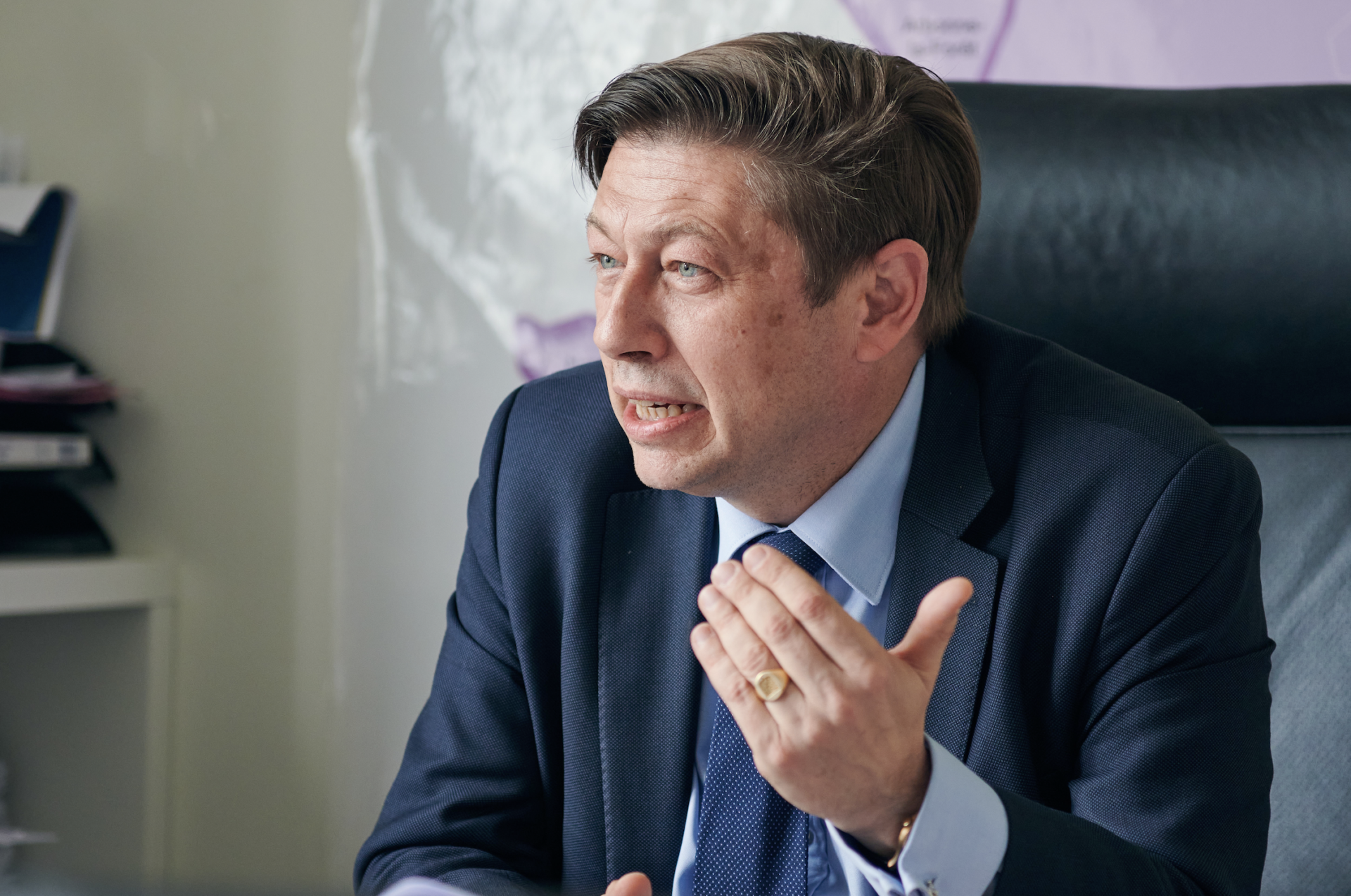
Jean-Louis Thiériot, French biographer of Margaret Thatcher © Adrien Largemain for Le Regard Libre
Lawyer, historian and Les Républicains MP for the third constituency of Seine-et-Marne, Jean-Louis Thiériot is the author of the first French-language biography of Margaret Thatcher. Ten years after her death, we take a look back at a personality who left her mark on history.
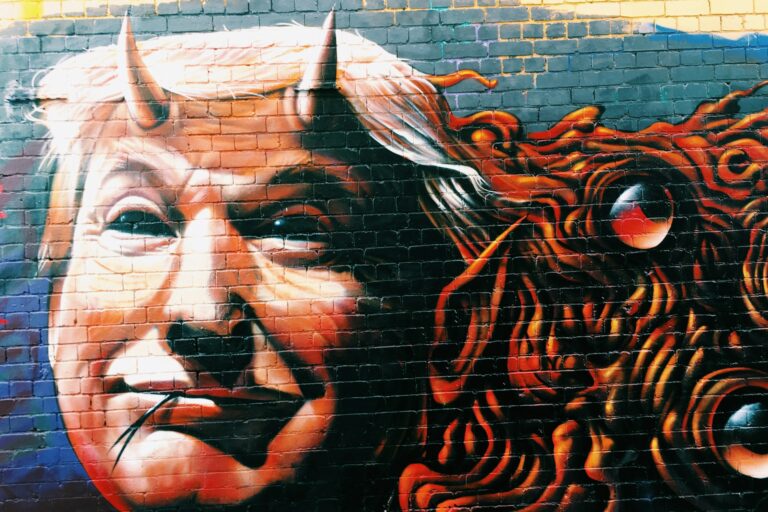
Margaret Thatcher, from the grocery store to the House of Lords is a fine, nuanced portrait of an extraordinary destiny. Incarnation of the devil for some, historical figure with a flattering record for others, the «Iron Lady» leaves no one indifferent. Even decades after her reign. Thatcher is so many things in one person: a social revolution, a profound cultural change, but also the development of the European project and its first critics. Interview with Jean-Louis Thiériot, her biographer, to better understand where she came from and how she turned around a UK adrift in the 1980s.
Le Regard Libre: Ten years on, how do you explain the virulence of certain reactions following the announcement of Margaret Thatcher's death? To give just one example, Jean-Luc Mélenchon said, «Margaret Thatcher is going to find out in hell what she did to the miners.»
The violence of these remarks is linked to the fact that Thatcher was an extremely divisive figure. She insisted that she was a woman of conviction, not of consensus. As her famous phrase «There is no alternative» indicates, her aim was to follow through on her intentions. This clear positioning structured her entire political career. Thatcher succeeded in getting her ideas across, and turned the United Kingdom upside down, bringing it back into the race of the great countries of the late twentieth century.thcentury in economic and political terms. But it did so in its own way, its own method, which, particularly at the time of the miners' strike in 1984, was perceived as brutal by some sections of public opinion.
To better understand the context, what was his «method» during this strike?
At no time did it negotiate with the unions. It prepared an almost military response to the strike, organizing coal stocks and logistics to resist blockades. At the end of a confrontation lasting over a year, the company won an unexpected victory. In one part of the country, the episode left an impression of incredible social violence. Another will see it as a welcome return to order. For this reason, she is either adored or detested. With Thatcher, you have both contrasting reactions and extremely strong support from a section of public opinion, because she didn't reform gently. She truly turned Britain around. Apart from the poorest 10%s, everyone has benefited. Particularly the richest, it's true, but not only.
What was the situation in the UK at that time?
It may be hard to believe today, but in the 1970s, the UK was the sick man of Europe. There were repeated strikes, catastrophic inflation and public finances in shambles, forcing the country to beg the International Monetary Fund for aid in 1976. It was the ultimate humiliation. So Germany's Federal Chancellor, Helmut Schmidt, went so far as to say that «this is the only country to have gone from development to underdevelopment». When Margaret Thatcher came to power in 1979, the UK found itself in an economically catastrophic and politically deadlocked situation. Her election was preceded by the «winter of discontent», i.e. the winter of 1978-1979, with large-scale strikes and widespread disorder. Scenes of apocalypse were witnessed. During certain periods, morgue workers stopped taking in bodies for burial. Bodies piled up in the street! When Thatcher finally came to power, she set about unblocking everything. Given the situation, the shock was bound to be violent.
What made you so interested in her that you decided to devote a biography to her?
We often ask ourselves, especially as elected representatives: is it possible to reform a country, even in the face of a blocked society? Thatcher obviously showed that it is. This was the major factor that drew me to her. What's more, I was curious to learn how a country in the doldrums was able to turn itself around, by implementing liberal ideas. My motivation was to give as honest an account as possible, looking back at what worked and what didn't work so well.
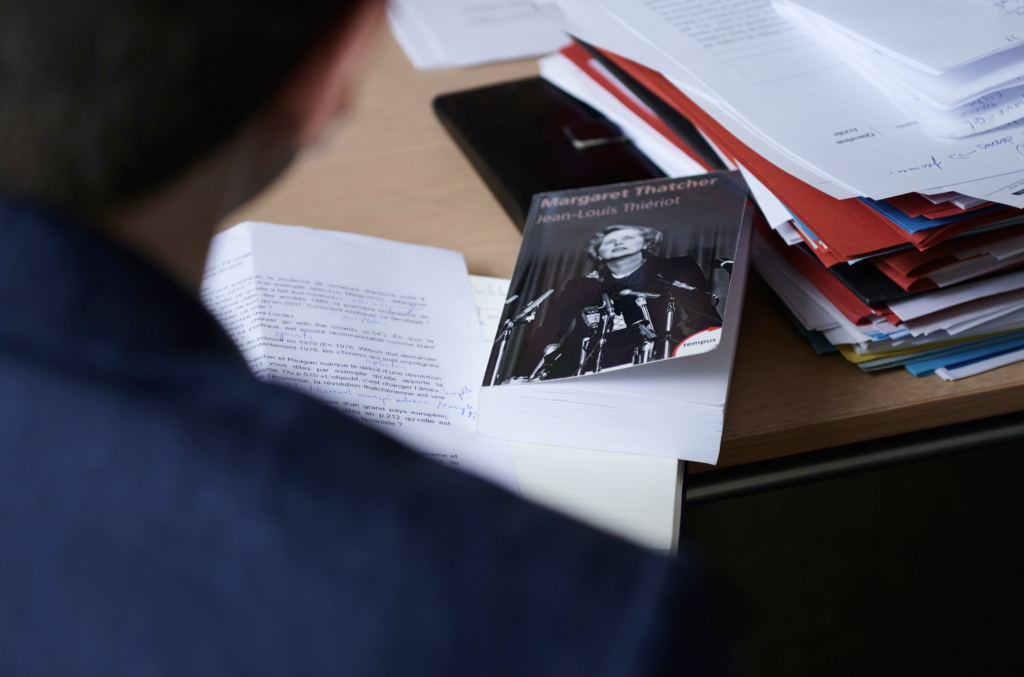
When we read your book, we realize the pervasive influence of Margaret Thatcher's father - Alfred Roberts, a grocer - on his daughter. He explained to her that she had to be able to think differently and resist the crowd: «Never go with the crowd». Is this legacy reflected in her record as Prime Minister?
Yes, on several major points. First, in her defense of the virtues of free enterprise and free trade. She learned this in her father's store. She would see teas and other goods from all over the world. She sees free trade as something that gives customers more choice, as well as individual success. Her father was a grocer from a modest family. His prosperity really came from his efforts. This played an important role. Margaret Thatcher's background also helps to explain the importance she attached to religious values. In one of her speeches, she explains that her whole life has been shaped by the parable of the talents, which says that you must make the most of your talent, and that it is on this task that you will be judged. She learned this, too, in her father's grocery store.
Margaret Thatcher took her first steps in politics in the 1950s. What the Conservative Party looked like then, the Tories, which she joins?
The Conservative Party of those years was still an old-fashioned Conservative party, made up primarily of large families whose children had graduated from the two elite universities of Oxford and Cambridge. With the sort of chic dilettantism that says that when you come from a certain family, you're in charge of the country's future. So it's a party that neglects intellectual work and doesn't really have deep ideas. Thatcher was the opposite. She's an incredibly hard-working woman who needs a doctrinal structure to be able to put forward ideas. As a result, she participates in many think tanks that produce studies on social issues.
So it was at this point that his liberal convictions were solidified?
Yes, she reads economists, especially those of the Austrian school such as Friedrich Hayek, who oppose state interventionism. She also took an interest in the monetarist ideas of the Chicago school embodied by Milton Friedman, according to which an increase in the money supply necessarily leads to a rise in prices. Little by little, she built up an ideological framework. Years later, at a time when the policies advocated by the Labour Party were proving to be a complete failure Labour - and the drifting of the UK, she is the only one capable of clearly expressing why the country is paralyzed and proposing a new way forward, a coherent overall scheme. In this general shipwreck, she is an intellectual lifeline. She advocates more aggressive and professional political campaigns, American-style. Not least with hard-hitting posters, such as the one showing a long queue of unemployed outside an employment agency, with the slogan «Labour Isn't Working».
Given his origins, his arrival in power marked a veritable social revolution.
Thatcher comes from a world that has absolutely nothing to do with the classic British elite. She didn't have the accent and codes of the elite - she took classes to get closer to it. Throughout her political career, her aim was to retain the virtues of British-style elitism, but to facilitate access on the basis of talent rather than social origin, as had previously been the case. She believes that birth should never be a barrier, but that those who can rise should have the tools to do so. When she liberalized the banking sector to a large extent, a new elite based on talent and qualifications was able to emerge, which differed from the social elites of the time. Her policy thus had a revolutionary dimension, in the sense that it opened up access to elite functions to new strata. A new world was entering the world of business and power.
His rise to power as Prime Minister (1979-1990) coincided with Ronald Reagan's presidency of the United States (1981-1989). A cultural paradigm shift took place.
There is a real ideological closeness between these two leaders. Thatcher identified with Reagan's philosophy when he said that «the state is not the solution to our problem, the state is the problem». Thatcher imported the optimistic values of American society into the UK, insisting on the importance of work and saving. For her, man's first duty is to make good use of his freedom, and to choose between good and evil. The choice between effort and expense. Margaret Thatcher's discourse on frugality is by no means an ode to degrowth. It's a defense of savings, because they enable us to build fortunes.
Thatcher also insists on a more philosophical dimension to this classic liberal discourse.
Completely. It aims to promote the idea that material success is the logical reward for a morally dignified life. So, it's not so much the profit as the way you make it, and especially the way you use it, that determines whether your behavior is dignified or not. Thatcher brings a philosophical and moral dimension to capitalism in the political arena, explaining that not only is this system the one that works the best, but also is the best in herself. Her speech is all the more credible because she embodies the success of the model she is defending.
At the same time as the world was becoming more liberal, France elected its first socialist president, François Mitterrand (1981-1995). How can this discrepancy be explained?
Thanks in no small part to General de Gaulle, who implemented economist Jacques Rueff's liberal reforms in 1958, France emerged from the Trente Glorieuses with the impression that all was well, and that there was no real need for a liberal revolution in France. Great Britain was facing military, economic and political decline. The United States too, with the rout in Vietnam (1975) and the humiliation in Teheran with the Iranian revolution (1979), which eluded them. Added to this was the collapse of the Bretton Woods system, with the suspension of the dollar's convertibility to gold (1971). A sense of decline and failure pervaded both countries. The only path left to explore was the liberal one, which had been all but abandoned since the war. In France, on the other hand, socialism embodies the alternative.
The result today: the sick man of Europe is France...
In retrospect, France's great tragedy is that it didn't have either Thatcher's or Gerhard Schröder's reforms in Germany in the early 2000s. Emmanuel Macron had everything it took to be a Schröder - but he missed out.
Back to Thatcher: she was the first female Prime Minister, yet she called herself more feminine than feminist. Why this distinction?
When asked how it felt to be the first female Prime Minister, she replied that she hoped to be there because she was the best, not because she was a woman. Competence was her only compass. She wasn't interested in gender. Although, of course, she knew how to play it, as when she said that ’in politics, if you want speeches, ask a man. If you want action, ask a woman«. But she was deeply convinced that you should be interested in what people do, not in what they are.
She is often referred to as the «Iron Lady». In your book, we discover that this nickname comes from... the USSR!
Thatcher was a fervent anti-communist. She saw the two totalitarianisms of Communism and Nazism as two faces of the same monstrosity, that of undermining human freedom. In the 1970s, when tensions between the two Cold War blocs eased, Thatcher opposed «détente» as geopolitically dangerous. She advocated rearmament and total intransigence towards the Communists. As a result, the Red Army newspaper called her the «Iron Lady of the West». Rather than take offense, she turned it into a slogan, which she wore with pride.
On many points, his argument has become the majority view. But not on the fact that communism and Nazism are equally serious. Even today, despite the millions who died, public opinion still has an embellished image of communism. How can this be explained?
Firstly, and this is something I regret, there was no Nuremberg for Communism. Thus, the international and universal condemnation of communism did not take place. As a result, the complicity of many intellectual elites with this way of thinking could not be thematized. What's more, the transition away from communism was more or less peaceful. In fact, it was neither realistic nor strategically desirable to send part of the Eastern European elite to prison. What's more, every time you criticize a communist or communist sympathizer today for their ideological record, they'll tell you, in bad faith, that it wasn't real communism that was in place. And yet, when you've tried it a hundred times and it hasn't worked a hundred times, maybe there's a connection between the doctrine and the fact that each time it causes thousands or millions of deaths...
Thatcher's final major theme was Europe. At first, she was rather favorable to European integration, even hoping for it. Then her tone hardened.
Her initially positive stance can be explained by the fact that, in the beginning, European integration was primarily a large free-trade zone. Over time, however, she became more skeptical, concerned about the growing importance of technocrats and bureaucracy. She also objected to the supranational tendency of the European adventure, which threatened to undermine national sovereignty and thus British singularity. It's not so much Thatcher who's changing, but rather the European project.
His «I want my money back» embodied his skepticism. Years later, many of the arguments of those in favor of Brexit resembled her critics at the time. Thatcher died in 2013, before the 2016 Brexit referendum: what do you think she would have thought of this choice?
I hate talking to dead people. Frankly, I'm unable to give you a clear answer. But I believe that the excesses of the Brussels technostructure mean that she would probably have been for the Brexit. In the pro-Brexit camp, there were several arguments. There was, of course, the cost argument. It's the «I want my money back» argument. But the Brexit is also, perhaps above all, a desire to get rid of the European Court of Human Rights, which is perceived as undermining their sovereignty. Which sounds like a very Thatcherite fear.
Thatcher undoubtedly left her mark on the UK. But her record is not perfect. With hindsight, what can we reproach her for?
I'd say there are two things Thatcher failed to see that have had serious consequences. Firstly, she didn't sufficiently integrate the strategic dimension into her thinking. When England saw its industry disappear and become a nation of services, she had no problem with it. It thought the market should decide, not politics. In my opinion, this is a mistake for the sovereignty and security of the United Kingdom. The second element she neglected was regional planning. She was a city woman, and the English countryside bored her. The England of small towns and villages, so important to the British mentality, held no interest for her. Thatcher allowed industrial and therefore economic deserts to develop. The gap between the North and South of England widened. And it's this divide that was reflected in the Brexit vote. The weakened former industrial England, the North, clearly supported the exit. The Brexit may be interpreted as a cry for help from this part of the UK, but it's the wrong answer to a good question.
Co-founder of Liber-thé media, Nicolas Jutzet is project manager at the Institut libéral, Switzerland. Latest book published under his direction: Should intolerance be tolerated?
You have just read an interview from our print edition (Le Regard Libre N°97).

You'll also like
 French
  German
  English
Leave a comment