




How to combine neoliberalism, illiberalism and fascism

Photo: Jon Tyson (Unsplash)
Illiberalism has established itself as one of the most widely used concepts for thinking about the mutations of the Western right. In a recently published essay, Raphaël Demias-Morisset attempts to trace its intellectual contours and the political traditions it claims to encompass.
At a time when Viktor Orbán has just suffered a reassuring defeat, it's worth delving into the intellectual arcana of the illiberalism that the Hungarian president has worked so hard to embody and promote. Raphaël Demias-Morisset's recently published essay on the subject, taken from his thesis, seemed to offer a good opportunity to come to grips with this concept with such uncertain contours.
Too good, no doubt... Dismayed by the ongoing dismantling of liberal democracy, the author's ambition is certainly to shed light on the genesis of illiberalism in order to combat it more effectively, as he is honest enough to announce. However, instead of explaining the complex genealogy of this notion, often mixed up by some observers with populism, postliberalism or all the variations of the modern «radical» right, he injects a new dose of confusion.
Yet his approach is not without appeal. Instead of exploring the idea of populism per se, he concentrates on the construction of illiberalism, which has its origins in the United States, in the failure of a conservatism he describes as «mainstream», but without going into much depth about what he means by this. It is precisely such approximations that make this book so uncomfortable to read. Anxious to give meaning to words, the author ends up emptying them of all substance.
The spectre of fascism
Indeed, his entire thesis is condensed in the permeability of the boundaries supposed to separate the various ideologies claimed by today's rightists. Drawing on authors such as Patrick Deneen and Yoram Hazony, and concluding with Curtis Yarvin, Raphaël Demias-Morisset draws a clear intellectual link between the neo-liberal conservative revolution of the 70s and 80s, spearheaded by Reagan and Thatcher, and the much-criticized illiberalism of today. In the end, the specter of fascism looms - surprise, surprise - as the culmination of this sinister journey...
It's true that some of the most zealous illiberals dream only of extirpating all democratic ideas from a conservatism that would regain its majesty only in the annihilation of that liberalism always suspected of drifting towards progressivism, the coffin of the nation, the family, religion and the free market. Erecting a new authoritarianism would save freedom, according to the thinkers of illiberalism. On this denunciation, we can certainly join the author.
Right-wing liberal democracy?
But what about this liberalism that so excites the hatred of its illiberal enemies? Eager to get away from the semantic quarrels in which the word «liberalism», synonymous with «social democracy» in the USA, is mired, the essayist evacuates the idea of a right-wing liberal democracy, which, in his eyes, must surely be an oxymoron.
In fact, it adopts the fallacy that, since liberalism is the source of progress, and progress can only flourish in democratic equality, progress can only be driven by a progressive political movement, i.e. a left-wing one. Faced with the conservative and liberal right, trapped in a carnivorous illiberalism, only the left would still profess liberalism, thanks to its fierce respect for individual rights and those of minorities.
Wokism? A chimera, proof of the undemocratic spirit animating these conservatives now aligned with illiberalism... and on the verge of fascism. Such a «demonstration», if it can be called such, unfortunately obscures the real, and serious, issues facing liberalism and conservatism which, like all political doctrines, contain within them the seeds of a possible extremist degeneration. Demias-Morisset's Manichean analysis is no more than an exposé of the real issues. pro domo, far from the scientific rigor it claims to display.
Olivier Meuwly is a historian, specializing in 19th century. He is the author of numerous essays on direct democracy, liberalism and Swiss political parties.
You have just read an open-access article from our print edition (Le Regard Libre N°126). Debates, analyses, cultural news: subscribe to support us and access all our content.
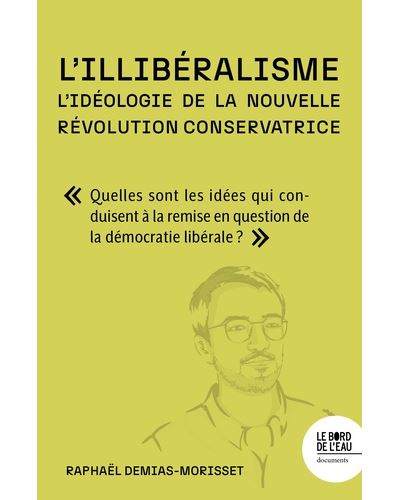
Raphaël Demias-Morisset
Illiberalism. The ideology of the new conservative revolution
Editions Au bord de l'eau
October 2025
176 pages

You'll also like





 French
  German
  English
Leave a comment