




Oresteia’, a family tragedy
Theatrical walks (4/6)
Le Regard Libre N° 17 - Loris S. Musumeci
«ELECTRE. O beloved care of thy father's home, long mourned hope of a saving offspring, go, call upon thy valour and thou shalt recover the paternal hearth. O sweet object, which holds four parts of my tenderness! Fate wants me to greet a father in you, to you I owe the love due to my mother - I hate her with all my soul - and to my mercilessly immolated sister; and here I find in you the faithful brother who will restore to me the respect of mortals! May only, with Strength and Right, Zeus very great lend me his help too!»
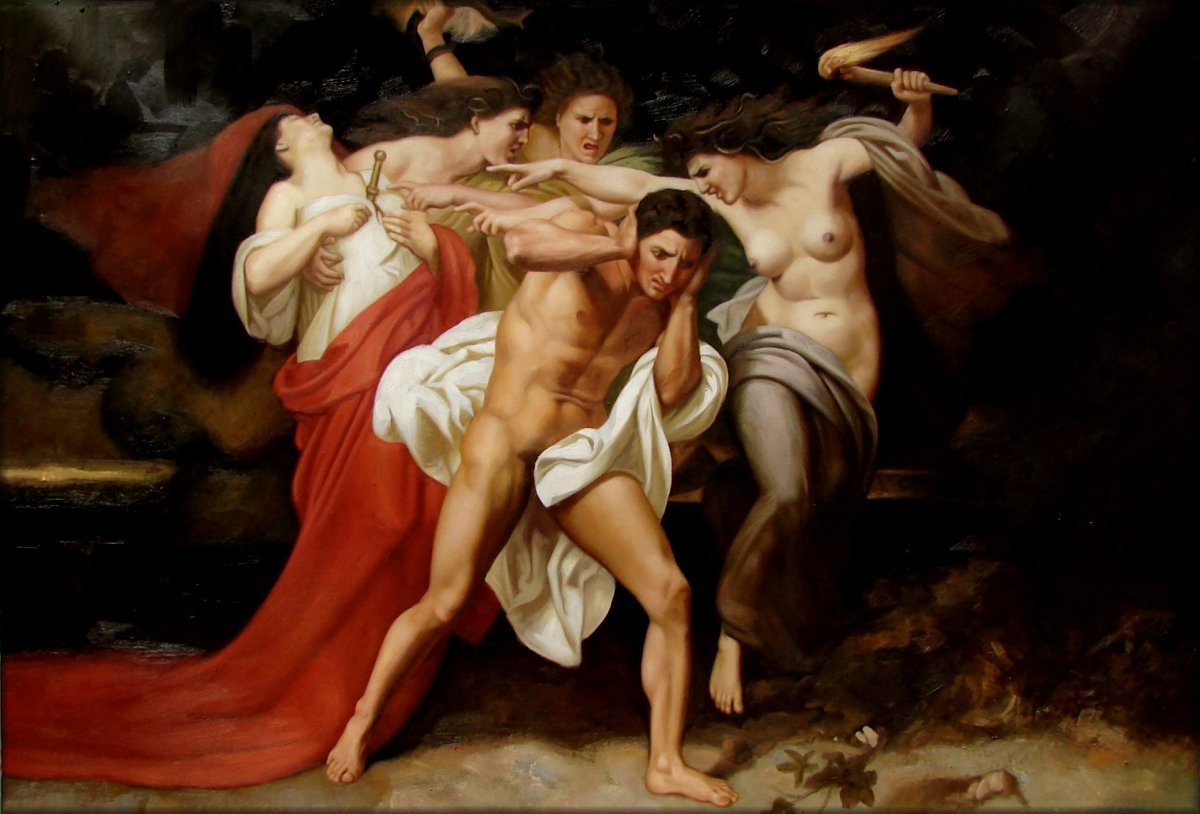
King Agamemnon sacrifices his daughter Iphigenia; Clytemnestra, the king's wife, kills her husband to avenge her daughter; Orestes, the king's son, returns from exile to avenge his father's memory by murdering his mother; and the Erinyes, Clytemnestra's partisan goddesses, persecute Orestes for the memory of their protégée. If the dramas of’Agamemnon, and Choéphores and Eumenides, which together form a single tragedy, the’Orestie, may be summed up in these family murders, Aeschylus' masterpiece set in noble, high Greece in the spring of 458 B.C. remains more profound and important than it seems.
One of the reasons is that it is a tragedy. Murder, whether familial or not, is not tragedy as such. The presence of death makes for drama, but what makes for tragedy is the presence of transcendence. «There is tragedy through the presence of transcendence: there is drama through the presence of death.» Death is to drama what transcendence is to tragedy. Transcendent is that which transcends man. Transcendence par excellence is found in the gods, against whom we can do nothing. But it is also to be found in genealogy, where the family's past is imposed and cannot be changed. These two aspects are fully manifested in the’Orestie.
The gods are omnipresent, driving the plot of the story. Jacqueline de Romilly, in her study Greek tragedy, highlights this:
«Men turn to them [the gods]; All three tragedies are bathed in the sacred, which is tangibly present in each of them. Agamemnon the spectator to Cassandra's prophetic delirium; the Choéphores take place around the king's tomb, and he is called upon at length for help; in addition, the main springs that trigger the action are an oracle given to Orestes and a dream by Clytemnestra; lastly, the Eumenides feature gods (Apollo, Athena) and above all those horrifying beings the Erinyes, the goddesses charged with avenging crime.»
However, human action is not denied. On the contrary, it is accentuated by the divine will. Orestes is a hero precisely because he kills his mother at Apollo's urging. He's responding to a divine order; it's honorable. God wills, man acts. And so it has been from the very origins of the’Orestie, when Agamemnon sacrificed his daughter. In reality, he did so at the request of Artemis; a condition by which he spared the lives of a multitude of soldiers and won the war. Reprisals span generations, from Helen's discord to the Trojan War, in fact; but always through the action of one man. «Nothing that happens happens without a god's will; but nothing that happens happens without man's participation and involvement: the divine and the human combine, overlap.»
At the end of the tragedy, human prowess combined with that of the gods leads to the creation of the Aeropagus, the grand court of Athens. Orestes must stand trial for the murder of his mother. While Apollo defends him body and soul, the Erinyes cry out for vengeance, or else they will curse the entire city and the Athenians will suffer. Athena, in her wisdom and reason, decides to set up a human and popular tribunal. Orestes is spared thanks to the votes in his favor. The Erinyes are furious, but Athena appeases them with a promise of Athenian worship. The tribunal is formalized. Compromise takes precedence over impulse. Justice overcomes retaliation. This is the greatness of’Orestie, a political and moral exaltation of democracy accompanied by a benevolent divine presence.
Write to the author: [email protected]
You'll also like






 French
  German
  English
Leave a comment