




El Greco, Entierro del Conde de Orgáz«
Le Regard Libre N° 20 - Loris S. Musumeci
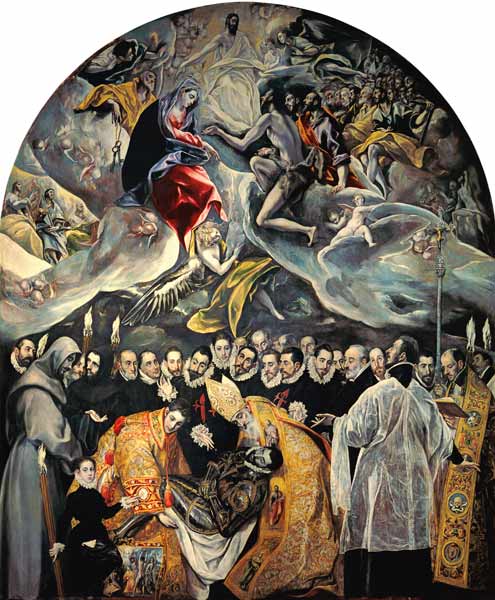
Where do we go when we die? To hell, to heaven, to organic decomposition? For a pious man like Gonzalo Ruiz, Count of Orgaz, heaven is certainly where he's headed. Or so says Domenikos Theotokopoulos, known as El Greco. He expresses this with a cool, warm delicacy in his pictorial masterpiece the’Entierro del conde de Orgáz - l’Burial of Count d'Orgaz.
In Toledo, legend has it that in the year 1323, on the outskirts of the church of San Tomé, the soul of the devout notable ascended to divine heights. The body was buried by Saints Augustine and Stephen themselves. Such an event was not entirely regarded as mysterious; Don Gonzalo did indeed contribute a great deal to the building of the miraculous church, but above all he prayed unceasingly for the good of all. Consequence: sacred intervention. I agree, however, that this is not an everyday occurrence.
The painting was commissioned by the parish priest of San Tomé on March 15, 1586. He completed the assignment in two years. Knowledge of the period in which the painting was produced is essential for accurate observation. In fact, if we find ourselves in the twilight of one artistic period, another is already dawning. The succession from Mannerism to Baroque is a fruitful one. Mannerism owes its name to Georges Vasari, a 16th-century art historian.th century, which defines the period from Michelangelo's late style onwards as the new «maniera» to imitate, that of daring an exaggerated and powerful stroke. The second is an exaltation of form, detail and the play of light. L’Burial of Count d'Orgaz lies exactly between these two aesthetics.
Heaven and earth are close, but distinct. The imposing painting (480 x 360 centimetres) is then as if separated into two parts. One is divine, the other human. The link between the two is not absent, however: Christ in white illuminates the mourning courtyard. The light passes through gentle intermediaries such as the Blessed Virgin Mary, who welcomes him into her red-clad body. The luminous ray from the highest heaven then passes through the angel's sumptuous yellow robe, to reach the saints at work: Augustine and Stephen illuminating mankind. Apart from this brighter path, the rest of the depiction is rather dark. In this respect, the work is truly Baroque, as it plays with light to invite the religiousness of an upward gaze.
There's more of a Mannerist feel to the brushstrokes that show through. This is particularly true of the clothes and clouds, which look as solid as stone, but move like a golden eagle.
The Byzantine influence is also present, and it is, in my opinion, this infimity that gives Domenikos Theotokopoulos' entire late painting an exceptional and incredibly appealing charm. After all, he was born on the island of Crete. Hence the fascinating gilding of the episcopal vestments of the two burial saints. Or the bland, elongated faces of the figures, but animated by a sober passion.
The marriage of two successive styles, two cultures coming together with a preciously cultivated talent, offers a pictorial spectacle worthy of calling the soul to soar, albeit in a different way from that of the Count of Orgaz.
Write to the author: [email protected]
Photo credit: © Emol.com
You'll also like
 French
  German
  English
Leave a comment