





Find out all about Hitchcock today with «Le Regard Libre».»
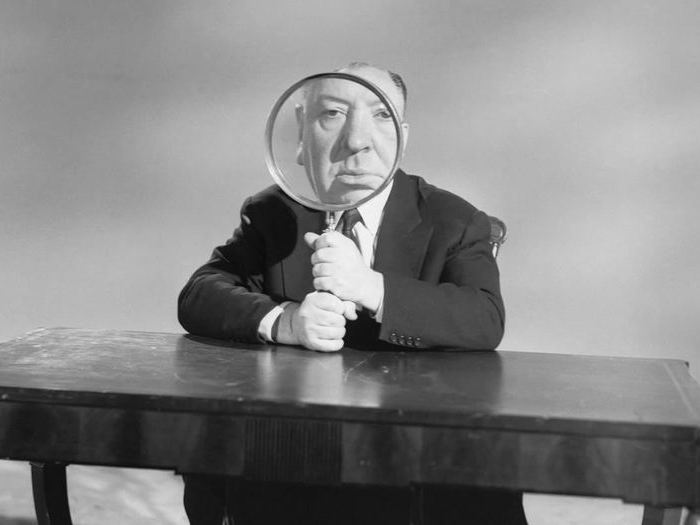
Archives du Septième Art / Bettmann
Who better than the man known as master of suspense to tell us about suspense? Who better than a master filmer to talk to us about cinema? Who better than a master to speak to us? Hitchcock speaks through his films, through recurring themes and equally recurring techniques. To offer the Seventh Art his life's work, always at the service of spectators, whose love for him was reciprocal. To offer the Seventh Art a whole universe through his camera, which is nothing other than the mirror of the soul.
Hitchcock's «Human Comedy
Fear and anxiety, always mixed with a touch of humor, are the emotions felt when watching a Hitchcock film. By playing with these emotions, the director plays with human beings. By playing with human beings, he plays with himself, with his own emotions, with his obsessions. It's as if he's constantly exploring himself through his work. To know himself better. Like Balzac with his Human comedy, Hitchcock has explored the passions, hauntings and jubilations of man so much that he seems to know everything about us - or almost everything.
Now it's our turn to play the same game. By entering into the world, the settings, the details, the staging, the story, the characters and their psychology of six of his films - and by taking a look at them. Rebecca (1940), The Fifth Column (1942), The House of Dr. Edwardes (1945), Courtyard window (1954), Psychosis (1960) and The Birds (1963) - we're going to find out everything - or almost everything - about Hitchcock. The master retains his share of mystery. Just like his works, which, as true classics, never cease to question us. Inexhaustible sources of cinema that never tire of being seen again and again.
The mystery surrounding the master doesn't prevent us from getting to know the man. This was an exercise Hitchcock willingly indulged in during his lifetime. A true prude, he would happily recount episodes from his life in the form of short stories, always with an air of amusement, whether the episodes were funny or not. Perhaps to remain cordial and gentleman from journalists who asked him questions that were sometimes purely biographical and often indiscreet. Doubtless, this was his way of forging an ever closer bond with his public, to whom he was never ungrateful for the success he accorded them, and to whom he always felt close, as a normal man, despite his genius and fame.

Obese and lonely
Alfred Hitchcock was born in London on August 13, 1899. His childhood was devoid of drama or exploits. Nevertheless, the filmmaker he would later become was forged in childhood. He was already learning about the solitude of the craftsman faced with his tool, of the creator faced with his work, of man faced with his destiny. He himself said he had no friends in his youth. Little Alfred is shy. He plays alone. He endured the torments inflicted on him by his mother, whose upbringing was very Catholic, very Irish, very strict.
He struggled to find his bearings, lacking affection and self-esteem. Alfred Hitchcock was always obese. People laughed at him; he saw himself as a monster. As a teenager, he entered the Jesuit school of St. Ignatius. There he experienced the fear and anguish of corporal punishment. However, he does not seem to have been totally traumatized; he remembers a rigorous education and a strong faith for the rest of his life.
Afterwards, Hitchcock continued his studies and became an engineer. Working for the advertising department of a telecommunications company. It was here that he began drawing for his assignments as a graphic designer, while also writing short stories for his colleagues. As he opened up to the world, he developed a passion for theater and cinema. Which he gradually integrated by becoming an intertitle designer for silent films. His career took off.
Building a cinema
Always discreet and humble, Hitchcock was appreciated for his talent and perfectionism. He went through all the trades and techniques of the cinema. He tried his hand at directing, then returned to being an assistant director. Educating his eye with a professional sojourn in Germany, which forged the aesthetics of his cinema, he returned to England and gradually began to make a name for himself. In the meantime, he married Alma Reville, whom he had met on a film set. His only love was with this woman, who remained his best friend and closest collaborator. She gave him a daughter, Patricia, their only child and their greatest happiness.
Noted for his talent and style, already apparent in his English films, Hitchcock was called across the Atlantic. In 1939, he settled in Los Angeles with his family. Producer David O. Selznick opened the way for him. It was in America that Hitchcock would become the great Hitchcock. It was here that he learned from his mistakes, and where the quality of his work grew. It was here that he learned the value of independence. Where he learned to build himself. To create his own universe. To become the director most loved by the public, for the films he makes of course, but also for his simplicity and bonhomie.
A man of laughter, a man of faith
A bonhomie reflecting the spirit of an extremely funny and generous man. Who enjoyed eating, drinking and smoking. Who made a number of direct television appearances, clowning around and toying with the audience. As an adult, Hitchcock was never afraid of the ridiculous. He laughed at himself, his career, his weight, his looks, his films. From a lonely, sad child, he has become a man who assumes responsibility for his art and his personality. A man who doesn't shy away from the indiscreet question of faith he is so often asked.
For Hitchcock, laughter and faith play a similar role. Whereas «humor is necessary to suspense» because it «attenuates it and contributes to the relief of the audience», faith seems to be necessary to existence, or at least to his existence, because it attenuates its dramatic dimensions. But Hitchcock doesn't go into too much detail on this subject; he prefers to tell anecdotes about his family's bigotry and his fear of confession in the form of jokes. He also succeeds in doing what Catholic artists do best: not imposing a religious vision on everything, not trying to make their art a vehicle for the good word. Yet faith remains an inspiration, both in its aesthetics and symbols, and in its themes. The innocent sacrificed, the false guilty persecuted. The weight of sin, the lightness of salvation. The anguish of losing everything, the relief of knowing oneself saved and loved.
Craftsmanship in cinema
Before being an auteur with themes, Hitchcock is an auteur with techniques. In this, the filmmaker is a craftsman. Solitary and passionate by nature, he was interested in every little detail of the craft of filmmaking. He handles film with as much ease as he does camera, capable of imagining in the evening in his study - with a good glass of whisky - the entire set, all the costumes, down to the practical details. Just as on his sketches he places such and such a spotlight in such and such a place, with such and such intensity; just as he traces the path that the travelling, imagining the depth of the zoom and already seeing the shot that will be filmed. This is how Hitchcock is truly a master filmer and not just a talented filmmaker. So, in addition to being the master of suspense, he is also the master and editing.
Starting with the technique, the aesthetics that flow from it and the themes that the script brings to the fore, the films have a purpose. It's not directly to instruct the viewer, nor to convey a message, but to move them. «I'm prepared to give audiences perfectly healthy emotional shocks.» Emotion as a purifier of the soul, the emotion that lays us bare and purges us. Emotion that brings us face to face with our fears, our struggles, our weaknesses, to help us confront them in life. What Hitchcock offers his audience through his cinema, he offers to himself. Filmmaking as psychoanalysis, or at least as self-knowledge.
Giving yourself over to the public
And since he's the type practical, With his feet firmly on the ground, he delivers through his films what people pay for. As long as there's a reputation for a filmmaker, there's a reputation for his style and the kind of films he makes. Audiences know they'll get their thrills from Hitchcock; that's what they pay for. Period. The director is well aware that his films educate the eye and uplift the soul. He knows that he doesn't give viewers fear for fear's sake, anguish for anguish's sake; he allows his cinema to provide entertainment, suspense, relaxation, reflection to which everyone is free, technical prowess on screen, photography that never foregoes subtlety and therefore beauty.
«Why do men want to suffer and love suspense? I say: why do they ride roller coasters screaming with joy and fear? The truth is, despite the fear inside them, they enjoy the ride and know that their anguish won't last. When it's over, they relax and laugh.» Alfred Hitchcock
Hitchcock's record amounts to some fifty films, most of which have no wrinkles of obsolescence, technical innovations that are still in use today, a suspense procuration that never ceases to inspire, subjects that still raise questions, characters that still intrigue, cult scenes, a whole cinematic culture, and, of course, pleasure. The human toll is Hitchcock's alone. But in any case, he was a happy man, proud of his family, proud of his friends, proud of his heirs in the film world. A man who learned to love himself thanks to the love of his public, to whom he gave his all from film to film, right to the end. When he died in 1980, his ashes were spread in the Pacific Ocean.
You have just read an article from our special operation «All about Hitchcock».
You'll also like

 French
  German
  English
Leave a comment