




«Carnage», when Polanski denounced self-righteousness
Cinema Wednesdays - Special edition: Polanski's cinema - Jonas Follonier
With Carnage (2011), Polanski brought us a virtuoso in camera film, in which the theatrical interplay and proportions of the story strike a blow against the conventional wisdom of neighbors and friends. A film to see again and again for 79 minutes of tension and pleasure.
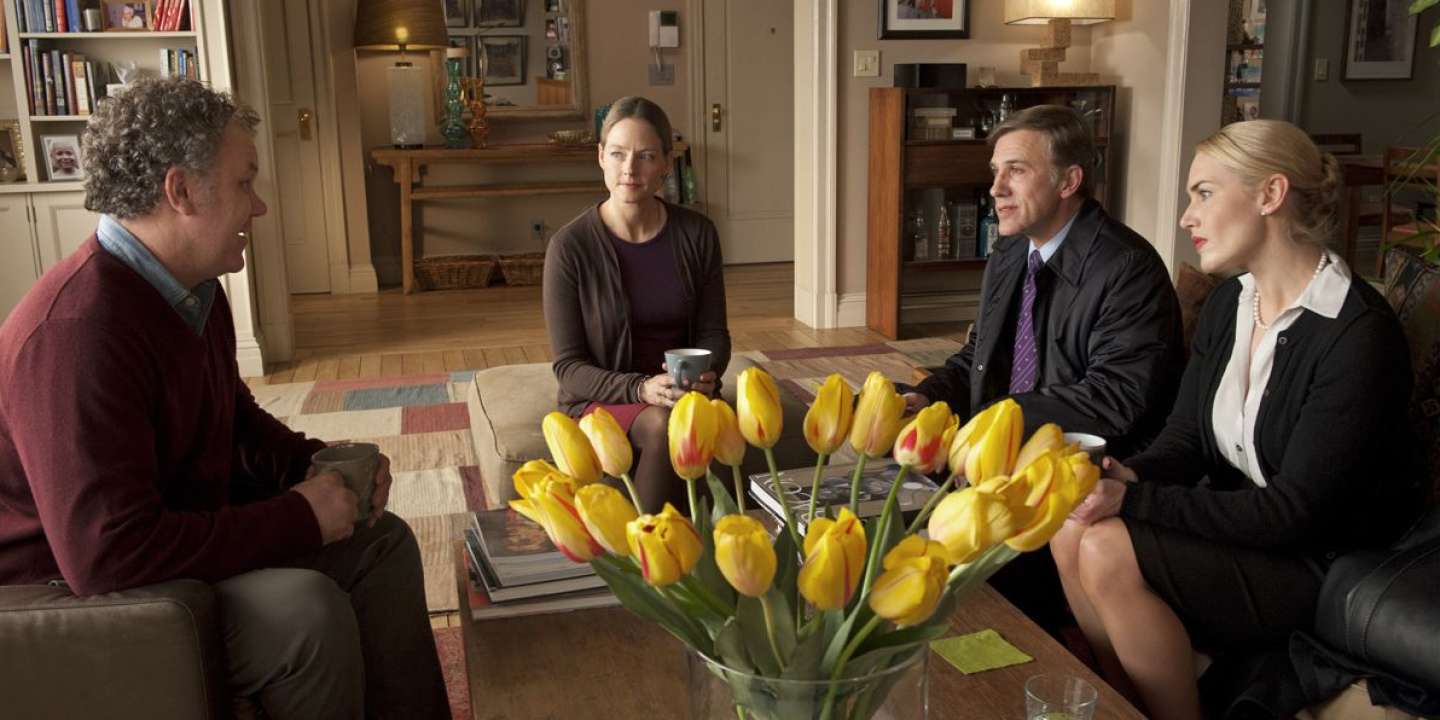
New York, in an upper-middle-class apartment building. Two kids got into a fight. Or rather, one of them hit the other, as the latter's parents insist a hundred times over. They invite the parents of the «aggressor» to organize an apology and get information about the fight and what they think of it. From the outset, it's clear that we're dealing with typical characters. Penelope Longstreet (Jodie Foster) is an outraged woman; Nancy Cowan (Kate Winslet), a hypocrite; Alan Cowan (Christoph Waltz), an upstart; Michael Longstreet (John C. Reilly), a redneck. Their deeply stereotyped nature is reflected not only in the characters' dialogue, but also in their theatrical performance.
- It was impressive to see a child with no face and no teeth.
- Oh yeah, I guess.
The gestures accompanying the words are in fact very accentuated, too accentuated to be cinema. What we're really dealing with is theater! Not only are Carnage is an adaptation of the play The God of Carnage, but this cinematic revival itself is theatrical, just as First name d’Alexandre de La Patellière et Matthieu Delaporte, chef-d’œuvre du genre, sorti une année plus tard. Avançant à temps réel, le long-métrage qui a d’ailleurs juste la durée qu’il faut nous fait entrer dans cet appartement où nous reconnaissons tant de personnes de nos entourages respectifs, tant de conventions, tant de paroles de rien du tout, à la fois pathétiques et touchantes:
«It was driving him crazy, the mess this bug was making. Look, I'm not ashamed to admit it, I'd been wanting to get rid of it for a long time, so I thought, I'll take it with me and leave it on the street.»
This line comes from Michael, who despite his good-naturedness and willingness to smooth things over, gives himself away with a remark like that (he's talking about his daughter's hamster). The two women are not to be outdone. Nancy, having just reproached her husband for caring too much about his toys, throws a fit because her make-up has been spilled on the floor; extremely mannered and clean-cut, she gets drunk and barfs in her neighbors' apartment. Penelope, on the other hand, externalizes her anti-globalization, peacemaking activism in the form of extreme aggression, and behaves like a veritable shit-seeker. In the end, only Alan escapes incoherence, assuming his status as a cynical asshole lawyer right from the start.

Another interesting theme is that of solidarity between women and between men. When circumstances are so serious that antagonisms fade, women band together against men - a brave occupation - who are content to praise themselves: «Did you know Etan had a gang? No! But I'm delighted to find out! (With a blissful smile) I had one too, I was the leader. - Yes, me too.» Michael shoots down the woman he'd been defending twenty minutes earlier, turning out to be the same Alan: «You know what? All these discussions, all these bullshit considerations, I've had enough. We bought tulips. You know my wife tries to make me out to be a left-wing guy, but in fact I've got no patience for all that corny stuff! I'm a pure, basic temperamental guy and fuck you, OK?»
It's an opportunity for wives to share considerations about their men. «My husband has decided that life is nothing but mediocrity.» As if it were a matter of deciding, the film tells us! What idealists take for projections is sometimes indeed pure and simple reality. The real thing is average, bland, never pure; mediocre. Kundera, the most philosophical of novelists, explained why this is so: life is just a dress rehearsal. Since we only live once, we can never see the real play. All our actions are nothing but trial and error, in a place where we're locked up like this apartment, I call social life. We do what we can, trying to get as much pleasure and as little trouble as possible out of it. But when the mask comes off, the truth can be a source of trouble.
«You come into the world alone, and you die alone, so that's enough; who wants a glass of scotch?»
Write to the author: [email protected]
Photo credit: © Wild Bunch Distribution


You'll also like





 French
  German
  English
Leave a comment