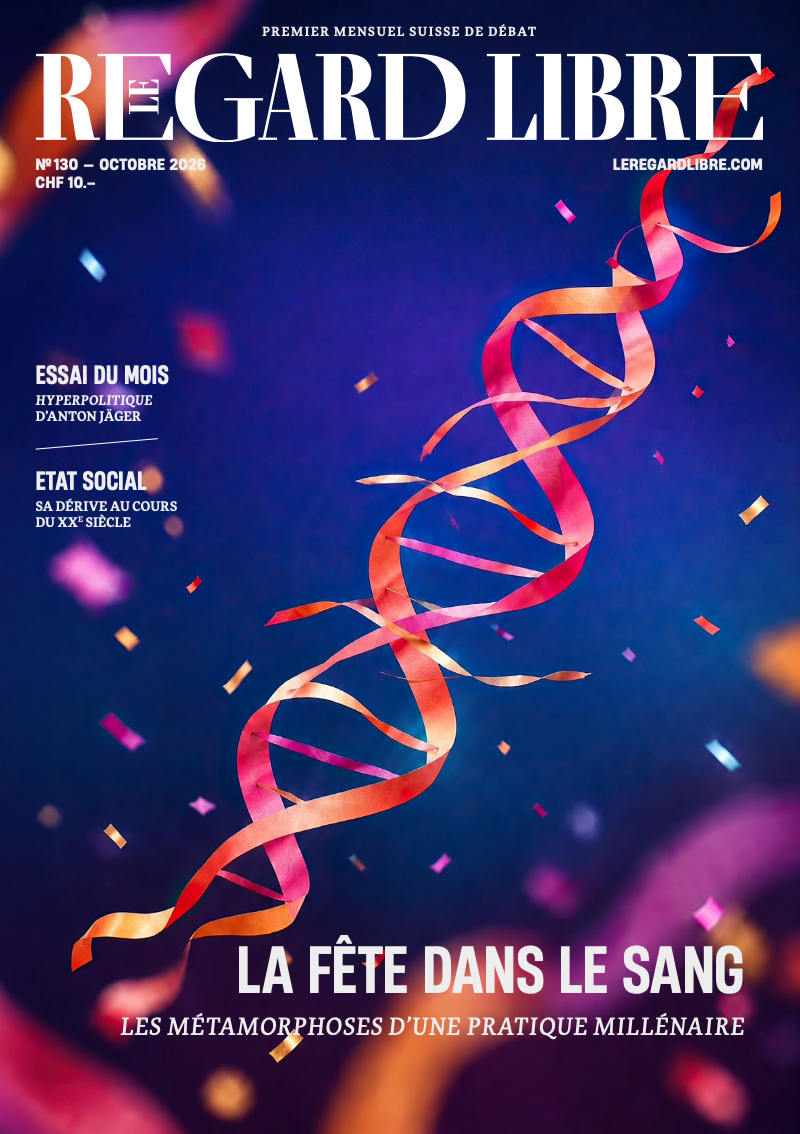




Interview with Thierry Jobin, film lover and artistic director of the FIFF

Le Regard Libre N° 50 - Loris S. Musumeci
FIFF 2019 special report
Thierry Jobin is ill. He has love sickness. For cinema. And beware, because it's contagious. It's impossible not to be fascinated when talking to him, to discover films and another kind of cinema. As he tells us about his career, he makes a positive assessment of the last edition of the Fribourg International Film Festival (FIFF), held from March 15 to 23. And he doesn't fail to share with us some delightful episodes and his dreams for future editions.
Loris S. Musumeci: What was your career path before becoming artistic director of the FIFF?
Thierry Jobin: When I was ten years old, I started collecting all sorts of movie-related items. I lived in Delémont, and I was one of three movie buffs in town, along with my math teacher and another retired teacher. That math teacher wrote movie reviews in The Democrat and was a contributor to Radio Fréquence Jura. When he decided to stop doing that, I was contacted to take his place. Of course, I was delighted. By the time I started at the University of Fribourg, I was already working for four newspapers and a radio station. In fact, my studies were mainly a way to reassure my parents. That didn’t stop me from continuing to write my articles. Starting in 1992, I wrote for Le Nouveau Quotidien, a groundbreaking move for the French-speaking Swiss press, when he was hired in 1998 at the Time, formed from the merger of Le Nouveau Quotidien, The Lausanne Gazette and Le Journal de Genève. I was in charge of the cultural calendar and headed the film section. In addition, I wrote film reviews for RTS for six years. All of this lasted until 2011. That was my path; I was always in the right place at the right time. I was very lucky.
What prompted you to join FIFF?
The former artistic director, Edouard Waintrop, who had just Release, had been hired for the Directors’ Fortnight at Cannes. He called me right away to suggest I apply and take his place. I was accepted. The committee welcomed me, and I was able to start making changes—such as creating new sections—with the aim of making the festival more accessible by featuring Westerns and romantic comedies. That’s when attendance skyrocketed. Starting in my first year, in 2012, the average age of the audience dropped by ten years. But most importantly, we went from 30,000 to 36,000 attendees, and we’ve continued to grow toward 40,000 and beyond.
Does the festival's structure play a direct role in its growing success?
I think one of the key factors in our success has been the reduction in the number of films. Among the major Swiss festivals, we’re the one with the fewest films in the lineup. This limits the choices and creates a certain sense of unity among festivalgoers, who are more likely to see the same film and, all in all, share a common experience.
This is my second year participating in the FIFF, and I have to admit I was amazed at just how popular the festival is with the public. I suppose that’s exactly what you wanted.
Absolutely! Not only is that our hope, but I’m also glad to hear that it made an impression on you. People from all walks of life attend the festival’s screenings, and especially people of all ages. We welcome a lot of children and students in particular, since we organize the largest school field trips in Switzerland. Our goal, in fact, is to have a festival on a human scale, where you can experience both cultural heritage, the discovery of other cultures, and popular cinema. If you want to understand a country like China, you can’t do so by focusing solely on arthouse cinema. We also need to show what Chinese audiences actually go to see in theaters.
What exactly do you do throughout the year to prepare for the event?
People often ask me why I’m paid 100% for an entire year for a festival that lasts only a week. First of all, there’s the programming. It involves a lot of travel, which easily takes me three months. I have to attend the biggest festivals, such as Cannes, Toronto, Busan, and so on. Then, I spend a tremendous amount of time watching films here in Fribourg—2,500 films for the last edition. Finally, there’s the entire promotional aspect—not just for the festival but for the many organizations that partner with the city of Fribourg. This involves reviewing projects within committees to support the development of cinema in so-called emerging countries. Of course, I also have to devote time to putting together a team before the festival.
What can the FIFF offer the city of Fribourg—and even the Swiss Confederation?
Fribourg remains the hub. This is where all the synergies with other organizations take shape. Naturally, many connections are forged with the political and business communities at the cantonal and even national levels. A study found that every franc invested in the festival generates between three and seven times that amount for the local economy, through restaurants, hotels, and shops. As you can imagine, our guests quickly spend large sums of money buying cheese and chocolate to take home! I’d even go so far as to say that Fribourg is internationally renowned. The festival is almost more respected around the world than it is locally.
No one is a prophet in his own country!
(Laughter)
What does your film festival bring to the world of cinema?
The FIFF’s mission is to foster discovery. To do this, we must seek out films in obscure corners, outside the mainstream market. Helping film industries develop also means contributing to the promotion of democracy. A country that can express itself through film is, in a sense, already protecting its democratic voice.
The films you choose have great aesthetic significance—spanning both popular and arthouse cinema—and often philosophical depth as well. Without being pretentious, do you aim to educate viewers and offer a true cinematic experience?
If there were no festivals like the FIFF, what would people have to choose from? We’d still be stuck with the same cinematic language; it would still be the same cultures expressing themselves. It is absolutely essential to expose the public to other cultures and other ways of telling stories. Ignorance breeds mistrust; mistrust breeds intolerance; intolerance breeds the far right. We want to fight against this vicious cycle.
You also reinterpret certain older films to convey a message to today's society.
Exactly. And I like to do that by giving them free rein. I let filmmakers choose the films. I certainly wouldn't want to choose all the films myself.
What is your overall assessment of the 2019 event?
I always recover from the post-festival blues by having people sign the guestbook. And it’s just wonderful to see that the guests and the audience appreciate the warm, welcoming atmosphere we offer them. It’s important to me to put on a festival that reflects the city of Fribourg. Simple, friendly, laid-back—a chance to get together over a drink, with a warm welcome. Two years ago, we had a pretty tough edition that forced us to cut back on the number of films. And by doing that, we actually started seeing more attendees. This year, oddly enough, we had just a tiny bit fewer attendees «because of» the nice weather, but we made more money in terms of box office revenue. It’s likely that more people bought individual tickets rather than passes.
So moviegoers were more likely to decide on a whim to go see a movie, thinking, «Why not go see this movie today?»
If that’s the case, I like it! People didn’t necessarily come for the long haul, but out of curiosity. Maybe a new audience is starting to emerge. Now we’re also seeing that after two editions with fairly similar attendance figures, we need a catalyst to bring about radical change—without altering the spirit of the festival. If we had a budget of 300,000 or 400,000 francs more, we could, for example, provide German subtitles for everything. That would be excellent for the audience and would open up the festival even more to German-speaking Switzerland. I also feel there are limits to our hospitality. As soon as I reach out to someone who’s well-known, I realize that welcoming them to Fribourg isn’t always straightforward. Even though people like Charles Aznavour, Eric Cantona, or Ken Loach never asked me for a penny—they were simply thrilled to be there.
How can changes be triggered?
We all need to come together—with the business and political communities and other cultural stakeholders—to decide whether or not we want to make the FIFF an exceptional event. The festival raises the profile of the city and the canton at least as much as Gottéron, our club hockey. So there's still more to be done.
This is fully in line with Fribourg’s identity and the projects it already has.
Yes, it's an incredible city that champions openness, culture, and intellectual life. Not to mention the media scene. I'm so happy to announce to my guests that we'll be conducting interviews with La Liberté, along with other high-quality newspapers, radio, and television. The selection of movies is also extremely impressive. The blockbusters obviously take up a lot of space, but that doesn’t mean art house cinema is being overshadowed. Even so, we need to take action to preserve the films shown at the Rex. I should point out, however, that this call to move forward is not a criticism directed at policymakers. They’re doing what they can—and they’re already doing a lot. We also have to accept that there’s always a bit of skepticism toward the cultural sector at first, and that’s normal. Nevertheless, I think we’ve proven over the past few years that we’re serious and reliable.
You’ve told me about your hopes for the festival—and your hopes for cinema, since you’re such a film lover?
Quite simply, that people keep going there. Honestly, there’s nothing better than getting together in a theater to watch a movie. In fact, this year we spent Get Out by Jordan Peele, and we had a full house. I was stunned, and I told some audience members that they were paying 17 CHF to see the movie in theaters, when they could have bought the DVD for 12 CHF in stores. They replied that what made it special was going out with friends and all going to the theater together to see the movie.
When you go out, when you leave home, you really experience something. Going to the movies is, in fact, a celebration of the seventh art.
Absolutely, and when it comes to quality, there's no contest. See Breakfast at Tiffany’s, starring Audrey Hepburn, or The Sugarland Express Seeing a Spielberg movie in theaters is like going to see the Mona Lisa at the Louvre when you've only ever seen it on a postcard. Honestly, when the team and I found out we were going to have it at the festival Diamonds on the Couch in other words Breakfast at Tiffany’s The restored version gave us chills! And during the screening, we cried!
Let's go back in time a bit, and tell me what your fondest memory has been since 2011 as artistic director of the FIFF.
One of my most recent wonderful memories was the visit by Adewale Akinnuoye-Agbaje, director of Farming, who was a member of the jury this year. This man is actually an actor first and a director second— Farming —which, incidentally, is his first film—and he has appeared in, among others, Lost, Game of Thrones; he shared the set with Jean-Claude Van Damme, Sylvester Stallone, Robert De Niro, Jason Statham, and other stars. After lengthy negotiations with an agent in Los Angeles, we had to arrange a series of unimaginable details, such as a limousine to pick him up at his home in London, and so on. When Adewale arrived here, he watched movies from all over the world, ate at the same places as everyone else—no red carpets, no barriers, no VIP areas. All of that was, quite literally, a real eye-opener for him!
What do you mean?
It did him a world of good. He discovered a different kind of cinema, a different way of storytelling, and above all, the simplicity of a small festival. He was so happy that he’s been writing to me every day since then. We’re now exploring the possibility of having him bring his friends—famous actors—to experience a different kind of week, with a fresh perspective. Let’s make FIFF a place where we get back to basics! We keep our guests pretty busy—watching movies, giving interviews, exploring the city, having drinks, and eating fondue! With Adewale, a new door has opened. He’s building a bridge between commercial cinema and auteur cinema—which aren’t mutually exclusive. I love all genres, just like the entire artistic team: we just love good movies. And as François Truffaut said: «I'd rather watch a bad commercial movie than a bad arthouse film, because a bad arthouse film is boring right away, whereas a bad commercial movie can be entertaining.»
To access the rest of the coverage on FIFF 2019, there's just one thing you need to do: Order our 50th issue!
Write to the author: [email protected]
Photo credit: © Indra Crittin for Le Regard Libre
-
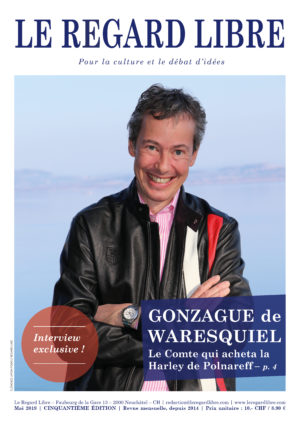 Le Regard Libre - N° 50CHF10.00
-
 Standard subscription (Switzerland)CHF100.00 / year
-
Support subscriptionCHF200.00 / year
You'll also like

 French
 German
 English
Leave a comment