




«Joyland»: the desire to be oneself

Trigon Film
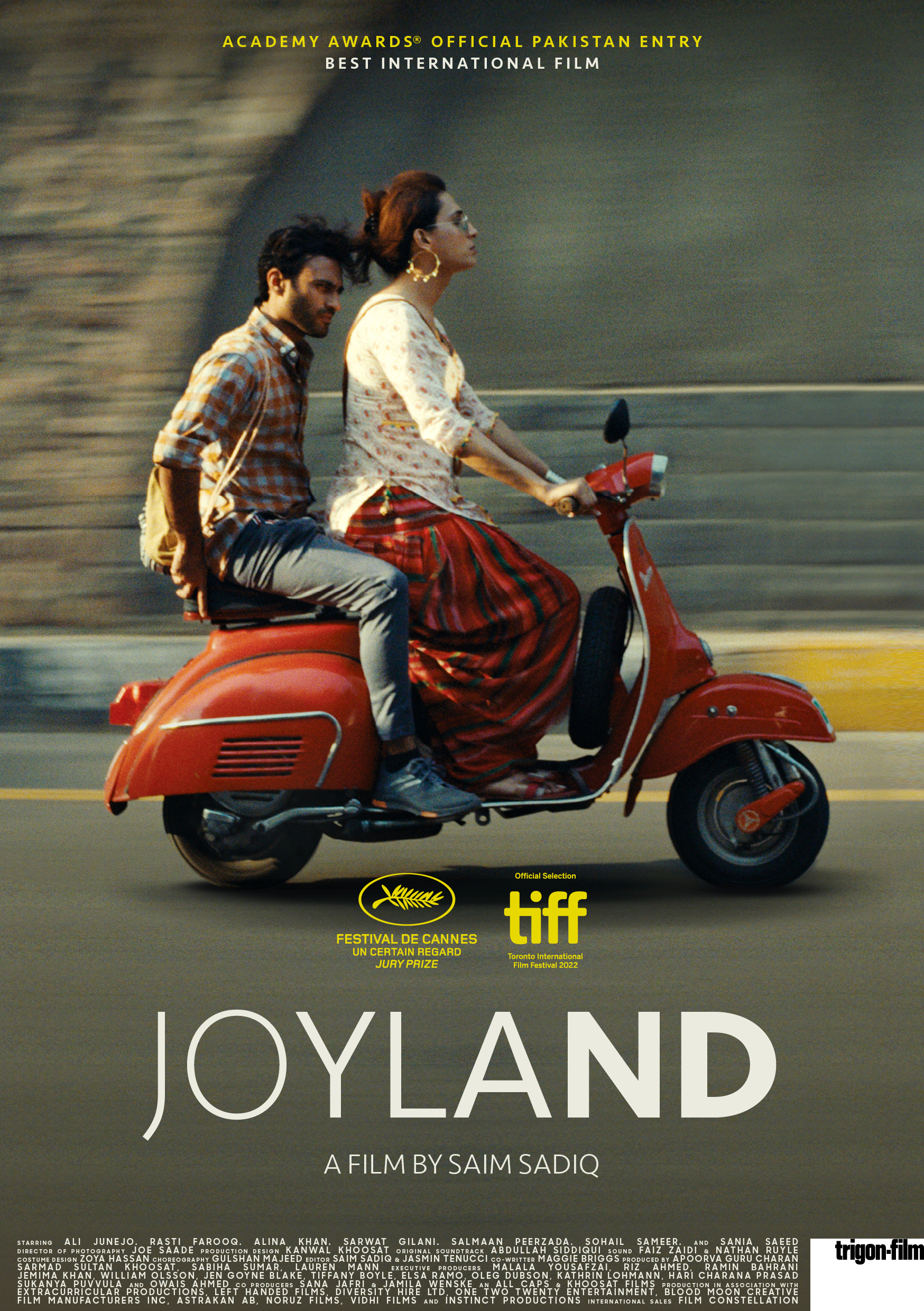
For the first time in the history of the Cannes Film Festival, Pakistani cinema took to the Croisette, winning in the Un certain regard and Queer Palm categories. Saim Sadiq takes us on a journey through Pakistan's troubled history.
In Lahore, Haider (Ali Junejo) lives with his wife Mumatz (Rasti Farooq) in the family home, which he shares with his brother, sister-in-law, children and father, with no real privacy. Despite his wheelchair, the patriarch dictates everyone's roles through strict gender codification, urging his son to find a job and have a baby. Haider, struggling to come to terms with an imposed masculinity, finds a job as a dancer in an erotic cabaret, where he falls in love with the national celebrity, Biba (Alina Khan), a trans dancer - whose performance is commendable. Beyond the atypical idyll.., Saim Sadiq captures a series of complex portraits torn between moral injunctions and personal desires.
Subversion nipped in the bud
Is it a lure for moviegoers who see social issues as a guarantee of cinematic quality? Joyland takes the risky gamble of reactivating sensitive subjects - trans-identity, patriarchy, homosexuality - with the notable originality of its Pakistani origins, too little represented in cinema. These are subjects that many filmmakers confront, but fail to overcome completely. Unfortunately, a pitfall that Joyland difficult to avoid.
A furtive love affair is born between Haider and Biba. Since desire can only be expressed in deserted, even hidden places such as an alley or a bedroom, this love is confined. Unsurprisingly, Sadiq uses the square format to capture the suffocating atmosphere caused by an omnipotent religious morality. The shots are colorful and polished, but impose a watertight boundary between the scenes and the viewers. Emotion therefore struggles to resonate.
The cabaret, during the dance performance, appears to be the place where it becomes possible to free oneself from the imposed moral straitjacket. Haider expresses himself through his body; Biba is this time inaccessible to the desires of the all-male audience, and physical contact between the two lovers is perceived as normal. But this scene is reduced to a succession of conventional shots with no real risk-taking, stretching out over a very short, even too short, duration. Formal choices, Joyland struggles to infect the viewer with the collective jubilation of the place. Moderate and aesthetically clean, the subversion of moral codes it purports to criticize remains insubstantial, even vain. Despite a certain depth conferred on the characters and the leaden staging, the filmmaker locks them into their sole function as subjects.
Ambivalence and desire
Nevertheless, the film has a naturalistic interest. The development of Mumatz's character opens our eyes to contemporary Pakistani society. By spying on the stranger who indulges in solitary pleasure in an alley in the middle of the night, Mumatz reveals societal malaise. Beyond the subject of taboo love affairs, Joyland testifies to a universal disapproval of desires that bend under moral and religious injunctions.
Read also | Only the Earth or homosexuality in a peasant context
To achieve this, Sadiq subtly translates this split through the use of symbolic oppositions: it's the night that brings to light what must be hidden during the day, the patriarch's immobility versus Haider's bodily discovery, authoritative but particularly self-effacing male characters. The result is a «bipolar» society - a term Sadiq himself uses in a interview to describe the situation of trans people in Pakistan. And the reality proves it: initially censored by the government in her country of origin due to pressure from religious groups, the latter has now reversed its decision.
Write to the author: [email protected]
You've just read an open-access editorial. Debates, analysis, cultural news: subscribe to support us and get access to all our content!
You'll also like





 French
  German
  English
Leave a comment