



«Jumanji: next level», the level too far?
Cinema Wednesdays - Fanny Agostino
Only two years after the first sequel, Jake Kasdan once again opens the doors to the dangerous and fantastic world of Jumanji. Now a video game, what remains of the soul of Joe Johnston's first film?
If you’ve been to movie theaters or subway stations recently, you certainly haven’t missed the advertising buzz promoting the film’s release. Look up at the movie theater entrances and admire the huge banners; walk along the red carpets stretching over five meters in length; and take in the traditional posters evoking safaris. Jumanji: The Next Level will most certainly tie the record for box office attendance during the holiday season with the sequel to Frozen. With Christmas just around the corner, the franchises are running at full speed. Compared to the little blonde princess, Jumanji It has the advantage of appealing to fans nostalgic for the very first film adaptation of Chris Van Allsburg’s novel in 1995. You’ll roll the dice again—or should we say, flip the switch.
Launched in 2017 with its subtitle Welcome to the Jungle, the makeover of Jumanji has not, at least on paper, succumbed to the trend of reboot. Yet the mysterious board game that drew players into a world ruled by animals has mysteriously swapped out its game pieces and its famous mirror—which displayed unsettling messages—to transform into a SEGA Mega Drive-style game console. It’s just another way to sugarcoat the pill for viewers hoping to revisit the Robin Williams version. From the film’s first sequel, Next Level keeps his characters—four teenagers with very stereotypical profiles: the introvert, the jock, the popular girl at school, and the introverted girl bis, a mirror image of the first one. During winter break, our protagonists reunite in the small town where they grew up and find themselves, in a series of incredible twists and turns, back in the game’s unique jungle world. But surprise—not everyone is reunited with their avatar…
Generational Conflict
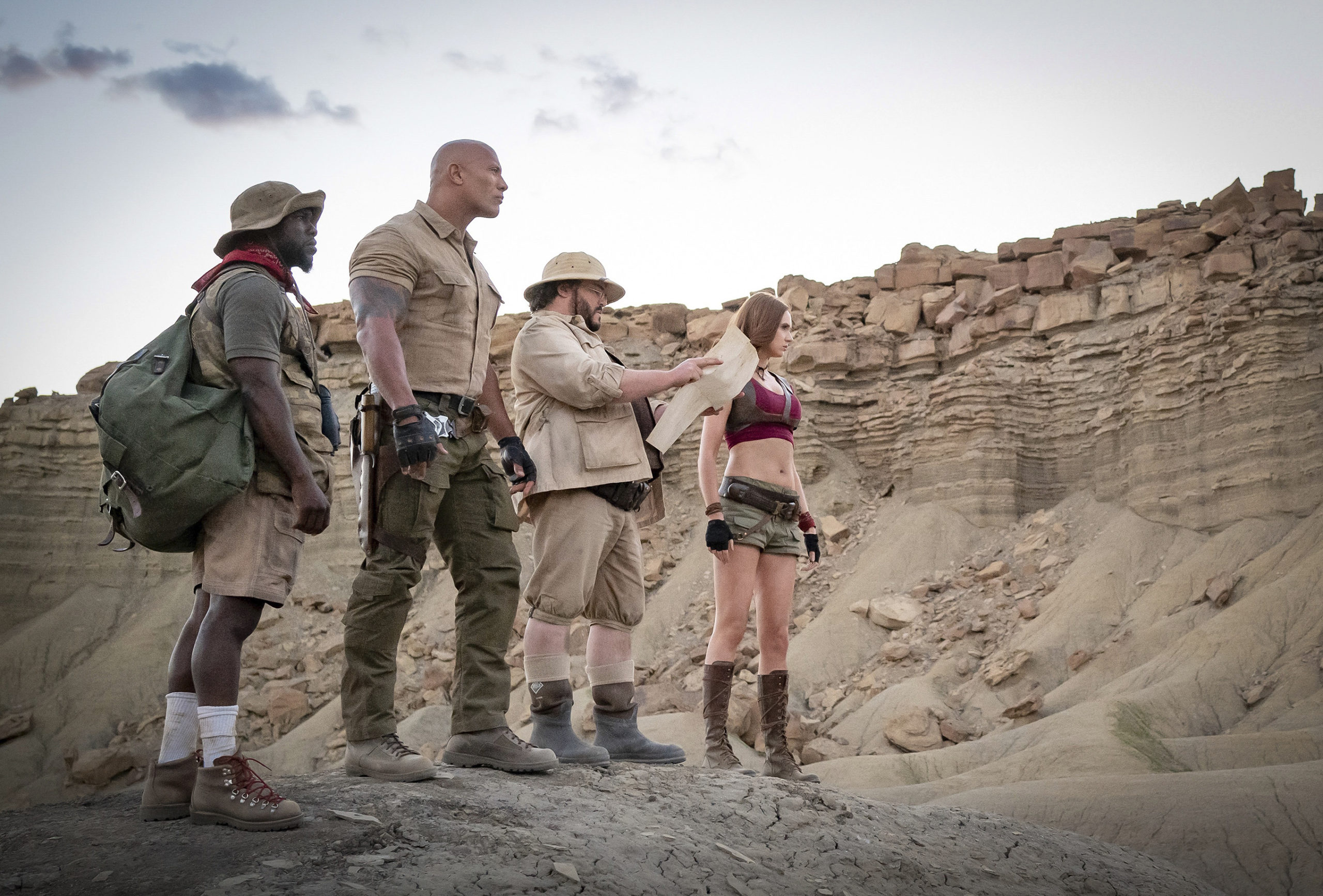
Leveraging the first suite of Jumanji, the film plays on the identification viewers associate with the characters in the video game world of the previous film opus by reshuffling the cards. By mistake, Eddie—the hero Spencer’s grandfather—and his former business partner fall into the Matrix. As a result, the shy Spencer (Alex Wolff) is no longer embodying the vigorous Dr. Bravestone (Dwayne Johnson). The same goes for the other characters, except for Marta (Morgan Turner), who is still disguised as Ruby (Karen Gillan), the embodiment of a modern-day Lara Croft.
No need for viewers who discover this new role reversal late in the film to worry: the entire first half of the script is devoted to staging the gags specific to this ailment… to the point of overkill. This “indisposition” itself is explored through the characters’ entry into the Jumanji universe, which is actually quite amusing; it falls to the younger generation to take on the tedious task of explaining how the wild universe works and what its rules are—the very world in which the avatars will navigate. Everything is covered: the cutscenes explaining the quest needed to escape the game, the players’ abilities and number of lives, and even how to interact with NPCs—non-player characters whose lines are limited and play on a loop.
Strip away the surface of tabletop gaming; extract the essence of role-playing games
All this comedy, though sometimes a bit over-the-top, still serves its purpose right up until the last third of the film. In fact, much like a deus ex machina, players find a way to change their appearance and thus regain their favorite character, just as it had been assigned to them in the first sequel from 2017. This sudden, abrupt shift speaks volumes about the film’s plot and moral: on the one hand, it implies that the entire story relies primarily on the platform onto which the game has been transposed. The game console creates a dual cast by dematerializing the group of young students, transforming them into fully-fledged characters. The boundary is established. The blending of worlds depicted in the Jumanji The 1995 version is thus shattered, since—except for a nod at the end of the film—the two worlds never intersect.
But above all, what is presented in the film as the restoration of the established order in the assignment of the player to their character runs counter to the very possibilities of digital role-playing, where everyone is free to embody a character, move forward, and develop that character independently of their own abilities. Yet this upheaval at the end of the game seems to demonstrate the opposite: to achieve their goal, everyone must be assigned to a role predefined by the universe in question; the initial accident and each player’s feats are ineffective and would lead the dream team to the traditional Game Over. In other words, pushing oneself beyond one's limits in another universe no longer counts; only abilities acquired later on can lead to victory.
While not insurmountable, Jumanji: The Next Level It’s watchable. However, the magic that the first film instilled—the sense of discovering a terrifying world (we remember how the drumbeats set the stage for entering that world)—no longer works. Is this due to the adaptation into a video game, or to the distorted image presented by the film’s ideology?
Write to the author: [email protected]
Photo credit: © Sony Pictures Releasing Switzerland

You'll also like






 French
  German
  English
Leave a comment