



«Les Veuves», a feminist film, but not just that
Cinema Wednesdays - Loris S. Musumeci
«I just wanted to know how you were doing after the loss of your husband.»
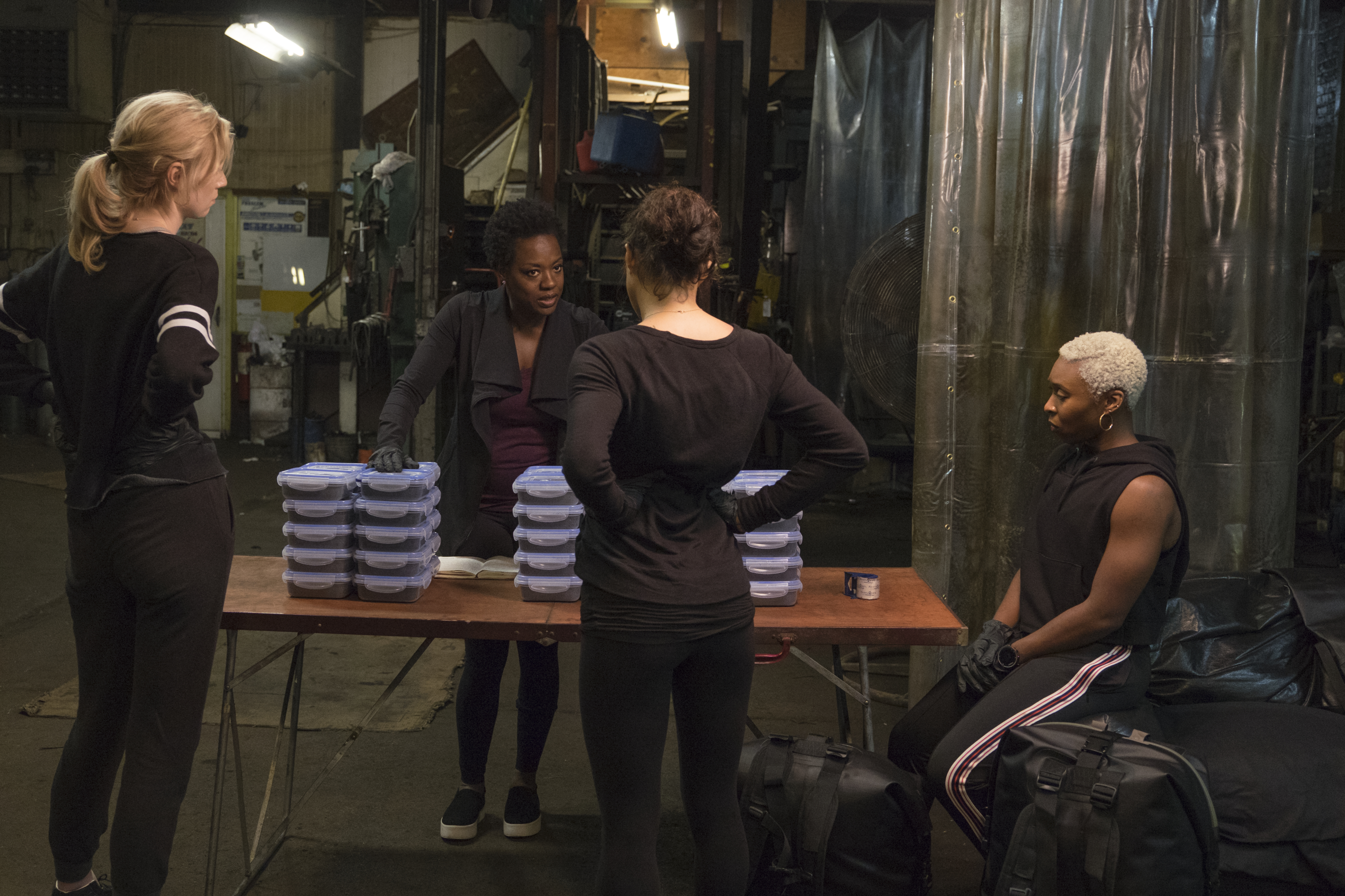
Portraits of four family lives follow one another, interspersed with a hotly contested robbery scene. The four families are those of the four robbers. Caught red-handed, they are surrounded by the police after a chase. The episode ends in gunfire from the relentless police. The death of the four bandits now leaves four widows. Despite their grief, they're not out of the woods yet. The local African-American mafia is keen for the four women to pay off some debts.
A feminist film
From the synopsis, you'd expect this to be a feminist film, with all the heavy-handedness that implies. All the more so as this is largely an action film. It's not feminist films that are heavy, or even action films. However, when the seventh art mixes these two genres, it often can't help but go overboard, multiplying shots of femme fatales in sexy little dresses and pistols in hand. Just think of the Charlie's Angels (Funny ladies) or the films Ocean's.
The Widows gives a priori to think that the viewer is going to be bombarded with slow-motion sequences of four women walking side by side, hair blowing in the wind, sunglasses firmly placed on their noses, wearing spy boots and adorned with flames in the background. As it happens, however, Steve McQueen has chosen to make a more subtle film.
Certainly, there's feminism, but brought to life in a clever, thoughtful way. The four women in question are strong, courageous and astute. They are beautiful. And fragile. At times, they give way to tears, just as they momentarily crumble in fear or despair. The finesse with which these four characters are built lends the film credibility, accuracy and a real appreciation of women.

L’excellente Michelle Rodriguez et la sublime Elizabeth Debicki dans «Les Veuves», un film de Steve McQueen, © Twentieth Century Fox
And let's not forget that the director is tackling a subject that may seem somewhat outdated today, namely widowhood. Yes, it goes without saying that a wife can manage without a husband. But the film has the audacity to show just how complicated everything becomes when a woman loses her husband and has to take sole charge of the children. The theme of widowhood gives the film its tragic dimension from the outset.
In this respect, the director's originality is commendable, offering different experiences of tragedy according to the widows' family cultures, notably through funeral rites. From the white, Protestant sobriety of honoring the gang leader's remains, we move seamlessly to the all-Catholic, passionate, Hispanic agitation of burying one of the criminal group's members. In fact, the portraits of the four women are complemented by the culture of origin of each woman's husband.
No Manicheism
At the same time, the viewer is introduced to another story: that of a presidential election taking place in the mayor's office of a working-class Chicago neighborhood. A white candidate faces off against a black candidate. Two worlds, two cultures, two ways of looking at faith. In short, two very different styles. Here again, the film shows its intelligence.
In fact, it leaves no room for the Manicheism that would reduce the white candidate to a rich, racist, corrupt bourgeois, and elevate the black candidate to a poor representative of minorities, honest and a victim of his opponent's schemes. Both are legitimate. The script shows them, each in turn, touching and true to life; just as it shows them to be crooks when it comes to money.
Efficient formal work
If The Widows is remarkable in terms of content, the form is not to be outdone. Even if certain procedures, such as filming the characters through the reflections of a mirror or a window, are a little tedious, too repetitive and not necessarily very effective, we must give Steve McQueen credit for having carried out an aesthetic search for a genre of cinema which, in principle, does without it. What's more, he's succeeded in making the camera fluid in its movements, and the images are pleasant to look at.
The form still has qualities to offer in terms of music and sound, which accompany the locations and create authentic atmospheres. This is undoubtedly one of the film's most appreciable technical points. Each of the widows has a distinct profile, very different from the others. Each family is different; each background; each community; each intimacy. All this helps to create different moods that, at the outset, distinguish the four women precisely, only to lead them towards a common quest.
The Widows, Finally, the whole story is that nothing can be salvaged from the past. And that, yes, a widow's suffering is real. And that, no, there is no solution to everything. But that doesn't stop these four wonderful women from fighting, helping, sacrificing, giving of themselves, changing and resisting, to preserve their dignity, which is not negotiable.
«I don't let you or anyone else treat me like shit anymore.»
Write to the author : [email protected]
Photo credit: © Twentieth Century Fox
You'll also like

 French
  German
  English
Leave a comment