




«Nope: the cloud gives birth to a storm

After Get Out (2017) and Us (2019), Jordan Peele continues his exploration of the horror genre. But this time, by borrowing from - and hijacking - the codes of science fiction and the western. With Nope, coming out in a week's time in French-speaking Switzerland, Jordan Peele will definitely be one of the filmmakers to watch. Among auteurs, however, things are a little more complicated...
Otis James Haywood (Daniel Kaluuya) is a horse trainer—a tradition passed down from father to son. One evening, at his remote ranch in California, his horse panics and runs away. In the sky, he thinks he sees a strange shape. Accompanied by his sister, «Em» (Keke Palmer), he sets out to capture an image of this mysterious unidentified flying object. It’s a difficult task that will lead the characters to face all kinds of dangers.

Forced Writing
Jordan Peele embodies this generation of filmmakers who are turning to genre cinema to breathe new life into its traditional themes. For indeed, ever since its inception, genre cinema has successfully combined its conventions with its themes. The Western is the most direct illustration of this, having constructed the image of the virile, free-spirited cowboy as a model of individualism—one who often protects society more than society protects him.
Science fiction reflected America's fears for much of the Cold War (The Invasion of the Grave Robbers, 1956), before subverting its conventions to take an ironic look at the most controversial aspects of American citizens (Mars Attacks!, 1996 or Starship Troopers, 1997). But although the issue of identity was central to Jordan Peele’s first two feature films, he did not take that approach this time.
A la place de cela, le film se propose comme une parabole autour du spectacle. Si l’intention y est, le résultat est bien plus compliqué à obtenir… Tiraillé entre une science-fiction plus intimiste, le western où l’on en a déconstruit les légendes, et l’horreur pour grand public qui nécessite la pudeur, le récit peine à effectuer le croisement et le discours en pâtit sévèrement. L’effort est si laborieux qu’il débouche sur le principal problème: l’ironie est trop discrète. Le film ressemble ainsi dans son récit à la plupart des films de science-fiction.
Read also | Dune: Will Villeneuve Redeem Lynch's Failure?
As for its theme, Nope is a continuation of the saga Jurassic World, which took the same approach and fell into the same traps. We’ll have to wait a while longer to see a filmmaker dare to truly challenge the spectacle without simply applying its conventions at face value. In the meantime, we’re left with a very conventional film, with a predictable and somewhat drawn-out editing style.
A new star that will dazzle us for a long time
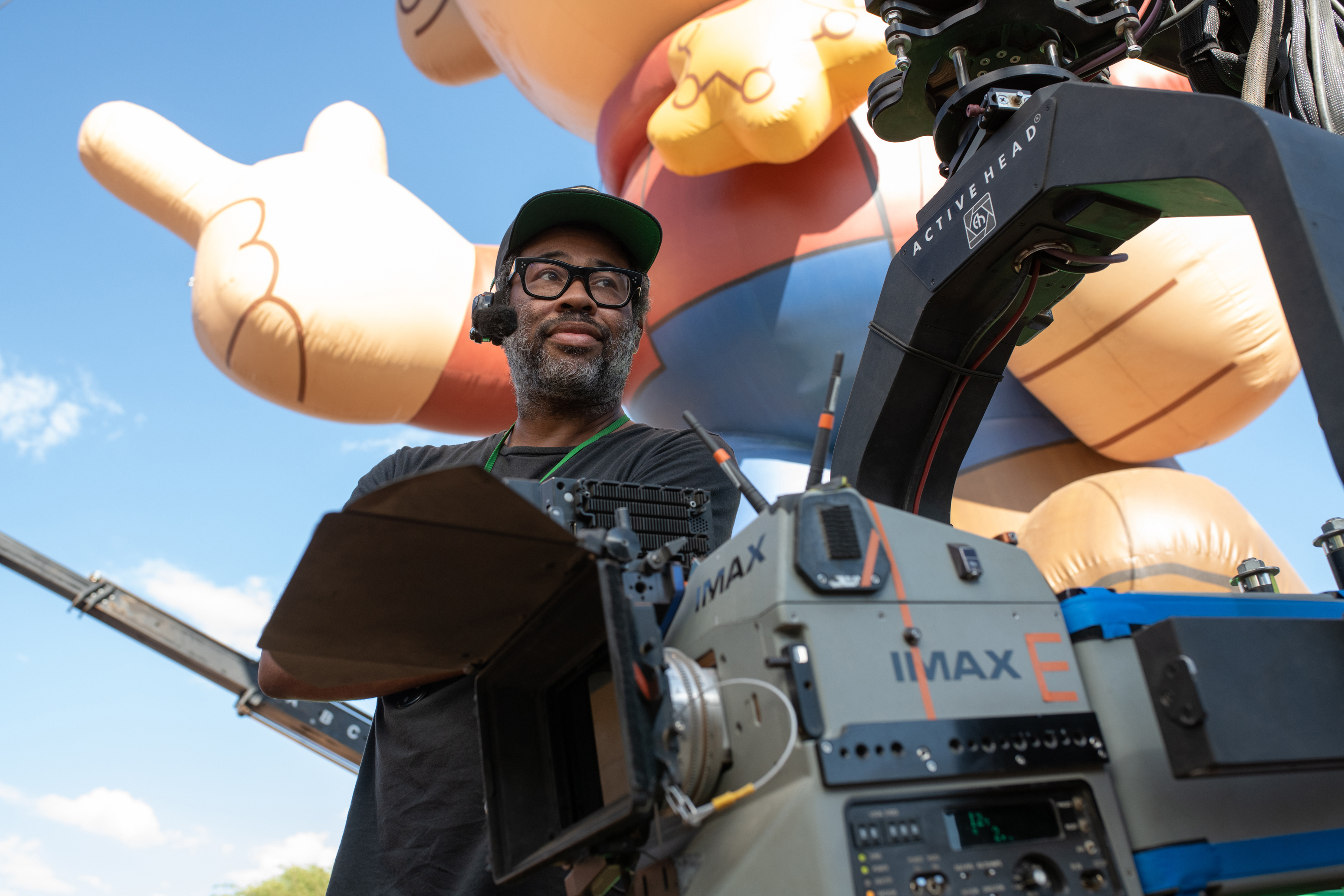
Writing isn't Jordan Peele's strongest suit. It's a shame, actually, that Get Out had won the Oscar for Best Screenplay—this mistake will only delay the scrutiny of its author. Despite these few quips, we must acknowledge that Jordan Peele excels in another area: directing.
In fact, the main strength of Nope is the director’s ability to always know where to place his camera. Far from sticking to a single style, he varies his approach, making long static shots just as unsettling as certain action sequences filmed with a handheld camera. Furthermore, the use of depth of field amid these vast, empty spaces yields a series of images that are as crisp as they are innovative. We always know where each character is, and every action is not only visible but aesthetically stunning. Never before has the sky been filmed like this.
A film about the tools of the entertainment industry
More than just a movie about the show, Nope is a film about the tools of show business. In that sense, it’s fascinating to see that, right from the first sequence, the director turns his back on the green screen and opts to shoot on location. It’s a strangely reactionary return to nature (hence the presence of the Western), which at the same time shows us that spectacle can emerge from something other than a green screen.
The only downside: the excessive post-production work strips the sets of their authenticity. By adding too much artificial lighting, sand, and color to that dark sky, the natural look is overshadowed. This is ironic for a film that seeks to celebrate this force of nature! However, dwelling on this point for too long would be disingenuous: Nope It is aesthetically stunning, and this is also largely due to these additions.
While Jordan Peele may struggle to keep viewers engaged through his writing, he has definitively established himself as an excellent director. His future projects are definitely not to be missed. Let’s just hope that this artist, who holds so much promise, does not suffer the same tragic fate as M. Night Shyamalan. In the meantime, Nope is a truly wonderful film to enjoy in theaters.
Write to the author: [email protected]
Photo credit: © Universal Studios
You've just read an open-access article. Debates, analysis, cultural news: subscribe to support us and get access to all our content!


You'll also like


 French
  German
  English
Leave a comment