



«The Man Who Killed Don Quixote,» the perfect fantasy

Cinema Wednesdays - Alexandre Wälti
It’s all there: energy, madness, ingenuity, adventure, and even homage. It’s Terry Gilliam’s take on Don Quixote, aged in a Monty Python barrel—the 2018 vintage, at last! That’s an understatement, given how long the adaptation of Cervantes’ classic has been an ordeal for the director, who had the project in mind as early as 1990 and began production in 2000. He isn’t the only director to have attempted a film adaptation: the great Orson Welles had already struggled with it for twenty years, starting in 1957. Why did it take so many years to make The Man Who Killed Don Quixote ?
First, the late Jean Rochefort had to turn down the title role due to a double herniated disc; then, a flood destroyed all the film’s equipment; and finally, the location initially chosen by Terry Gilliam was under a flight path. These setbacks ultimately put an end to the project starring Johnny Depp in 2002 and led to a documentary that also offers an interesting behind-the-scenes look at film production: Lost in La Mancha.
The idea for the film goes back a long time—25 years, to be exact, as the opening credits remind us. At the same time, the director is tackling a tome of over 1,000 pages that, at first glance, seems impossible to adapt for the screen—truly impossible. Why? For so many reasons that it’s impossible to list them all here—at the risk of turning this article into an endless list. As you’ll no doubt agree, that’s something to avoid when reviewing a film. But mainly, it’s because the novel is a layering of characters within the character of Don Quixote, just as it’s a succession of stories within the story. In short, as you’ve probably gathered, Cervantes’ two-volume work is the infinite book by definition.
A clever use of the "mise en abyme" technique
Enough about literature—let’s talk about movies! That’s why you’re here, isn’t it? Yet I’m really tempted to whisk you away, like some Don Quixote emerging from the shadows, on «a perfect day for adventure.» Specifically, Terry Gilliam—echoing the introduction to this article (and yes, all that rambling wasn’t for nothing)—chose to create a mise en abyme. How? He decided to enter the world of Don Quixote through the perspective of the American director Toby (Adam Driver, superb). Toby had shot his graduation film inspired by the adventures of Don Quixote. He returns to Spain—did he ever really leave?—for a film shoot, perhaps the sequel to *Don Quixote*.
Overnight, through a series of chivalrous events—Toby, the director, returns to the location of his first shoot and discovers, ten years after his graduation film, what has become of the actors and extras. In particular, he realizes that he has forever changed the life of Javier, his cobbler-Quixote (Jonathan Pryce, wildly possessed), and that he has influenced so many other lives without really realizing it. At this point in the article, it’s worth noting the emergence of the Portuguese actress Joana Ribeiro—fabulous and intense—in the role of Angélica. Let’s return to the film. This journey into the past suddenly transports Toby into the very story of Don Quixote. He becomes Sancho Panza, the faithful squire of the knight-errant, and relives his adventures in the modern era. Once again, Terry Gilliam’s approach keeps the film from getting too close to the endless tales of Don Quixote, without ever overlooking certain iconic passages from Cervantes’s work.
The encounter between the director and Don Quixote serves to make the disconnect between two eras and two mindsets even more believable. This is the film’s central theme, far more so than Don Quixote’s adventure. This is undoubtedly the adaptation’s greatest strength. It actively contributes to the tension, which is both comical—because, yes, Gilliam hasn’t abandoned his offbeat English humor, and we do have a good laugh—and dramatic, as the quest remains unattainable.
From Wild Imagination to Comic Reality
Gilliam’s Quixotic epic thus literally plunges the viewer into the madness of Cervantes’s character, his tenderness, his loyalty, his life; pardon me—the characters, the tenderness, the loyalties, and the lives of the knight-errant, which are, in a way, those of every person who indulges in the pleasure of inventiveness and imaginative passion. But be careful not to lose your way! The English director doesn’t overlook Quixote’s megalomania and personifies it in the form of a Russian vodka baron (Jordi Mollá, icy). We’ll leave it to you to imagine what that looks like through the eyes of a Monty Python member—those in the know will understand; the rest will discover it for themselves.
In summary, the pace of The Man Who Killed Don Quixote is clearly comical. Just take the example of the fictional inn—very real in Cervantes’s work and freely adapted by Gilliam—where the new Sancho and Don Quixote find shelter. When the Inquisition storms in, even the viewer firmly believes the madness is real and begins to doubt the time period in which the film is set. Exactly the effect of the novel! The two companions panic, and all the scenes that follow are absolutely packed with slapstick and other highly entertaining antics. Pure pleasure!
Write to the author : [email protected]
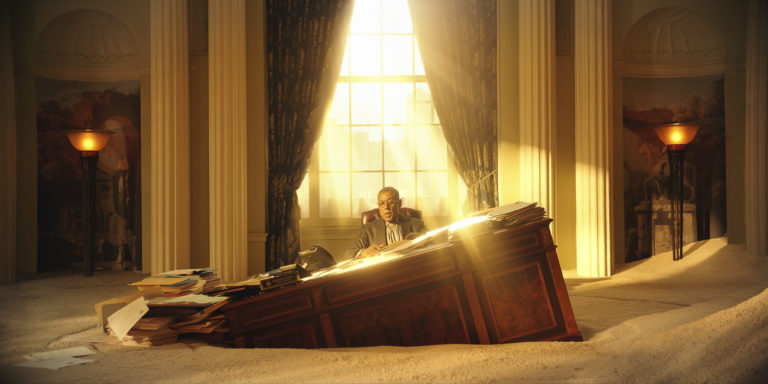
Photo credit: © Diego Lopez Calvin for Ascot Elite Entertainment
You'll also like

 French
  German
  English
Leave a comment