




Haute-couture, a world of aberrations and misinformation

Art fashion photo of a gorgeous woman in paper dress. Black and white.
Le Regard Libre N° 46 - Hélène Lavoyer
The fashion sector of the luxury industry is a world with two faces. The first is hypnotic, aesthetic. It has built up a strong, smooth image of fashion, using craftsmanship and rarity as arguments to justify the inordinate monetary value of products of supposedly exceptional quality. The second side, insidiously hidden, is ethically unjust, at odds with the values advocated by the brands themselves.
At the beginning of October 2018, the show Cash Investigation publishes a televised investigation of this other face of luxury fashion. It was produced by Zoé de Bussière, a journalist for Premières Lignes Télévision, the press agency and production company that initiated Cash investigation. With «Luxe: les dessous chocs», the LVMH and Kering groups unwittingly reveal the working conditions of Italian tannery workers, the rabbits with their hopeless abscesses and tocs, and the priceless fortune amassed by these groups.
Luxury, that aesthetic giant
If LVMH - for Louis Vuitton, Moët et Henessy - and Kering have been targeted by this investigation, it's because between them, these two groups own most of the world's leading luxury brands: Guerlain, Fendi, DKNY, Givenchy, to name but a few brands, no sorry, a few «Maisons», owned by LVMH, and Gucci, Yves Saint-Laurent, Balenciaga or Alexander McQueen, belonging to the Kering group. It's only natural, then, that these giants, with sales of some forty billion euros and a net profit of five billion euros in 2017, should be investigated.
In the fashion and leather goods sector, sales of fur and leather products account for more than half the turnover of these brands; the catwalks that can easily be found on the internet attest to this, these raw materials are key elements, and through their precise, creative and unique finishes generate a fascination that forgets to question the ethics behind production. How do these brands legitimize the thirty-five thousand euro value of a handbag, or the almost thirteen thousand of a Givenchy coat with a leopard print on Italian lambskin fur?
«In order to continue their progress, all the Houses will continue to focus on the creativity of their collections, the extreme quality of their products, excellence in distribution and customer experience, improving their digital presence and developing their online sales.»
Half-year financial report 2018, LVMH
Their strategy is based on the widespread idea that a product's rarity is its value, and on the product's image, constantly renewed, revamped and reworked through advertising campaigns, conveying an image of luxury as a means by which the individual too can assert his or her uniqueness. Of course, it's not all about image; raw materials themselves cost more or less, and have their own «hierarchy of quality». However, the preconceived notion that a luxury brand is a guarantee of ethics and quality needs to be challenged.
The case of subcontractors and workers in Italian tanneries
And what about the conditions under which these luxury brands produce their products? Santa Croce, in Tuscany, is home to what is known as the «Republic of Leather». Here, tanneries have declared that they work for brands such as Louis Vuitton, Hermès and Céline. In these LVMH subcontractors, which manufacture a product or part of it before it is finished in Italian or French workshops, employees work in inhuman conditions.
However, the «Supplier Code of Conduct» clearly states that «the LVMH Group attaches great importance to its brands and their partners sharing a common set of rules, practices and principles in terms of ethics, social responsibility and environmental protection». In the same code, the Group refers to the standards set by the International Labour Organization, which stipulates a maximum working day of eight hours. The Thermoplak tannery employees (trained on the job), however, work up to thirteen hours a day in forty-degree heat.
We're well aware that it's not just in the tanneries of deepest Tuscany that the eight-hour standard is not respected. In the catering and hotel sectors in particular, employees often end up exhausted by working hours that sometimes involve up to fourteen hours a day. Does the widespread nature of this situation make it acceptable? No. But at Thermoplak, it's not just the hours that are questionable. Unpaid wages, beatings, mechanical transport of hides weighing ten to thirty kilos, handling dangerous chemicals without gloves or respiratory protection, accidents...
«That day, it was the first skin I'd worked on. I picked it up, put it on, the blade jammed the first time. I flipped it over, put the skin back on, and... it grabbed me. It took my gloves, and removed the phalanges of three fingers. The doctor asked me what had happened, and the man in charge wanted to lie. [...] He said a board fell on my fingers.»
«Luxury: the shocking underside», Cash investigation, October 9, 2018
Animal welfare and respect for the environment, other hypocrisies
Still in its code of conduct, LVMH insists on «implementing best practices throughout their supply chain in favor of respect for animal welfare». Isn't it naïve, given the way employees are treated, to believe in healthy animals? Isn't it hypocritical to talk about these possible «best practices» for animals, when even in Switzerland, where most people still believe in the image of the pretty cow Marguerite frolicking in a pasture of fresh grass, farm animals are subjected to indecent rearing and slaughter conditions?
You didn't have to go all the way to China to find the horror. But, after Denmark, the country is the world's second largest supplier. Between them (it's time to put your coffee cup back on the table), these are at least three hundred million of animals killed every year. In other words, animals that man gives birth to so that he can kill them. The world of luxury isn't all it's cracked up to be, especially when you see those rabbits tossed in the air before landing in a skip with one or two broken legs. But neither the rich who live off luxury fashion nor the part of the middle class that dreams of it.
Read also: L’art, essence de la mode?
Shouldn't it be up to the bourgeoisie, to whose good will these groups bow, to use their economic power to put pressure on the hypocritical likes of François Pinault, whose billion-or-so smells of nothing but greed? Isn't it time that those whose voice weighs for the sake of their bank accounts, bind themselves to ethics despite the blow it could deal to growth? In fine and whatever their social background, consumers must take responsibility by making their voices heard and keeping their wallets quiet.
Write to the author: [email protected]
Photo credit: © Le Regard Libre
-
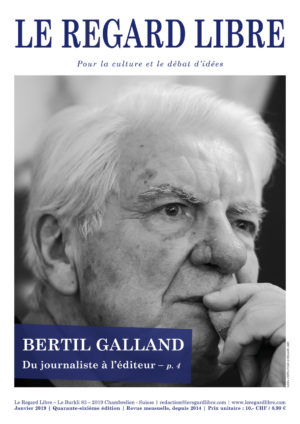 Le Regard Libre - N° 46CHF10.00
 -
 Standard subscription (Switzerland)CHF100.00 / year
 -
Support subscriptionCHF200.00 / year
You'll also like




 French
  German
  English
Leave a comment