




«Anonymity is a choice»
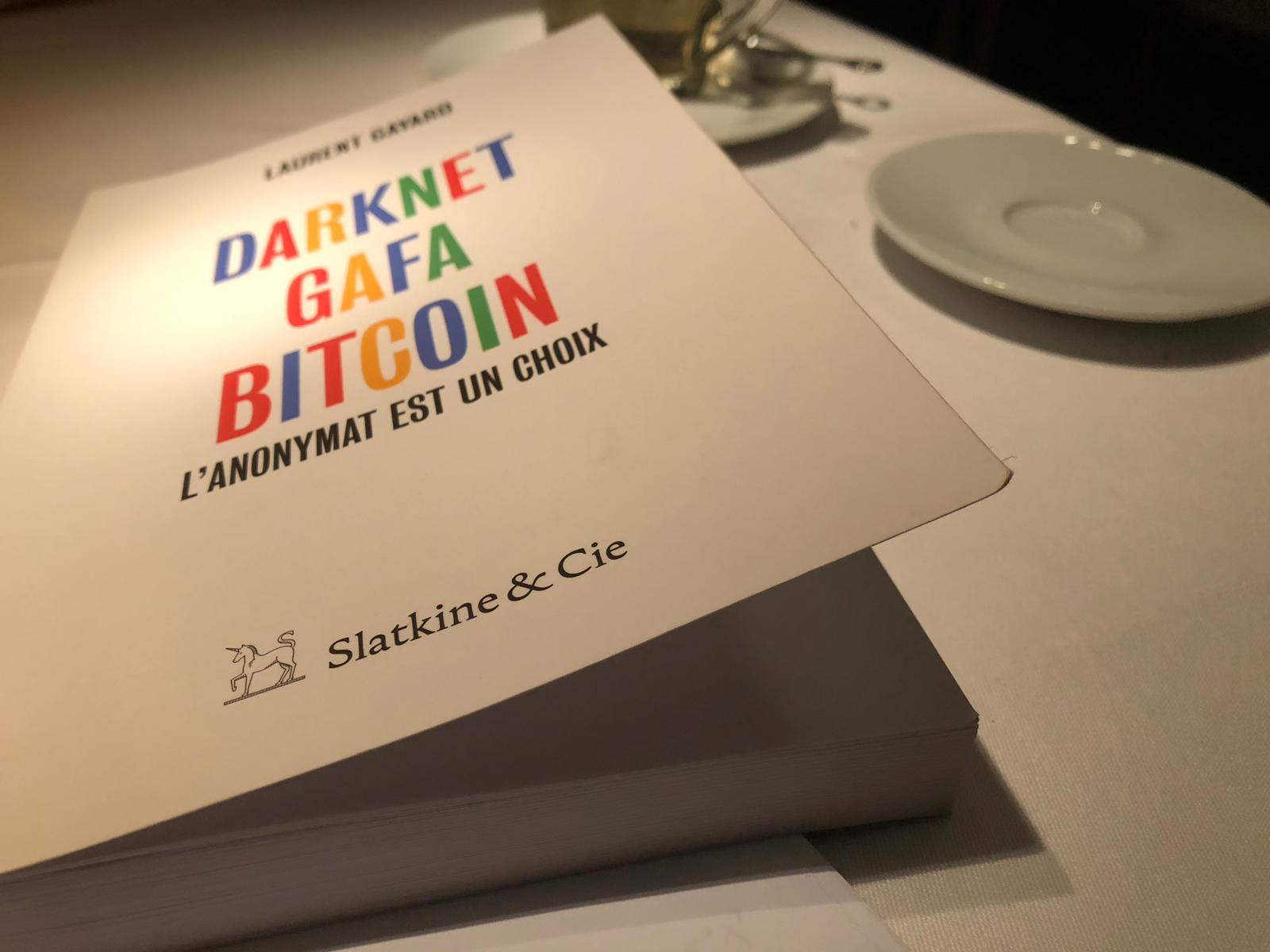
Le Regard Libre N° 43 - Nicolas Jutzet
In his book Darknet, Gafa and Bitcoin, Laurent Gayard, teacher and columnist, looks back at the emergence of the various players that accompany us day after day. GAFA stands for Google, Apple, Facebook and Amazon. Without forgetting to retrace the history of the ecosystem infrastructure that allows these players to spread throughout the world, and increasingly to intrude on our intimacy, thanks to the exploitation of our traces, i.e. our data.
Laurent Gayard delivers a little manual of resistance, which should serve as a wake-up call. We need to take a proactive stance in our relationship with the Internet, and stop resigning ourselves to a blissful technophile position, forgetting the importance of what's at stake, particularly in relation to our private sphere. Because there are alternatives to the established behemoths, with their advantages and shortcomings, of course.
Once upon an Internet time
What remains of the decentralized techno-libertarian dream, called the Internet since the 1ster January 1983, today? Laurent Gayard draws a bitter conclusion. In his view, the Internet has certainly changed our lives, but it has also changed us. Progress has come a long way, but far from liberating us, the adventure has turned into a veritable virtual glass prison. allows everyone to observe others, at any time, as never before. This reality is intimately linked to the hegemony of the above-mentioned players, who, through their dominant position, impose their way of doing things. The principle of winner takes all demonstrates exemplary continuity.
In the physical world, the marginal cost of a new customer, or of producing an additional product, is supposed to increase over time, for reasons of resource scarcity. In the digital world, however, the marginal cost of an additional user is virtually nil for the company offering the service. On the contrary, the offer becomes even more efficient and therefore monetizable in terms of advertising with a growing number of Internet users. A structural trend towards monopoly is emerging in this business model.
Europe, fighting with billions, is marginalized in this new world. It can testify to the difficulty of existing in a bipolar universe where American and Chinese giants fight greedily for market share. In the 2017 ranking of the top tech companies, only Chinese and American players feature. Laurent Alexandre, founder of the Doctissimo website, very active on social networks, author of various books on the subject and a specialist in artificial intelligence (AI), even announces that there will be a second colonization, a technological colonization. Are we condemned to endure?
The European market, with its diverse languages and shaky structure, means that our hopes of catching up are virtually nil. All the more so as the centralizing tendency that reigns on the old continent runs counter to the logic of thinking in this new world. The example of the Minitel and the technocratic stubbornness of the brilliant Valéry Giscard d'Estaing are the most illustrious examples. Ironically, the system that definitively popularized the Internet, the World Wide Web, was invented at CERN (European Organization for Nuclear Research) in Geneva by Tim Berners-Lee.
Googlocracy
This need to increase the size of the community requires another new feature: the need to make the product easily accessible and facilitate the consumer experience as much as possible. Make it easy to use. Here, borders are disappearing, and the market is global, following a fundamental trend. The physical barrier also disappears, and it is now possible to follow anyone, anywhere, at any time, establishing a deceptive reign of transparency.
The free nature of Facebook and Google is a testament to this new paradigm. But let's not forget that if it's free, we're the product. We produce data, the new black gold, which enables these players to know more about us than our nearest and dearest. In this respect, it's interesting to note that we need to analyze the GAFAs in a differentiated way. There are two models. On the one hand, Amazon and Apple, which resemble an updated version of traditional companies; and on the other, UFOs Google and Facebook.
Their omnipotence makes them indispensable for anyone wishing to have a minimum «2.0 social link» with their family or professional circle. All the more so as the ambitions of these companies are almost limitless. Google's Director of Engineering, Raymond Kurzweil, theorizes that an augmented human being will soon appear on the scene. Google's partner companies Life Science and Calico are on a mission to push back mortality, and even achieve immortality. Rejecting the defeatism of «it was better before», they follow a new mantra: «it will be better tomorrow». The beatification of technology is total. Not forgetting autonomous cars, personal assistants and all the rest!
Youtube belongs to Google, Instagram and WhatsApp to Facebook, and Snapchat is in Google's sights after turning down an offer from Facebook in the past. So, is there no salvation outside these two behemoths? Alternatives do exist, however. Far from being systemic, they should be seen above all as complementary to the GAFAs.
Making Big Brother obsolete, regaining control of our data
To date, a European's personal life - or, more precisely, the data he or she leaves behind in his or her digital life - has been worth over six hundred euros per year. Facebook, for its part, earns an average of between 5 and 15 dollars per profile, depending on the study. The adage known from other sectors applies by analogy: free has no price, but it does have a cost. By knowing the smallest details of your lives, Google and company can easily influence your behavior.
To escape this siphoning off, deemed problematic by some of the original fans, alternatives are emerging. Placed in the hands of a malevolent state, this paraphernalia is so chilling that its power to cause harm is enormous, if not limitless. This is where we meet the darknet. According to Laurent Gayard's definition, «a darknet is a network superimposed on the Internet, using specific protocols to anonymize communications and exchanges on these networks. Originally, the term could refer to networks developed in parallel with the Internet project. In the 2000s, the term was popularized to designate peer-to-peer downloading networks, particularly illegal ones. Today, the term is often used to designate a ‘hidden Internet‘, whereas darknets are in fact quite distinct networks that can only be accessed using specific software or protocols’.
The first darknet available to Internet users: «Freenet». Its creator's idea was relatively simple: «to offer the guarantee of total anonymity on a network immune to censorship». In reality, it was more complicated. Decentralized, Freenet doesn't offer a search engine worthy of the name, and it's time-consuming to use. But anonymity is almost total. What's more, unlike Google, Freenet is far from being user friendly.
Another option: The Onion Router (the «onion router»), better known by its acronym Tor. Developed in the mid-1990s, it was intended as a means of Internet communication for the US military and intelligence services. It was intended to enable exchanges that would escape espionage, particularly from abroad. It is therefore an encrypted network.
Cryptographic principles are as follows: «There are several types of cryptography. Symmetrical cryptography assumes that a message is encrypted (encoded) according to a particular code that can be decrypted using a secret key possessed by the members of the network using this type of cryptography (Telegram messaging is an example). Asymmetrical cryptography, on the other hand, presupposes the existence of two keys: a public key used by an algorithm to encrypt the message or data being sent (i.e., to make it intelligible), and a secret key known only to the sender and recipient of the message, which will be used by an algorithm to decrypt the message. The symmetrical system has the advantage of speed, but the disadvantage of having to communicate the secret key securely between members of the encrypted network, without which confidentiality is threatened. The asymmetric system has the advantage of offering a more secure double encryption system, but the disadvantage of being slow and requiring a lot of computing power».
Of these two systems, the Tor network uses... both. Why? «In order to gain both speed and confidentiality, for both e-mail and data exchanges.» Data transmitted by the user is protected by several layers of encryption (like an onion). Theoretically, complete anonymity is guaranteed. This reality has a series of negative consequences, not least of which is significant illegal activity.
It would be wrong to summarize darknet to that, but denying it would be just as bad. Originally, anonymity was intended above all as an escape route for journalists and other persecuted dissidents. It's hard to avoid this protection also being used by crooked entrepreneurs or those ahead of their time, or simply ahead of the law.
However, a solution seems to be emerging. It addresses two issues: the darknets are not user friendly and suffer from the negative aura associated with the illegal activities that abound there. The answer is called «WebtoTor» and «Tortoweb». It's a bridge between the clear web (traditional) and dark web. There's no need to install Tor; the traditional browser is all you need to access hidden «.onion» pages. However, with this solution, only the guarantee of anonymous publication remains; that of browsing disappears. It's a transitional solution that guarantees security for journalists and other whistle-blowers who want to publish information, without ensuring total impunity for illegal offers and their consumers.
In a nutshell: «Freenet, like Tor, invites us to rediscover some of the cautionary reflexes that Web 2.0 has all too often led us to lose, and the difficulty of finding our way around initially invites a certain restraint.»
And in response to the many controversies surrounding the use of Facebook and Co. data, new social networks are emerging. According to Laurent Gayard, «diaspora*» is the most interesting: «the only social universe where you are in control. Each user hosts their own connection relay and information on their computer, which acts as a server. In this way, unlike Facebook, no personal data can be recovered for commercial purposes, since the user is the only one to host the data he or she puts online on the social network.»
There are many other projects worth mentioning, but let's focus on the main lesson: «Anonymity-enhancing tools on the Internet, such as hidden networks, anonymizing search engines and secure operating systems, are not only instruments in the fight against surveillance by government agencies, they are also ways for ordinary users to protect themselves against mass data capture.»
It's not a question of denying the benefits of the current offer, that of the Silicon Valley behemoths or their Chinese counterparts, but rather of getting us to react to the system and its underlying logic. By reminding us that there are alternatives, but that there is no such thing as free, or that we all have a responsibility when we share our intimacy with others via platforms that run on the exploitation of our private lives. And that the whole thing works thanks to, or because of, our consent! In the end, the revolution will be above all intellectual, to escape a new form of social, economic and, one day perhaps, genetic control. The existence of a counter-culture that cares about the privacy and real freedom of Internet users is a prerequisite for this. sine qua non so that the players in place understand its importance. No coercion by law or otherwise name and shame that collectivists are always keen to see, it's only through the debate of ideas and the ability to transform this dissident offer into a real alternative that success will be achieved. Let's discuss it on «diaspora*»?
Write to the author: [email protected]
Photo credit: © Nicolas Jutzet for Le Regard Libre

You'll also like




 French
  German
  English
Leave a comment