




Free movement of people is not liberal, it's socialist
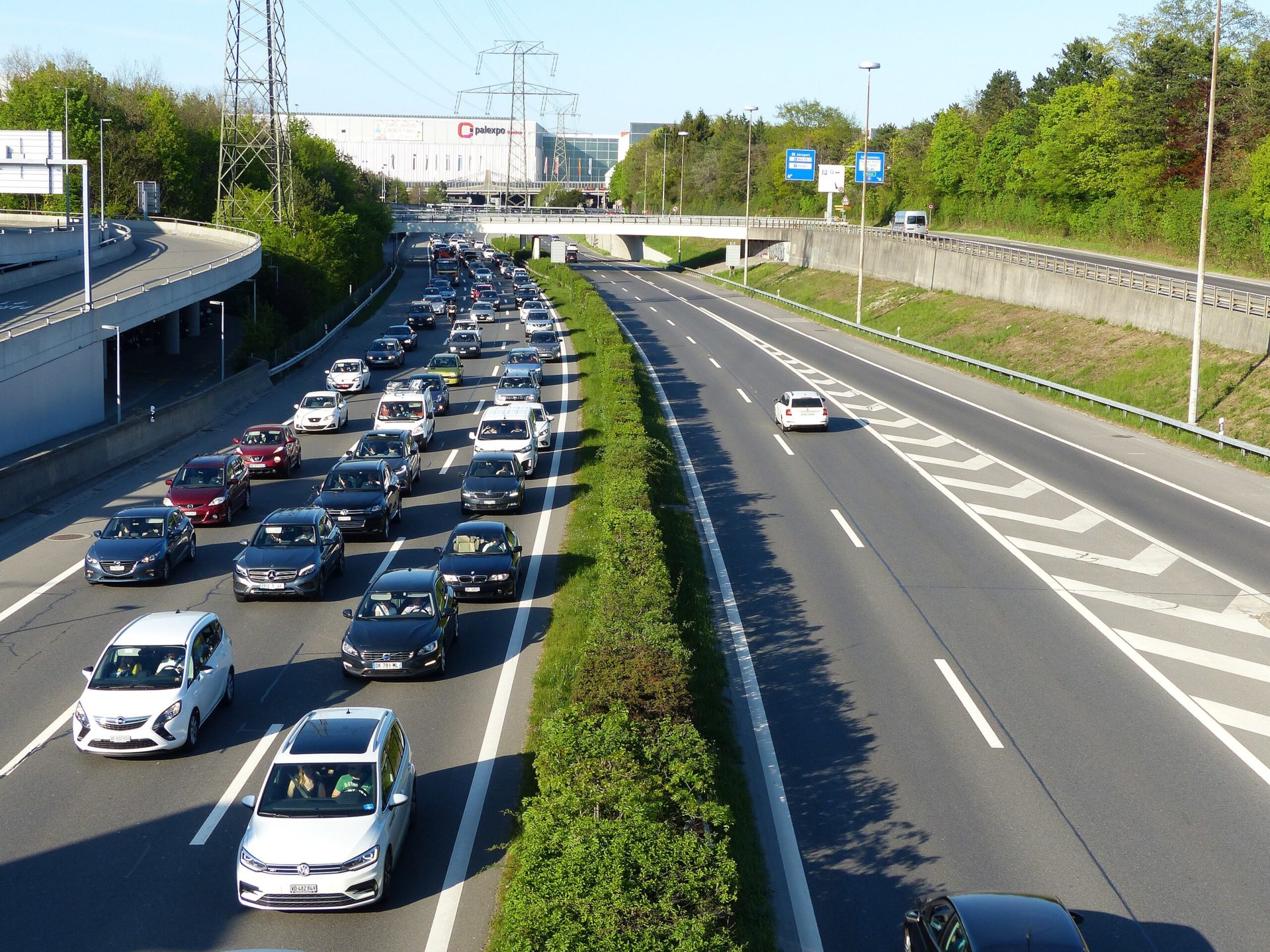
Traffic jam on the A1 freeway, in front of Geneva airport, 2018. Photo: Wikimedia CC 4.0.
Free immigration from the EU certainly boosts economic performance, but it has serious side-effects that have been overlooked. It is thus becoming the driving force behind Switzerland's illiberal transformation.
L’original article by Reiner Eichenberger and Fabian Kuhn was published in German in Schweizer Monat.
The free movement of people brings Switzerland more immigration and therefore more growth in population and gross domestic product (GDP). It brings the few «special citizens» - political decision-makers, powerful companies and leading associations - higher tax revenues, sales and membership fees, and thus «vitamin B3»: budget, importance, bonus.
For «ordinary citizens», on the other hand, what counts is whether immigration improves their quality of life. And here, it's not GDP that's relevant, but GDP per capita. To do this, special citizens set thought traps, such as «immigration alleviates the shortage of skilled labor». If this were true, the skills shortage would have disappeared long ago after eighteen years of total free movement of people. But in reality, immigration feeds the skills shortage, because immigrants need housing, goods and services - largely produced by skilled workers.
Immigration thus becomes a natural phenomenon. Rapid population growth makes all those factors that cannot be reproduced at a constant average cost - land, infrastructure, environmental assets, self-sufficiency and efficiency - more scarce and more expensive. These «infill costs» reduce quality of life.
Read also | Immigration: Labour's reality check
There are numerous studies on the effects of immigration, most of them commissioned by the Swiss government. Many of them focus on the past evolution of the labor market, although this is where we would expect to encounter the fewest problems - precisely because immigration is a natural phenomenon. Unsurprisingly, they show that as long as the labor market is flexible, the effects of immigration are minimal, neither strongly negative nor strongly positive.
Certaines études simulent les conséquences d’une future immigration. Une étude récente, réalisée par le bureau Ecoplan sur mandat de la Confédération, analyse les conséquences économiques de l’abrogation des Bilatérales I d’ici 2045. Selon le Conseil fédéral, cela entraînerait pour la Suisse une perte annuelle importante de 4,9% du PIB. Mais il s’agit là d’un latin spécial. Pour les revenus par travailleur, l’étude ne trouve que des effets minimes malgré l’hypothèse qu’il n’y aurait pas de coûts de remplissage. Alors que la population augmenterait de 344’000 personnes et de 45’000 frontaliers en moins, les revenus du travail n’augmenteraient que de 0,62% de moins qu’avec les Bilatérales I et la libre circulation des personnes. Ces dernières n’apportent donc presque que des coûts de remplissage aux citoyens ordinaires.
The black hole of filling costs
To date, filling costs have not been studied. This makes it all the more important to think about the issue in an economically disciplined way. What is decisive for Switzerland is not the effect of immigration, but the effect of the free movement of people. The latter prohibits what is the rule in other immigration countries such as Canada or Australia: limiting, managing and selecting immigration in a targeted manner.
The lack of control, combined with differences in size and prosperity - the EU has a population 50 times larger and a GDP per capita 60% lower than that of Switzerland - results in asymmetrical migratory pressure towards Switzerland. For would-be migrants, it's worth moving to Switzerland as long as the differences in quality of life outweigh the costs of migration. Or, to put it another way, net immigration will only dry up when the Swiss quality of life, due to higher filling costs, falls to the level of the countries of origin plus the costs of migration. But while the costs of immigration fall as the proportion of foreigners rises (for example, because more and more people speak English), the pressure to migrate, and therefore the costs of filling in, continue to rise.
Read also | René Schwok: «We're giving the EU powers it doesn't have».»
Infill costs affect almost all areas of life. More inhabitants - 21% in 18 years of free movement of people - need more living and working space, which drives up rents despite the enormous construction activity and shrinking green spaces. They need more transport infrastructure, electricity, health services, training places and so on. Communes and cantons have to develop schools, hospitals, roads and public transport in a short space of time, and ensure self-sufficiency and waste disposal objectives. The costs of all these services rise disproportionately with rapid expansion. The result is a decline in the quality of services, an increase in the burden on public budgets and, ultimately, in taxes.
Immigration boosted by the country's attractiveness
Some see the solution to the problem in greater efficiency, for example by integrating more women and older people into the labor market or deregulating the construction sector. But these too are thinking traps: the more Switzerland uses its resources, i.e., the more efficient it becomes, the more attractive its business location becomes, which in turn increases migratory pressure and filling costs.
This balancing act deprives citizens of the incentive to engage in good politics. In addition, high immigration is eroding Switzerland's successful institutions, such as the militia system and direct democracy. Meanwhile, the share of foreigners in the permanent resident population rises to around 40% in the 30-40 age group. While the demand for militia work in politics, the army and society is increasing with population growth, the supply is hardly growing at all. At the same time, a growing proportion of the population is excluded from direct participation.
Read also | The taboo reasons for the SVP's surge and the Greens' failure
Markets are thus infiltrated. As locals are no longer allowed to discriminate directly against immigrants to protect their comfortable housing and employment situation, they discriminate against them indirectly by discriminating against all «outsiders» wishing to enter the market (i.e. immigrants and their own young people) or all local non-residents (whether Swiss or immigrants). As a result, the rental market is increasingly regulated to protect existing tenants, while new housing applicants are left out in the cold. Similar trends are evident in the labor market, for example in the form of minimum wages or accompanying measures that make it more difficult to enter the market. The free movement of people is thus becoming the driving force behind Switzerland's illiberal transformation.
Constructive solutions
There are two solutions.
1. Direct tourist taxes that do not comply with the free movement of people. Immigration from the EU and certain third countries should be as free of bureaucratic obstacles as possible, but not free of charge. New adult immigrants would pay a tax of 10 to 25 francs per day (similar to a residence tax) for three to five years. This would effectively reduce and direct immigration, making Switzerland less attractive, especially to those who bring little to the table. For foreigners from the EU, it would still be attractive, because even with the residence tax, the tax burden on immigrants would still be much lower than in the EU; a small part of their migratory gain, however, would accrue to Switzerland. The revenue of between 1.5 and 5 billion francs a year (depending on the model) would once again encourage locals to commit to openness and good politics.
Read also | Sovereignty versus international governance
Great Britain shows just how effective the pricing model is. It introduced a comparable model after the Brexit, but for all prospective immigrants. This made immigration from the EU more expensive, but from outside the EU much easier. As a result, immigration from the EU has fallen, while immigration from non-EU countries has soared. The ideal situation for Switzerland would therefore be a 2- or 3-circle model: all new immigrants would have to pay a fair price for their stay. But for prospective immigrants from non-EU countries, there would also have to be a case-by-case examination, for example using a points system. On the other hand, prospective immigrants from the EU benefit from free immigration at a lower «friendly price».
2. State burdens that weigh heavily on the Swiss and constitute genuine «Swiss taxes» must be distributed more fairly, and state services for long-term residents must be increased. L’impôt suisse le plus important est le service militaire obligatoire. Il oblige les jeunes hommes suisses à servir 245 jours, soit une bonne année de travail, ce qui leur coûte entre 50’000 et 80’000 francs en raison du manque à gagner et du retard dans la formation, malgré l’allocation de perte de gain.
Read also | «The Clash of Civilizations: immigration vs. immigrations
Le service militaire obligatoire pourrait être aboli et remplacé par une «contribution à la société»: tous ceux qui entrent dans la vie adulte en Suisse – que ce soit par leur dix-huitième anniversaire ou par l’immigration – devraient verser une contribution de 50’000 francs sur quelques années, sous forme de service militaire, de travail d’intérêt général ou d’argent. En parallèle, l’Etat pourrait constituer un capital de base pour tous les jeunes en leur versant des contributions annuelles, avec lesquelles ils pourraient également payer leur contribution à la société une fois adultes. Au total, cela aurait l’effet d’une taxe d’immigration non discriminatoire.
Such considerations might frighten liberals into thinking that the free movement of people is a liberal model. But this too is a thinking trap: the free movement of people is not a liberal concept, but rather a socialist one: it deprives citizens of their property rights over their own country by allowing others to use it for free. The fact that it doesn't work is in fact trivial.
Reiner Eichenberger is Professor of Economic and Financial Policy at the University of Fribourg. Fabian Kuhn is a graduate assistant in the same chair.
You have just read an open-access article. Debates, analyses, cultural news: subscribe to support us and access all our content.

You'll also like
 French
  German
  English
Leave a comment