



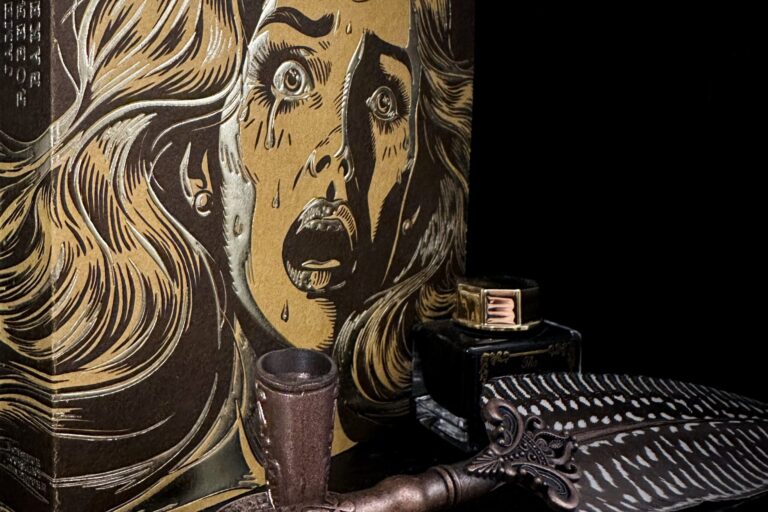
«Blood», extract no. 5

Le Regard Libre No. 29 – Sébastien Oreiller
Chapter I: Loss (end)
As he walked home that evening, along the dry edge of the forest, he thought back on the way she had appeared to him—Pauline L****—almost absent, like a specter drawn to life-giving flesh. He knew she was beautiful, still young though already beginning to fade. Yet, as is often the case during that fleeting moment when one meets someone for the first time—and reflects on it afterward—he struggled to make out her features. He saw her from behind, tall, almost as tall as he was, her long blond hair loose. It had a hint of the green or blue of that sea he had never seen, hair that fell in waves down her back, almost to her lower back. Strangely, he saw it loose, even though he was certain she must have tied it up in buns above her head, above her face. That was the image that came to him, and the one he held onto afterward.
He didn’t want to talk to his mother about it. No, definitely not. He knew she would find out. In fact, she already knew. She asked him where he’d been—without confronting him, almost discreetly, as if she truly trusted him. Ah! He still preferred his father’s blunt brutality, which came crashing down like a storm but didn’t gnaw at him. So he told her the truth by lying to her; he told her he’d gone to help his friend at his father’s bar, that the L**** family’s valet was staying there, and that they were looking for a gardener for the summer. Yes, he knew the reputation these people had; he knew the trouble they’d caused his father, but it was a good offer, and he was going to accept it. The mother couldn’t say a word.
My grandfather couldn’t even remember the first time he’d pressed his lips against hers—what they had tasted like, or whether she’d closed her eyes or not. He was a cold man who never took pleasure in anything—not because he didn’t dare, but because every act seemed to have an ultimate end, known only to him, and yet one he never reached. He had agreed to be her lover to recapture his youth—as she had, for that matter—and not to love her. Surely he must have been happy at that moment, happy to be the lover of a great lady—beautiful, to boot—and all the more desirable because she desired no one but him, but that kiss could not have carried within it the seed of the absolute that he sought in everything—barely a seed of dust, that of his own finitude, of skin that withers and desire that fades. Nothing saddened him more than the seeds of death, those beginnings in which he could discern nothing but the hope of their end—his own, above all. Unconsciously, she must have seemed contemptible to him. What a disappointment it was to be loved by her, that frail little thing in search of love, to have to take her in his arms and reassure her, to whisper sweet words in her ears, and then to love her—almost violently in its tenderness—so that she might forget herself. How selfish she was, above all—she who loved only to be loved in return. Not a seed of chaos, not a seed of that abyss that drew him so strongly, and yet which he dreaded. His resentment was born with that kiss on the first day; yet he had to convince himself that he had loved her at first sight. I don’t think, for that matter, that he would have been capable of loving after that; at any rate, not after losing his youth.
He loved her for a whole week, on and off, in the shade of the ivy. Docile at first, he imposed his masculine mark on her; he did not let her approach him whenever she wanted, nor even kiss him. He banished her sentimentality, the lingering glances, even the first signs of tenderness that were already taking root as habits. He didn’t want to be her lover, nor even to be the everything that would fill her emptiness. What he wanted was a communion—not so different, in fact, from the one he received at church: rare, fleeting, but one in which man becomes God, eyes closed and on his knees.
Their summer afternoons slipped away in the languor of that moment. He must have loved her under the June sun, a selfish embrace made bearable by the breath of the plain—that dry wind that rose, burning toward them, trembling with life and sweat, from the vineyards on the hillsides; that cry of the rocks, which the mountain’s stillness condensed into a warm aura, enveloping them as her body smiled against his. Before their eyes, the river slithered away like a snake.
END OF THE LOSS. ARRIVAL OF THE SON.
Write to the author: [email protected]
Photo credit: © valais.ch
You'll also like




 French
  German
  English
Leave a comment