




Françoise Sagan had the devil at heart
Tuesday's books - Lauriane Pipoz
In 1954, Françoise Sagan was eighteen years old. That summer, in six weeks, she wrote her first novel. A masterpiece as trenchant as it is meticulously written, it takes the reader into the heart of a family on the verge of reconstitution. While it says a lot about the mores of the 1950s, it hasn't aged a day. So much so, in fact, that we find ourselves looking for contemporary elements. The story of my trip to the Côte d'Azur, seventy years earlier, in the vile mind of a young girl ahead of her time.
Through its frequent references to good and bad morals (and especially the latter!), Hello, Sadness reminds Dangerous Liaisons. And I'm not making this up; many others have drawn this parallel before me. But the book has also been associated with the Devil in the Flesh, a book that has caused a huge scandal when it was released in 1923. Because of its alleged immorality (it tells the story of an affair), but also because of the young age of its author, Raymond Radiguet, which made the treatment of such a subject seem even more scandalous in the eyes of readers. In fact, Sagan’s text was almost equated with this story, since it was initially published under the title The Devil in the Heart.
To what end? To heighten the sense of scandal, no doubt. In 1954, the author, having just earned her high school diploma, began approaching three publishers. Of the three, the least well-known, Raymond Julliard, was the first to accept this provocative short story, titled after Paul Eluard’s poem. The teenager, who knew nothing about the literary world, asked for such a low fee that the publisher offered her double that amount. It was the jackpot: The teenager wins the highly prestigious Critics« Award, and sales skyrocket. Just like the major guardians of morality at the time—the Vatican will ban this “poison that must be kept away from the lips of the young» (L'Express). How ironic for a book written by a young woman from a well-to-do bourgeois family!
A scandal? What scandal?
But let's get to the point: what scandal are we talking about? The main character in Hello, Sadness, Cécile, is seventeen. She is a carefree young woman who aspires only to lead a fun, carefree life alongside her father. That’s exactly what her father taught her when she left boarding school: ever since his wife’s death, shunning anything serious, he’s been hitting the nightclubs and stringing together fleeting flings like a young man. Closely attached to her father, Cécile is quite content with this situation. She failed her high school graduation exam? No big deal! She’ll still be able to enjoy her vacation on the French Riviera with her father and his current mistress, a young socialite who’s fun but rather shallow.
Read also: When lesbian passion becomes letter writing
It is during this vacation in the sun that our heroine will discover—and come to appreciate—the pleasures of the flesh with a young man. But a highly principled character disrupts her peace: Anne, a classy and intelligent woman, yet extremely harsh and wielding immense influence over Cécile. And she has decided to marry our heroine’s father. So Cécile resolves to harm her and devises a Machiavellian plan to push her father into cheating on her, which will humiliate and destroy her.
To me, as a 21st-century reader, through the main protagonist’s internal perspective, this tyrannical woman in her forties who locks her in her room comes across as nothing short of a bitter stepmother. I would even go so far as to say that our heroine has developed Stockholm syndrome: for brief moments, she seems to soften when Madame de Tourvel—no, Anne—shows her the slightest bit of admiration.
But what was the problem back then? Sex without love, of course! Cécile describes her first sexual experiences and clearly enjoys them. What’s more, she admits at the end of the book that she never loved her fiancé. And to make matters even worse—far from the moralizing tales of the time—she didn’t end up pregnant. It was also at that moment that the author of this article realized just how much contraception had become the norm: I couldn’t help but think that her unprotected encounters were very, very risky. No doubt, my thought was anachronistic. This clearly shows that the story was so contemporary that I had forgotten it had been written seventy years earlier.
Françoise Sagan’s story is highly relevant today. As Anne Berest noted in 2018, in her biography of the author of Hello, sadness, «When a woman takes up her pen to write about the female body, it stirs up a commotion.» Yes, in the present tense. If that is what we choose to remember today from the novel by this immensely original young woman, it is only one aspect of her masterful prose and sharp writing style—qualities that were recognized as early as 1954 and are still just as appreciated today.
Write to the author: [email protected]
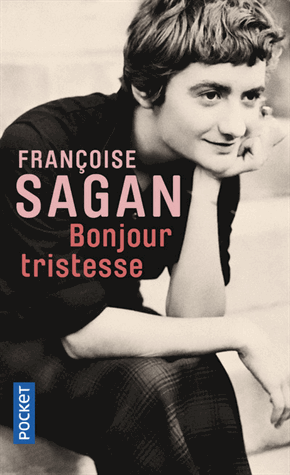
Françoise Sagan
Hello, Sadness
Julliard
1954
188
You'll also like






 French
  German
  English
Leave a comment