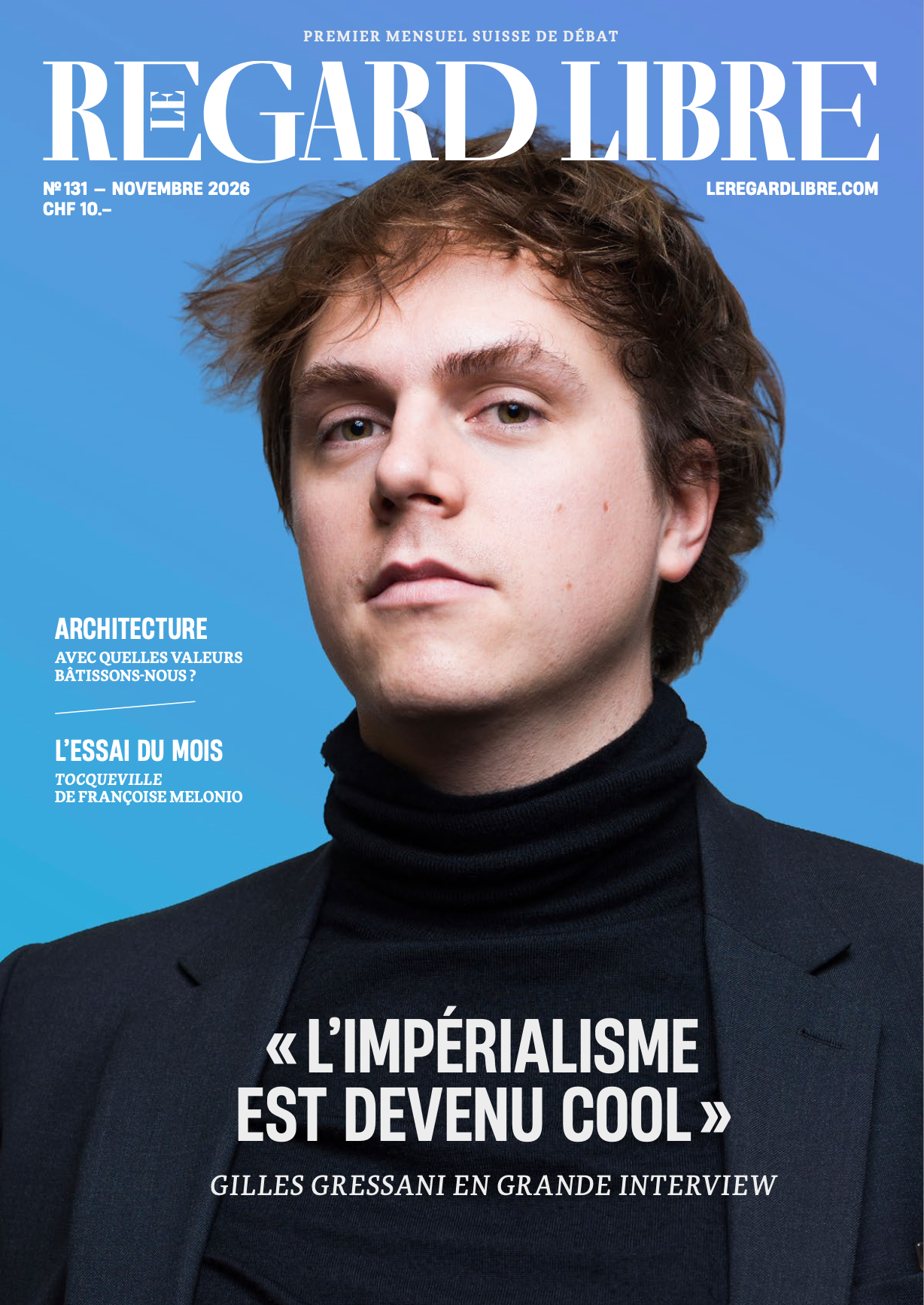




Liberalism in the Face of Authoritarian Temptation

The Austrian Parliament in Vienna, whose neoclassical architecture, inspired by Greek temples, evokes the ancient origins of democracy. Photo: Danny Taing via Unsplash
The principles of a free society must be constantly defended and adapted to the challenges of the present. Without courage, the right risks drifting toward identitarianism and nationalism, according to philosophy professor Armando Zerolo.
Politics is that strange science in which age-old questions call for ever-changing answers. That is why history is such a poor teacher. That is also why we sometimes feel as if we are reliving the past, with the burden of having to start all over again.
The same is true of nationalism and cultural identitarianism. How can we explain the success of Alice Weidel in Germany, Roberto Vannacci in Italy, Marine Le Pen in France, or Santiago Abascal in Spain? The same question keeps coming up: «Not again?» It’s as if we’ve learned nothing from the French Restoration, the Congress of Vienna, the Franco-Prussian War, Charles Maurras, Adolf Hitler, or Benito Mussolini. As if two centuries of nationalism and the conflicts that stemmed from it had been for nothing.
Memory alone is not enough
The confusion between memory and action is undoubtedly the most serious theoretical error committed by European liberalism since the end of the Cold War. The liberal right of the 21stth The 20th century believed that history had come to an end and that it was no longer necessary to defend the principles that had been won over time. As a result, it lacked the courage needed to fight its adversaries.
Memory preserves historical experience and allows us to make it our own in order to guide our actions. Without it, there is no freedom, since there can be neither learning nor reflection. Similarly, political traditions—and the parties that sometimes embody them—have their own memory, their historical burdens, and their own legacy. They transmit the principles and values that define them, make them recognizable to their electorate, and ensure a minimum of consistency amid the turmoil of an ever-changing and demanding news cycle.
Two Traditions at Odds
Within the Western tradition, we can distinguish two major political families from which numerous currents subsequently derive: that of institutional democracy and that of personal power. There are hardly any others. These are the two main trunks from which the many branches of our political family tree spring.
Socialism and liberalism, in turn, form two major families, which are themselves divided—like the Capulets and the Montagues—into rival factions. There is a form of socialism committed to institutions, which we now call «social democracy,» and another oriented toward personal power, commonly referred to as «communism.» Similarly, a form of liberalism that favors institutions and representation takes the form of «liberal democracy,» while another prioritizes the effectiveness of personal power and is found in what is commonly called «the far right.» These terms are hardly academic, but they have the advantage of referring to concrete realities as most citizens understand them.
The existence of two main branches and multiple offshoots shows that every political family is riven by tension. At the slightest lapse, it can tip over into something it never wanted to become. Social democracy will always teeter on the brink of communism; liberalism, on the brink of nationalist autocracy. There is no “end of history.” Anything that resembles it is merely an abdication of responsibility, generally attributable to a lack of courage.
One final lesson can be drawn from this tension inherent in any political family: it takes more energy to stay on the right path than to fall into the ditch. It is therefore always easier to stray than to stay on course.
The Courage to Remain a Liberal
Unfortunately, pluralism, the separation of powers, the rule of law, the market economy, and individual rights and freedoms—which constitute the historical legacy of liberal democracy—do not sustain themselves. They require real people who are capable of spearheading initiatives that embody these values and who are determined to make them operational principles for our time.
Memory is necessary, but it is not enough. It must be translated into action. Without that, the historical tendencies of the right eventually undermine the structures of liberal democracy, just as rust corrodes the metal pillars of a bridge.
Every liberal principle has its opposite, ready to spring into action as soon as it senses a lack of response, just as a car careens down a hill when its brakes fail.
From Pluralism to Identitarianism
Pluralism stems from a deep understanding of individual freedom. It is based on everyone’s right to choose their own way of life and on the resulting obligation to tolerate that of others. But it can easily give way to the imposition of a monistic social order, similar to the one Benjamin Constant attributed to the Ancients. When the value of pluralism is no longer understood, cultural identitarianism becomes the most likely outcome.
The Separation of Powers is a form of government that emerged when free men ceased to be captivated by personal authority and realized that the abuse of power posed a greater danger than its ineffectiveness. The division of power among the executive, legislative, and judicial branches was therefore not conceived as a way to better ensure the representation of the will of the people, but rather as an effective means of limiting absolutism.
However, just as absolutism was its starting point, it may once again become its endpoint if institutional tension is not contained with sufficient force—much like a rubber band that is released. The prestige of the executive branch and the belief that Caesarism would be more effective in times perceived as threatening will never disappear. The challenge for liberalism is to demonstrate that it is better suited to guaranteeing security and progress, even in times of uncertainty.
Personal Power Lurking in the Shadows
The Rule of Law, with its complex architecture of laws, judicial oversight, safeguards, institutions, and a hierarchy of standards, functions remarkably well. Yet it remains very difficult to defend. Its complexity makes it hard to explain, in the face of every alarming situation, why it is better to rely on established procedures.
It is not easy to emphasize the importance of the rights of the defense, the principle of proportionality, or legal certainty when borders are under attack, an economic crisis erupts, or an epidemic spreads. This is its main vulnerability and the great challenge posed to liberalism by populist oversimplifications, which stake everything on courage or firmness. A regulated process remains more effective than an unchecked tyrant.
The Market Economy, wrongly called «capitalism,» does not enjoy much prestige. Yet it is easy to demonstrate that legal certainty, monetary stability, open borders, and the freedom to engage in business and work improve both the quality of life and the quality of institutions. Democracy, as we know it today, is inseparable from the market economy.
Nevertheless, it continues to be suspected of creating inequality, fostering abuses by oligarchies, and breeding injustice. In difficult times, it has always been challenging to explain that «capitalism» could be an ally of the most vulnerable, given how pervasive the caricature is of the ruthless man guided solely by his own self-interest. Times of scarcity provide fertile ground for despots.
The Balance Between Religion and Politics
Individual Rights and Freedoms are the result of a long and painful historical experience, which has established the value of the individual as an end in itself, inseparable from his or her religious, sexual, and political freedoms. However, it is not always easy to defend these rights when national priorities take precedence. It is no coincidence that tyrants often begin by carrying out religious persecution.
Liberalism has frequently failed to understand the phenomenon of religion. It believed it could resolve the tension between religion and politics by eliminating one of its components: religion. The backlash can then become uncontrollable and fuel the opposite claim—that of substituting religion for politics. Balance is not impossible, and we know how to foster it. But it requires, once again, the courage to defend religious freedom in its entirety, without diminishing it.
The possibility that liberalism might degenerate—through renunciation or abandonment—into those old forms—identitarianism, autocracy, despotism, interventionism, and moralism—to the point of forming the toxic cocktail of nationalism is as real as it is ancient. This shift is not only the most likely—it is also the easiest. All it would take is for liberals to do nothing.
Armando Zerolo is a full professor of political philosophy and philosophy of law at CEU San Pablo University in Madrid.
You have just read an open-access article published in our print edition (Le Regard Libre No. 131). Debates, analyses, cultural news: subscribe to support us and get access to all our content!

You'll also like


 French
 German
 English
Leave a comment